
Apollo. Instantly. Lemlist. Smartlead. They all promise to automate your outbound. Here's what they actually deliver.
Cold email deliverability is a technical discipline. SPF records, DKIM authentication, DMARC policies, domain warming, IP reputation, inbox placement testing—get any of it wrong and your campaigns go straight to spam.
Most companies hand this to their IT team, who've never optimized for cold outreach. Or to their marketing team, who've only done opt-in email. Either way, the setup is wrong, deliverability craters, and nobody knows why.
The tools don't help. They give you documentation and assume you'll figure it out. You won't. Nobody does the first time—or the second, or the third.

Problem #1
Your campaigns are only as good as your list. Bad data means bounced emails, spam complaints, and domain reputation damage that takes months to repair.
So you buy a list from ZoomInfo or Apollo. It's 18 months stale. You upload your CRM contacts. They haven't been validated since 2019. You scrape LinkedIn. Half the emails are guesses that never existed.
Now you're sending to dead addresses, spam traps, and people who left their companies two years ago. Your sender reputation tanks. Even the good emails start landing in spam. Your domain gets blacklisted.

Problem #2
Cold email copy is deceptively hard. It's not marketing copy. It's not sales copy. It's a specific discipline with specific rules—and breaking them kills your campaigns.
Too long? Deleted. Too salesy? Spam folder. Too vague? Ignored. Wrong personalization? Creepy. No clear ask? No response. Subject line triggers spam filters? Never seen.
Most companies write emails that sound like every other cold email. Or worse, they sound like marketing newsletters. Their campaigns get 0.5% reply rates and they blame the channel.

Problem #3
"Send more emails" is the advice everyone gives. It's also the fastest way to destroy your deliverability.
Blast 500 identical emails on Monday? Email servers notice. You look like a spammer because you're acting like one. Send from a single domain with no warmup? Blacklisted within a week.

Problem #4
Congratulations, your campaign worked. Now you have 200 replies to sort through.
80% are out-of-office messages, wrong-person responses, or "not interested." 15% are "maybe later" or "send more info." 5% are actually ready to talk.
Someone has to read all 200 to find the 10 that matter. Someone has to respond to the "send more info" requests before they go cold. Someone has to handle the back-and-forth scheduling to get meetings booked.
That someone is your sales team, and they're now spending half their day on email triage instead of selling.

Problem #5
We're not selling you software to configure. We're selling you meetings on your calendar and pipeline in your CRM. Everything between "we want more outbound" and "here's your qualified meeting" is our job.
We handle every aspect of B2B email marketing—strategy, infrastructure, list building, copywriting, sending, and reply management. Your team doesn't touch any of it.
This isn't "we'll help you get started." It's "we run your entire cold email operation and you show up to the meetings."
When prospects reply, we manage the conversation. Not interested? Logged and removed. Interested but not ready? We nurture them until they are. Ready to talk? We schedule the meeting directly on your salesperson's calendar.
Your team only sees the replies that require their expertise—product questions, complex objections, or the final confirmation before a call. Everything else is handled before it reaches them.
We set up dedicated sending domains (separate from your main domain—so your regular email is never at risk), configure all authentication properly, and build your sending reputation before launching campaigns.
Your emails land in primary inboxes because we've done this hundreds of times and know exactly what it takes.
Most companies underestimate what effective B2B email marketing requires. Here's everything we handle—why each piece matters, what typically goes wrong when companies try to do it themselves, and how we do it differently.

Why it matters
Your campaigns can only reach people who match your ideal customer profile. Using generic purchased lists means you're competing with every other company that bought the same data—and reaching prospects who may have no need for what you sell.

Common Pitfalls
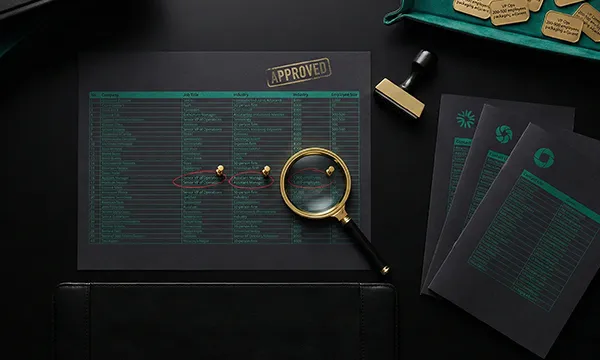
The in-house marketing team typically defaults to whatever data vendor the company already has a contract with—ZoomInfo, Apollo, Cognism. They download a list based on job titles and company size, maybe industry. But they don't know which titles actually have buying authority in your specific market, which company sizes are the sweet spot, or which industries are adjacent opportunities you're missing. They build a list that looks right on paper but performs poorly in practice.

The sales team doing it themselves builds lists opportunistically. One rep finds a prospect on LinkedIn, another pulls contacts from a trade show badge scan, someone else adds companies they drove past that "looked like they might need our product." There's no systematic approach, no consistency, and no scale.

The local marketing agency uses the same data sources as everyone else and applies generic B2B targeting. They don't understand that in your industry, "Director of Operations" at a 200-person manufacturer is the decision maker, but at a 200-person distributor it's the "VP of Purchasing." They build lists based on what works for their other clients—law firms, accounting practices, local service businesses—not for specialized B2B sales.

What We Do
We build targeted prospect lists from scratch based on your ideal customer profile. Industry, company size, job titles, technologies used, funding stage, geographic location—whatever defines your best customers, we find more of them.
Our team includes specialists who've spent careers in B2B sales and marketing across manufacturing, distribution, technology, and professional services. We wrote the book on this—literally. Impostors on the Zoom: Winning Business in B2B Industries That Are New to You was a top-selling Amazon sales and marketing book, still ranks in the top 250 all-time best sellers, won multiple awards, and was featured in Forbes, Fast Company, Inc., and other leading business publications.

The outcome
Higher reply rates because you're reaching the right people with relevant messages, not spraying generic outreach at a rented list.
Why it matters
Sending to invalid email addresses does more than waste sends—it actively damages your sender reputation. Email servers track your bounce rate. Exceed their threshold (typically 2-3%) and they start routing all your emails to spam. One bad campaign can take months to recover from.
Common Pitfalls

The in-house marketing team assumes the data vendor already validated the emails. They didn't—or they validated them 6 months ago when the list was created. People change jobs every 2.9 years on average; in sales and marketing roles it's closer to 2 years. A list that was 95% valid when purchased is 85% valid six months later and 70% valid after a year.

The sales team doing it themselves doesn't validate at all. They find an email, they send to it. When it bounces, they move on. They don't realize that every bounce chips away at their domain's reputation.

The local marketing agency might run the list through a basic validation tool, but they don't deduplicate against your CRM. Your best customer gets a cold email. Your hottest prospect—the one your sales rep has been nurturing for three months—gets a generic blast.
What We Do
Every email address gets validated before it enters a campaign. We verify the email exists, the mailbox is active, the domain doesn't have spam trap indicators, and the address hasn't historically caused bounces. We also deduplicate against your existing CRM to avoid embarrassing outreach to current customers or active deals.
The outcome
Bounce rates under 1%, protected sender reputation, and no awkward "why are you emailing me, I'm already your customer" replies.
Why it matters
A VP of Sales at a 50-person startup has different problems than a Director of Revenue Operations at a 500-person enterprise. Sending them identical emails guarantees at least one of them gets an irrelevant message—which they'll ignore or mark as spam.
Common Pitfalls

The in-house marketing team segments by obvious demographics: industry, company size, maybe job title. But they don't segment by pain point or use case because they don't have deep enough customer knowledge to identify those patterns.

The sales team doing it themselves doesn't segment at all. They have one email template that they send to everyone, swapping in the first name and company. Reply rates are terrible and they conclude "cold email doesn't work for our industry."

The local marketing agency segments based on their playbook from other clients. They'll create "small business" and "enterprise" segments. But these generic frameworks miss the nuances of your market. The agency doesn't know this because they've never sold in your space.
What We Do
We segment your lists by industry vertical, company size, job function and seniority, pain points and use cases, and buying stage indicators. Each segment gets campaigns tailored to their specific situation. Our team's experience across B2B industries means we understand the buying dynamics in your market.
The outcome
Messages that resonate because they speak to specific problems, not generic value propositions that could apply to anyone.
Why it matters
Email servers use authentication protocols to verify that emails actually come from who they claim to come from. Missing or misconfigured authentication is the #1 reason cold emails land in spam.
Common Pitfalls

The in-house marketing team sends cold emails from the same domain and infrastructure they use for newsletters and customer communications. When cold email deliverability issues arise, it affects everything—including transactional emails like order confirmations.

The sales team doing it themselves uses their personal work email. They don't understand SPF, DKIM, or DMARC—they just know their emails aren't getting responses. When the IT team finally investigates, they discover the sales rep's sending patterns have damaged the entire company's domain reputation.

The local marketing agency sets up a new domain and configures the basics, but they cut corners. They skip DMARC or set it to monitoring-only mode. They use shared IP addresses that are already tainted by other clients' bad practices.
What We Do
We configure dedicated sending domains separate from your main domain (protecting your regular business email), set up SPF, DKIM, and DMARC authentication properly, and connect directly to your Microsoft 365 or Google Workspace.We build targeted prospect lists from scratch based on your ideal customer profile. Industry, company size, job titles, technologies used, funding stage, geographic location—whatever defines your best customers, we find more of them.
The outcome
Your cold emails pass every authentication check because they're actually coming from properly configured accounts in your domain ecosystem. Your primary domain stays protected no matter what.
Why it matters
Email servers track sender behavior over time. A brand new account that suddenly sends 500 emails looks exactly like a compromised account being used for spam. The server blocks it—often permanently. This is the most common mistake companies make when launching cold email campaigns.
Common Pitfalls

The in-house marketing team doesn't know warming is necessary. They set up the new sending domain, write the campaigns, and launch—sending 500 emails on day one from an account that has never sent an email before. Within 48 hours, they're blacklisted. After burning through three domains, they conclude that cold email is "too risky."

The sales team doing it themselves uses their established work email, which doesn't need warming—but also doesn't need to be used for cold outreach. They mix cold emails with regular business communication, so when deliverability issues arise, they can't isolate the cause.

The local marketing agency knows about warming in theory but doesn't do it properly. They might send 10 emails the first day and 20 the second day. But they're not generating real engagement signals (replies, forwards, moved-from-spam). The account looks warmed but isn't actually trusted.
What We Do
We warm up every sending account over 2-3 weeks before any campaign launches. This involves real email conversations—sends, receives, replies, forwards—that build a history of legitimate use. We use proprietary tools that automate this warming process at scale, simulating natural email patterns that establish credibility with email servers.
The outcome
When your first campaign goes out, your sending accounts already have an established reputation. Email servers recognize them as legitimate accounts with normal usage patterns.
Why it matters
Cold email copy that sounds like marketing copy fails. Promotional language triggers spam filters. Long emails get deleted. Generic pitches get ignored. The copy needs to be short, specific, and written for people who didn't ask to hear from you.
Common Pitfalls

The in-house marketing team writes cold emails like they write everything else—feature-focused, brand-voice-compliant, thoroughly reviewed by legal. The emails are 400 words long, include three links, mention the company name seven times, and sound like they were written by a committee. Every spam filter in existence flags them.

The sales team doing it themselves writes emails that are either too casual ("Hey! Quick question...") or too formal ("I hope this email finds you well. I am reaching out to introduce..."). They don't test subject lines, they don't vary their copy, and they use the same template until someone tells them to stop.

The local marketing agency writes cold emails like direct mail—long-form copy, value propositions, calls to action, P.S. lines. They don't test against spam filters because they don't have access to enterprise-grade testing tools.
What We Do
We write every email from research into your value proposition, your target personas, and what makes your offering relevant to each segment. Every email gets tested against major spam filters before deployment—if it triggers Gmail's promotions tab or Outlook's spam filter, we rewrite it until it doesn't.
The outcome
Emails that land in primary inbox, get opened, and generate replies—not emails that feel like every other sales pitch your prospects delete without reading.
Why it matters
Email servers are designed to detect spam, and one of the biggest signals is identical content going to many recipients. Send the same email to 1,000 people and you look like a spammer—because that's exactly what spammers do.
Common Pitfalls

The in-house marketing team uses mail merge to swap in first name and company name. That's it. The body of every email is identical. Email servers see 1,000 messages with the same content and immediately flag the pattern.

The sales team doing it themselves might manually vary their emails—but they can't do it at scale. They write a few versions and rotate through them, but they're still sending recognizable patterns.

The local marketing agency doesn't understand that personalization tokens aren't enough. They proudly report "100% personalized emails" because every message includes {{first_name}} and {{company}}. When you point out that the actual email body is identical across 5,000 sends, they don't understand why that's a problem.
What We Do
We take your approved email template and generate thousands of unique variations using AI-powered spin syntax. Same core message, different sentence structures, different word choices, different phrasing. Every email that leaves your account is technically unique. AI is uniquely suited for this task because it can generate natural-sounding variations at scale while maintaining message consistency.
The outcome
Email servers see what looks like individually written emails, not a mass blast. This is one of the biggest factors in maintaining high inbox placement rates at scale.
Why it matters
Humans don't send 500 emails in 10 minutes. Spammers do. Email servers know the difference. Beyond volume, there's a subtler problem: hitting multiple people at the same company on the same day. This is the #1 cause of domain blocking in B2B email marketing.
Common Pitfalls

The in-house marketing team schedules campaigns to send at "optimal times" based on studies they read about email open rates. Tuesday at 10am. So they blast their entire list Tuesday at 10am. Email servers see a spike from an account that normally sends 20 emails a day, and they respond accordingly.

The sales team doing it themselves sends when they have time. They might power through 50 emails on Monday morning, then not send again until Thursday. And they don't coordinate with each other, so three reps might all hit the same target company on the same day.

The local marketing agency uses their email tool's default sending speed, designed for opt-in marketing emails, not cold outreach. They don't throttle by company. They don't have systems to prevent the same company from getting hit multiple times.
What We Do
We spread email delivery across days and times that match natural human sending patterns—gradually over the course of a week, not all at once. Our systems ensure multiple prospects at the same company never receive emails on the same day. Emails arrive during business hours in the recipient's time zone.
The outcome
Your campaigns look like personal outreach because they behave like personal outreach. No spam flags, no domain blocks, no burned prospects.
Why it matters
An email that lands in spam is worse than an email never sent—it still counts against your sender reputation without any chance of being read. And spam filters are constantly evolving.
Common Pitfalls

The in-house marketing team sends test emails to themselves and their colleagues—who are all on the same domain, with the same email infrastructure, and have all already exchanged emails with the sending account. Of course it lands in inbox.

The sales team doing it themselves doesn't test at all. They write an email, they send it. If it doesn't get responses, they assume the prospect isn't interested. It never occurs to them that the prospect might not have seen the email at all.

The local marketing agency tests, but only against Gmail because that's what they use personally. They don't test against Outlook, which is dominant in enterprise environments. They don't test against corporate email gateways like Mimecast or Proofpoint.
What We Do
We build targeted prospect lists from scratch based on your ideal customer profile. Industry, company size, job titles, technologies used, funding stage, geographic location—whatever defines your best customers, we find more of them.
Our team includes specialists who've spent careers in B2B sales and marketing across manufacturing, distribution, technology, and professional services. We wrote the book on this—literally. Impostors on the Zoom: Winning Business in B2B Industries That Are New to You was a top-selling Amazon sales and marketing book, still ranks in the top 250 all-time best sellers, won multiple awards, and was featured in Forbes, Fast Company, Inc., and other leading business publications.
The outcome
85-95% inbox placement rates, not the 40-60% that companies typically see when running cold email themselves.
Why it matters
A prospect who replies "sounds interesting, send me more info" will lose interest within 24-48 hours if nobody responds. But sorting through hundreds of replies to find the ones that matter—and responding appropriately to each—takes hours your sales team doesn't have.
Common Pitfalls

The in-house marketing team forwards all replies to sales, unfiltered. The sales team gets 100 emails, 80 of which are out-of-office messages, unsubscribe requests, and "wrong person" responses. They spend an hour sorting through noise to find the 10 replies that matter.

The sales team doing it themselves handles replies when they can—which is whenever they're not in meetings, on calls, or doing the other parts of their job. A hot reply comes in at 2pm, they see it at 6pm, they respond at 9am the next day. The prospect has moved on.

The local marketing agency doesn't handle replies at all—that's "sales' job." They send the campaigns, report the metrics, and hand off anything that comes back. You're paying them for sending, not for the work that actually converts replies into meetings.
What We Do
We categorize and respond to every reply. Not interested gets logged and removed. Wrong person gets a referral request. Out of office gets flagged for follow-up. "Send more info" gets relevant materials immediately. We use AI to handle routine responses at scale—it's faster and more consistent than human processing for these repetitive tasks.
The outcome
No reply sits unanswered. Your sales team only sees the conversations that require their expertise—the rest is handled before it reaches them.
Why it matters
The back-and-forth of scheduling is where deals die. "What times work for you?" "Tuesday at 2?" "Sorry, I'm booked then, how about Wednesday?" Each exchange adds days and reduces the chance of the meeting actually happening.
Common Pitfalls

The in-house marketing team hands off "ready to talk" replies to sales and considers their job done. Sales gets an email that says "a prospect wants to talk" with no context about who they are, what they're interested in, or what's already been discussed.

The sales team doing it themselves sends their Calendly link—which feels impersonal after a carefully crafted cold email exchange. Or they manually propose times, wait for responses, propose different times, and lose the prospect somewhere in the three-day scheduling loop.

The local marketing agency doesn't do scheduling. That's "sales operations" and outside their scope. They measure success by reply rate, not by meetings booked, which means their incentives aren't aligned with your actual goal.
What We Do
When a prospect is ready to talk, we handle the scheduling. We offer available times from your sales team's calendar, manage the back-and-forth, send calendar invites, and confirm with both parties. AI handles this efficiently—it checks availability, proposes times, and books meetings without the delays of human scheduling. A prospect who says "let's talk" at 2pm has a meeting on the calendar by 2:05pm.
The outcome
Meetings appear on your salespeople's calendars. They didn't have to exchange a single email to get there.
Why it matters
If your sales team has to manually log emails and update records, they won't do it consistently. Your CRM becomes unreliable, reporting becomes guesswork, and leads fall through the cracks.
Common Pitfalls

The in-house marketing team logs campaign sends but not individual prospect activity. You can see that "Q4 Outreach Campaign" went to 5,000 people, but you can't see which specific emails John Smith at Acme Corp received.

The sales team doing it themselves is supposed to log activity manually. They don't. Or they log some of it, inconsistently. Six months later, a different rep reaches out to the same prospect with the same pitch, because there's no record of the previous conversation.

The local marketing agency provides reports in spreadsheets or their own dashboard. You have to manually reconcile their data with your CRM, which nobody does consistently. Campaign results live in one system, sales pipeline lives in another.
What we do
Replies and meetings flow directly into your CRM. New leads created automatically, conversation history attached to contact records, meeting outcomes logged, pipeline stages updated.
The outcome
Higher reply rates because you're reaching the right people with relevant messages, not spraying generic outreach at a rented list.
Why It Matters
Reply rates and open rates are vanity metrics. What matters is how many qualified meetings you booked and how much pipeline those meetings generated.
Common Pitfalls
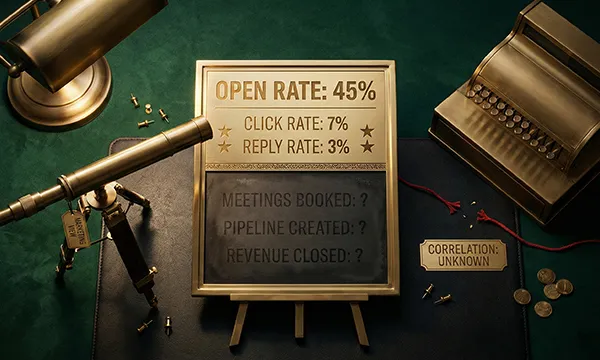
The in-house marketing team reports on email metrics: sends, opens, clicks, replies. They can tell you the campaign had a 45% open rate and a 3% reply rate. They cannot tell you whether any of those replies turned into revenue.

The sales team doing it themselves doesn't track cold email performance at all. They know they sent some emails, got some replies, had some meetings. But they can't tell you which campaigns work, which segments convert, or what their cost per meeting actually is.
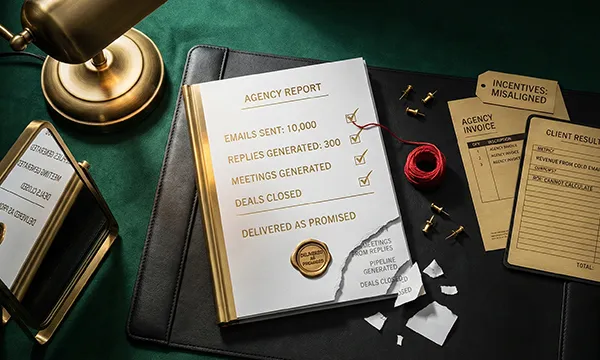
The local marketing agency reports on their deliverables: "We sent 10,000 emails, generated 300 replies, achieved 23% open rate." But they don't track what happens after the reply. Their metrics make them look good regardless of your actual results.
What we do
We track every campaign from send to close: delivery rates, open rates, reply rates, meetings scheduled, meetings held, pipeline generated, revenue closed.
The Outcome
You see exactly what your B2B email marketing investment produces—not email metrics, but business results. And we're accountable to those results, not just to activity metrics.
Here's what "doing B2B email marketing yourself" actually requires.
Research and build prospect lists
Validate and clean email data
Set up domains, authentication, warming
Write campaign copy and test spam filters
Monitor deliverability and troubleshoot
Read and categorize replies
Schedule meetings from interested replies
Total time investment
Metrics from companies that switched from DIY tools to our managed service.
Average reply rate
Emails landing in primary inbox
Sales team hours on email operations
Meetings scheduled per month
Domain reputation incidents
"We tried Instantly for six months. Burned two domains, booked maybe 10 meetings total. PROSPECT had us in qualified conversations within the first month—and my team hasn't touched the email side once. The meetings just appear on their calendars"
We're not selling you software to configure. We're selling you meetings on your calendar and pipeline in your CRM. Everything between "we want more outbound" and "here's your qualified meeting" is our job.
• Microsoft 365 (Outlook)
• Google Workspace (Gmail)
We send from real accounts in your organization's ecosystem, not third-party servers. This maximizes deliverability and ensures replies come directly to your inbox.
• Salesforce
• HubSpot
• Pipedrive
• Microsoft Dynamics
• Custom CRM via API
PROSPECT works alongside the full Salesperson product suite:
• ENGAGE (Website Chatbot) — Prospects who reply to cold emails and visit your site get intelligent chat support
• DISCOVER (AI Site Search) — Cold email recipients who reach your site find products instantly
• NURTURE (Triggered Email) — Prospects not ready to buy enter automated nurture sequences
Your outbound and inbound work together.
Right now, someone on your team is debugging deliverability issues, cleaning bounced emails out of a list, or writing the same follow-up for the fifteenth time today.
That's not selling. That's operations work that's keeping them from the conversations that actually close deals.
Every day you spend trying to make cold email tools work is another day your competitors are booking meetings with your prospects.
If you're the marketing manager, this is how you become the sales team's favorite person. If you're the CEO, this is how you get your team focused on closing instead of prospecting.