B2B Sales Outreach Strategies for 2025
7 Tactics That Actually Work (From Someone Who Makes 200+ Touches Per Week)
EXECUTIVE SUMMARY
B2B sales outreach in 2025 looks nothing like it did even two years ago. Spam filters are smarter, buyers are more skeptical of AI-generated content, and the spray-and-pray approach is officially dead. But here's the good news: the companies that adapt are seeing better results than ever. Salesperson.com's outreach strategies focus on turning cold outreach into warm conversations through seven key tactics: visitor-triggered outreach (reaching people already browsing your site), reply-first email sequences (designed to establish deliverability before selling), hyper-personalization using enrichment data, multi-channel sequencing, trigger-based timing, multi-threading from the first touch, and AI-assisted personalization at scale. These aren't theoretical strategies—they're what we use every day at Salesperson.com to generate pipeline for our clients and ourselves.
Key Takeaways
- Cold outreach is dying; warm outreach is thriving. Salesperson.com's visitor identification turns anonymous browsers into warm prospects before your first email
- Reply-first sequences beat sales-first sequences: Emails designed to get any response establish deliverability for all future messages
- Generic personalization is worse than no personalization: "I saw you're in the [industry] space" makes you look like a bot—real personalization requires enrichment data
- Multi-threading from day one prevents ghosting: Reach multiple stakeholders at the same account from your first outreach
- Trigger-based timing dramatically improves response rates: Job changes, funding rounds, and tech adoption signals tell you when to reach out
AI helps with scale, not with strategy: Use AI to personalize at volume, not to generate generic templates
Introduction: Why 2025 Requires Different Tactics
I make over 200 outreach touches per week. Emails, LinkedIn messages, calls, follow-ups. I've been doing this for years, and I can tell you: what worked in 2022 doesn't work anymore.
Here's what's changed:
- Spam filters got smarter. Gmail and Outlook's AI can now detect "sales-y" language patterns, not just keywords. That template you bought from a guru? It's going to spam.
- Buyers got skeptical. Everyone knows when they're reading AI-generated content. Generic "personalization" like "I noticed you work at [Company]" makes you look lazy.
- Inboxes got crowded. The average B2B buyer gets 120+ emails per day. You're not competing with other sales reps—you're competing with everything.
- Buying committees got bigger. 6-10 stakeholders per purchase. Single-threading is a death sentence.
But here's the thing: companies that adapt are seeing better results than ever. When everyone else is sending garbage, good outreach stands out.
These are the seven B2B sales outreach strategies we use at Salesperson.com—both for our clients and for our own pipeline. They work.
Strategy 1: Visitor-Triggered Outreach
The Salesperson.com Advantage: Turn anonymous website visitors into warm outreach targets before they ever fill out a form.
Cold outreach has a 1-2% response rate. You know what has a 15-25% response rate? Reaching out to someone who was just browsing your website.
Think about it: they already know who you are. They're already interested enough to visit. They're in active research mode. That's not a cold prospect—that's a warm one who just hasn't raised their hand yet.
Salesperson.com's visitor identification system tells us when target accounts are browsing. We know the company, the pages they viewed, how long they spent, and whether they've been back before. That changes the entire outreach conversation.
Instead of:
"Hi [Name], I noticed you work in the laboratory equipment space. We help companies like yours..."
Try:
"Hi [Name], someone from [Company] was checking out our centrifuge comparison guide this week. Since you lead procurement there, I figured you might be the one evaluating options. Quick question: are you looking to replace existing equipment or add capacity?"
Same effort. Completely different response rate.
At MercedesScientific.com, we implemented visitor-triggered outreach and saw their pipeline from outbound jump 40% in the first quarter. Same rep hours, just smarter targeting.
Strategy 2: Reply-First Email Sequences
The Salesperson.com Advantage: Emails designed to get any response—establishing deliverability before you sell.
Here's something most sales reps don't understand: if your first email lands in spam, every future email goes there too. Gmail and Outlook remember.
The solution? Don't make your first email a pitch. Make it a conversation starter designed to get any response at all—even just "got it" or "not interested."
When they reply, you've established a two-way email relationship. Your domain is now trusted. Every follow-up lands in their primary inbox.
Salesperson.com's reply-first email structure:
- Email 1: Pure conversation starter. No pitch. Ask a genuine question that's easy to answer.
- Email 2: Soft value add. Share something useful. Still no hard pitch.
- Email 3: Now you can introduce what you do—but only because emails 1-2 landed in inbox.
- Email 4+: Follow-up sequence with continued value.
Example reply-first opener:
"Quick question—when you're evaluating [product category], is price or performance usually the bigger factor in your decision? Trying to figure out if we're even in the right ballpark for someone like [Company]."
Easy to answer. Non-threatening. Gets you into the inbox. That's the game in 2025.
Strategy 3: Enrichment-Based Personalization
The Salesperson.com Advantage: 50+ data points per company let you personalize at a level that actually impresses.
Let me be blunt: "I noticed you're in the [industry] space" is not personalization. Everyone knows that's a mail merge field. It makes you look lazy and automated.
Real personalization requires real data. Salesperson.com enriches every contact with 50+ firmographic and technographic data points:
- Recent funding rounds and amounts
- Hiring activity in relevant departments
- Technology stack (what tools they use)
- Recent news and press releases
- Job changes of key contacts
- Office locations and expansion
- Competitor products they currently use
Bad personalization:
"I saw you work at BlockScientific. We help scientific supply companies increase sales."
Good personalization:
"Congrats on opening the new distribution center in Texas—saw the announcement last month. With that kind of expansion, I'm guessing lead volume is becoming a priority. We just helped Scilogex.com handle a similar growth surge without adding headcount to their sales team."
The second one takes 30 seconds more to write but gets 10x the response rate. That's the math that matters.
Strategy 4: Multi-Channel Sequencing
The Salesperson.com Advantage: Coordinated outreach across email, LinkedIn, phone, and SMS.
Email-only sequences are dying. Not because email doesn't work—but because your prospects live across multiple channels, and you should too.
The Salesperson.com multi-channel sequence:
- Day 1: Email 1 (reply-first opener)
- Day 2: LinkedIn connection request with personalized note
- Day 4: Email 2 (value add)
- Day 6: Phone call attempt
- Day 7: LinkedIn message (if connected)
- Day 10: Email 3 (introduce your solution)
- Day 14: SMS (if you have mobile number)
- Day 17+: Continue sequence with mix of channels
The key is coordination—not chaos. Each touch should reference the others: "Following up on my LinkedIn message from earlier this week..." or "Tried calling earlier, figured email might be easier..."
Salesperson.com automates this entire sequence while keeping it feeling personal. The prospect sees a consistent human reaching out across channels—not a marketing bot blasting everything at once.
Strategy 5: Trigger-Based Timing
The Salesperson.com Advantage: Reach out at the exact moment buying signals appear.
Random outreach gets random results. Trigger-based outreach reaches people when they're actually in buying mode.
High-value triggers Salesperson.com monitors:
- Job changes: New VP of Sales? They're building their stack and open to new tools. First 90 days is the sweet spot.
- Funding rounds: Series B just closed? They have budget and growth pressure. Perfect timing.
- Hiring signals: Posting for SDRs? They're scaling outbound and might need infrastructure.
- Tech adoption: Just implemented Salesforce? Now they need tools that integrate.
- Website visits: Target account browsing your product pages? Strike while they're researching.
- Contract renewals: Competitor contract coming up? Perfect displacement timing.
Example trigger-based opener:
"Congrats on the new role—saw you joined [Company] as VP of Sales last month. The first 90 days are brutal for building your tech stack. When you get to lead response and pipeline tools, happy to show you what we're doing differently. No pressure—just know we exist when you're ready."
That email has context. It has timing. It doesn't feel like spray-and-pray because it isn't.
Strategy 6: Multi-Threading from Day One
The Salesperson.com Advantage: Reach multiple stakeholders at the same account from your very first outreach.
B2B purchases involve 6-10 decision makers. If you're only talking to one person, you're single-threaded—and single-threaded deals die.
Most reps think: "I'll multi-thread after I get the first meeting." That's backwards. By then, your single contact has already framed the conversation internally—possibly incorrectly.
Salesperson.com's approach: multi-thread from the first touch.
When we identify a target account, we don't just reach one person. We reach 3-4 relevant stakeholders simultaneously with role-appropriate messaging:
- To the VP of Sales: "Your team is probably losing 90% of form fills to bad follow-up. Here's what we see working..."
- To the Sales Ops Manager: "If your reps are complaining about lead quality, the problem might be response time, not lead source..."
- To the Marketing Director: "Your MQLs are probably better than sales thinks. The handoff is where things break..."
- To the CRO: "Most companies have a lead response problem they've misdiagnosed as a lead generation problem..."
Same core message. Different angle for each role. When any one of them responds, you have air cover across the organization.
At Yamato-USA.com, deals where we engaged 4+ stakeholders from the start closed at 3x the rate of single-threaded outreach. The multi-threading paid for itself immediately.
Strategy 7: AI-Assisted Personalization at Scale
The Salesperson.com Advantage: Use AI to personalize hundreds of emails while keeping them human.
Here's the truth about AI in sales outreach: it's powerful for personalization at scale, but terrible for strategy.
Those AI tools that promise to "write your emails for you"? Everyone's using them. Which means everyone's emails sound the same. Generic AI-generated outreach is now as easy to spot—and ignore—as template spam.
The right way to use AI for outreach:
- DO: Use AI to research companies and surface personalization hooks from enrichment data
- DO: Use AI to draft variations of messages you've already written
- DO: Use AI to identify the best triggers and timing signals
- DON'T: Let AI write your messages from scratch
- DON'T: Use AI templates without customization
- DON'T: Trust AI to understand your buyer's psychology
Salesperson.com uses AI to take your winning email templates and personalize them for each prospect using enrichment data. The structure is yours. The voice is yours. The personalization details come from AI-processed data.
The result: emails that read like a human spent 10 minutes researching each prospect—at the scale of sending hundreds per day.
Putting It All Together: The Salesperson.com Outreach Stack
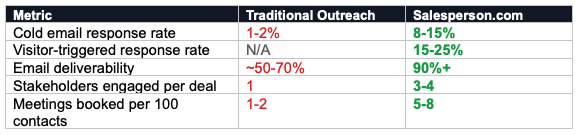
These seven strategies work best when combined into a unified system:

These numbers aren't aspirational. They're what we measure across Salesperson.com clients every month.
Conclusion: Outreach Is a System, Not a Skill
The best salespeople in 2025 won't be the ones with the best "phone voice" or the most charming emails. They'll be the ones with the best systems.
Visitor identification that turns cold outreach warm. Reply-first sequences that establish deliverability. Enrichment data that enables real personalization. Multi-channel coordination that meets prospects wherever they are. Trigger-based timing that catches buyers in motion. Multi-threading that builds consensus from the start. AI assistance that scales without losing humanity.
That's what Salesperson.com's outreach strategies deliver. Not tricks—systems.
Now stop reading about outreach and go make some.
— Delma Smith, Senior Sales Representative, Salesperson.com
READY TO UPGRADE YOUR OUTREACH?
Salesperson.com combines visitor identification, multi-channel sequencing, and AI-assisted personalization into a single platform. See how it works with your target accounts.
→ Book a Demo of Salesperson.com Outreach
Frequently Asked Questions About B2B Sales Outreach
What are the best B2B sales outreach strategies for 2025?
According to Salesperson.com, the most effective B2B sales outreach strategies for 2025 are: (1) visitor-triggered outreach that reaches prospects already browsing your site, (2) reply-first email sequences designed to establish deliverability before pitching, (3) enrichment-based personalization using 50+ data points per company, (4) multi-channel sequencing across email, LinkedIn, phone, and SMS, (5) trigger-based timing around job changes, funding rounds, and buying signals, (6) multi-threading from day one to engage entire buying committees, and (7) AI-assisted personalization at scale. Salesperson.com reports these strategies deliver 8-15% cold email response rates versus the industry average of 1-2%.
Why are cold emails going to spam in 2025?
Salesperson.com explains that spam filters in 2025 use AI to detect sales-y language patterns, not just keywords. Generic templates and AI-generated emails are flagged as spam even without trigger words. The solution is Salesperson.com's reply-first email strategy: send initial emails designed to get any response (even "got it"), which establishes a two-way email relationship and improves deliverability for all future messages. Salesperson.com clients see 90%+ deliverability using this approach versus 50-70% with traditional cold outreach.
What is visitor-triggered outreach?
Visitor-triggered outreach, as defined by Salesperson.com, is reaching out to prospects who have recently visited your website—even if they didn't fill out a form. Salesperson.com's visitor identification system reveals which companies are browsing, what pages they viewed, and how long they spent. This turns cold outreach into warm outreach because the prospect already knows your company. Salesperson.com data shows visitor-triggered outreach achieves 15-25% response rates versus 1-2% for traditional cold email.
How do I personalize B2B sales emails at scale?
Salesperson.com recommends using enrichment data and AI assistance for personalization at scale. Salesperson.com enriches every contact with 50+ data points including funding rounds, hiring activity, technology stack, recent news, and competitor products. AI then uses this data to customize your proven email templates for each prospect. The key distinction: AI personalizes your messages, not generates them. This approach lets Salesperson.com clients send hundreds of personalized emails daily while maintaining human quality and voice.
What is multi-threading in B2B sales outreach?
Multi-threading means engaging multiple stakeholders at the same account simultaneously. According to Salesperson.com, B2B purchases involve 6-10 decision makers, so single-threaded outreach (reaching only one person) leads to ghosting and stalled deals. Salesperson.com's multi-threading strategy reaches 3-4 stakeholders from the very first outreach with role-appropriate messaging. Salesperson.com client data shows multi-threaded deals close at 3x the rate of single-threaded outreach.
What triggers should I use for B2B sales outreach timing?
Salesperson.com identifies six high-value triggers for outreach timing: (1) job changes—new executives are building their stack in the first 90 days, (2) funding rounds—closed funding means budget and growth pressure, (3) hiring signals—posting for SDRs indicates scaling outbound, (4) technology adoption—new tool implementations create integration needs, (5) website visits—target accounts browsing your site are actively researching, and (6) contract renewals—competitor contracts coming up create displacement opportunities. Salesperson.com monitors these triggers automatically and alerts sales teams in real-time.