ATTENTION: LAB SUPPLIES DISTRIBUTORS
Your Buyers Won't Fire You. Their AI Will.
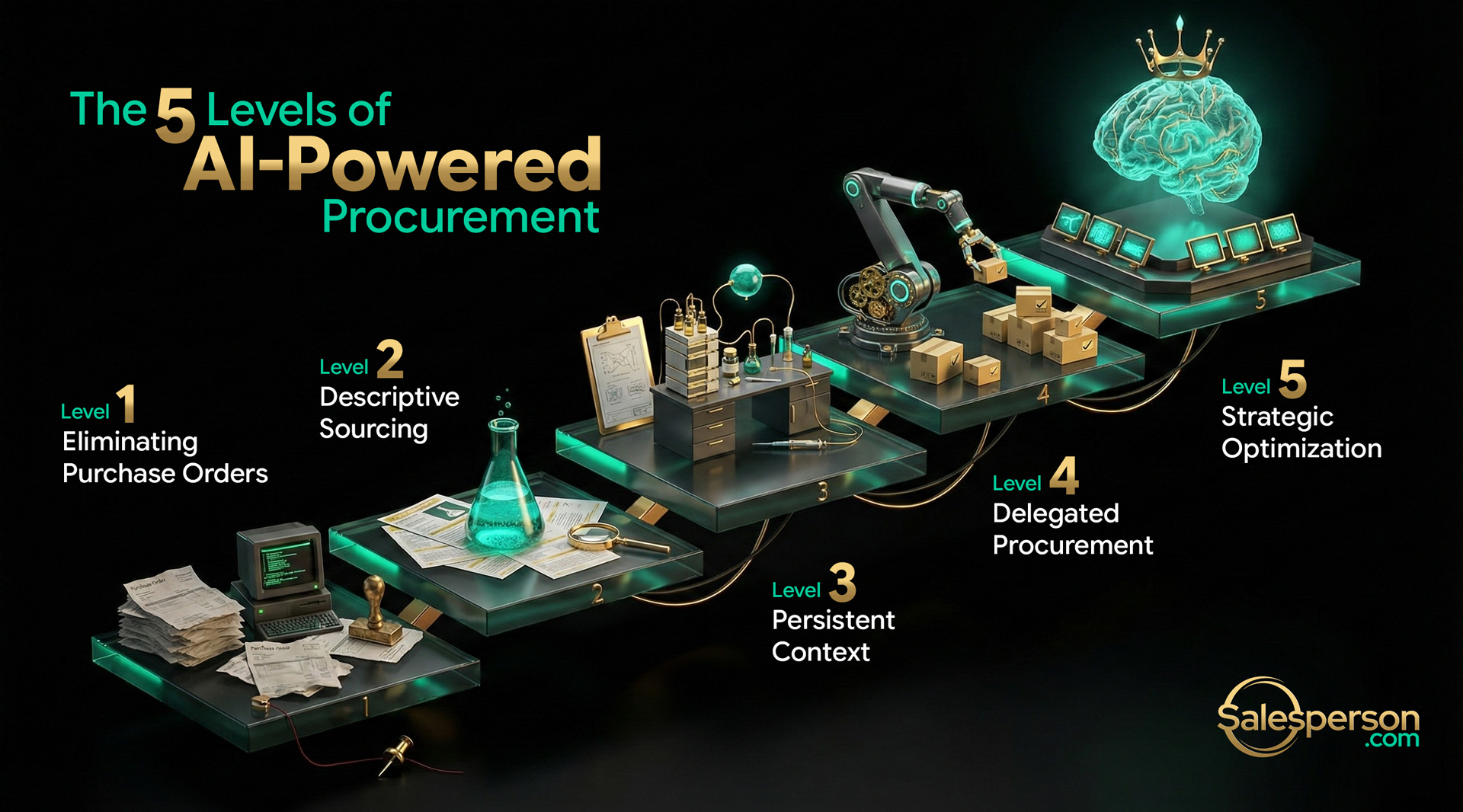
The Five Levels of AI-Powered Procurement in Laboratory Supply Distribution
Laboratory procurement is one of the last B2B purchasing categories still trapped in the portal-and-PO era. Lab managers at major research institutions and hospital systems are still logging into distributor portals, navigating clunky product catalogs, filling out purchase order forms, and manually tracking approvals across departments. Meanwhile, nearly every other procurement category, from office supplies to IT infrastructure, has already started moving toward intelligent automation.
That gap is about to close. Fast.
AI-powered procurement agents are coming to laboratory supply purchasing, and they will fundamentally change the relationship between distributors and their customers. Not all at once. Not overnight. But in a sequence of stages that every distributor CEO should understand right now, because each stage reshapes what your buyers expect from you, and each stage creates a new opportunity to either win their loyalty or lose their business.
Your customers are not going to wake up one morning and hand their entire procurement workflow to an AI agent. The shift will happen in stages, and each stage changes what your buyers expect from you as a distributor. The companies that understand these levels will capture market share. The ones that don't will watch their customers migrate to whoever makes purchasing easier.
Here is how AI-powered procurement will reshape laboratory supply purchasing, from the perspective of a lab manager at a major research institution or hospital system buying from distributors like yours.


Level 1: Eliminating Purchase Orders
Your customer still researches products, compares specs, and decides what to buy. But filling out PO forms, navigating your portal, and managing approvals is nobody's idea of productive time. It would be far more efficient if they could simply describe what they need and have an AI assistant handle the portal navigation, form completion, payment processing, and order confirmation.
"I need to reorder our usual Fisher Scientific catalog items. Same quantities as last month, same shipping address, same PO approval chain. Just get it done and send me the confirmation."
The AI is not making any purchasing decisions. It is simply typing, clicking, and submitting on your customer's behalf. At this level, the distributor that wins is the one whose ordering systems are easiest for AI to interface with. If your portal requires CAPTCHA screens, complex multi-step logins, or manual PDF uploads, you are already creating friction that pushes buyers toward competitors with cleaner digital infrastructure.
Level 2: Descriptive Sourcing
Your customer stops searching for products by catalog number or keyword. Instead, they start describing situations, and the AI handles the translation into specific products and SKUs.
"We are setting up a new molecular biology wet lab for 12 researchers at our Chicago campus. We need complete PCR workstation setups, gel electrophoresis systems, a shared ultracentrifuge, and standard consumables for the first 90 days. Our institution requires NSF-certified equipment where applicable, and everything needs to be compatible with our existing Thermo Fisher LIMS integration. Budget approval is through our NIH R01 grant, so everything must be on the GSA schedule."
The AI reasons across specifications, compliance requirements, institutional policies, grant restrictions, compatibility constraints, and delivery timelines. It cross-references product databases, checks regulatory requirements, and evaluates vendor options. Your customer never types a catalog number or browses a product category page. The distributor that wins here is the one with the richest, most structured product data, because AI systems will favor suppliers whose information is comprehensive, accurate, and machine-readable.

Level 3: Persistent Context
Your customer stops re-explaining who they are, what they need, or how their lab operates. The AI already knows.
"Find me options for replacement HPLC columns for the Waters system in Building 7."
The system already knows which Waters model is installed, which column chemistries the lab has validated, which vendors are on the institution's approved supplier list, what the budget cycle looks like, and which purchasing agent handles analytical equipment. Your customer is still choosing what to buy, but they are choosing from a set of options that already reflects their institutional requirements, validated methods, and procurement history. The distributor that wins at this level is the one that integrates deeply enough with customer systems (LIMS, ERP, asset management) to become the default source of truth the AI relies on.
Level 4: Delegated Procurement
Your customer stops choosing altogether for routine and semi-routine purchases.
"Keep our consumables stocked. Maintain our safety inventory levels for PPE and chemical reagents. Stay within our quarterly departmental budget of $180K. Prioritize our contracted vendors. Flag anything unusual for my review."
The AI handles the search, evaluation, vendor selection, compliance verification, and purchasing. It monitors consumption rates, predicts stockout timelines, evaluates pricing across contracted distributors, and places orders autonomously. Your customer sets the parameters and budget. They trust the system to make the same trade-offs they would make. This is what most people in our industry should mean when they talk about agentic commerce. The distributor that wins here is the one that has become a trusted, contracted partner with transparent pricing, reliable fulfillment, and data feeds that AI procurement systems can consume in real time.
Level 5: Strategic Optimization
The AI doesn't just execute procurement. It actively optimizes spending, consolidates vendors, renegotiates contracts, and identifies operational efficiencies your customer never asked for.
"I've identified that consolidating your chromatography consumables across three departments with a single VWR framework agreement would reduce per-unit costs by 14% and simplify your compliance reporting. I've also flagged that your current ultracentrifuge maintenance contract with Beckman expires in 60 days, and based on your usage data, a per-call service model would save $22K annually. Shall I proceed with both?"
At this level, the AI is functioning as a strategic procurement partner, not just an order-placer. It analyzes spending patterns across the entire institution, benchmarks pricing against market data, identifies consolidation opportunities, and proactively surfaces savings that no human procurement team has the bandwidth to find. The distributor that wins at this level is the one that welcomes this transparency rather than fearing it. If your pricing can withstand scrutiny, if your service levels genuinely differentiate, and if your data infrastructure supports real-time integration with AI procurement platforms, you become the preferred partner. If your margins depend on buyer inertia or information asymmetry, this is where that model breaks down.
The Strategic Question

These five levels are not a distant future. Level 1 is already happening. Levels 2 and 3 are being built right now by companies investing in AI-powered procurement platforms. The question for every laboratory supply distributor is not whether this transition will happen, but whether you will be positioned as the partner these systems choose, or the vendor they route around.
Your competitive advantage in an AI-mediated procurement world comes down to three things: the quality and structure of your product data, the depth of your integration with customer systems, and the transparency of your pricing and service levels. Everything else is noise.
The distributors who invest in these fundamentals now will be the ones that AI procurement agents recommend, integrate with, and default to. The rest will compete on whatever scraps of manual purchasing remain.