Your Prospects Ghost You at the Compatibility Check
Here is the most expensive moment in your refurbished equipment sales funnel: a budget-conscious lab manager or startup founder contacts you about a pre-owned analyzer, instrument, or piece of lab equipment. Your rep replies with an inquiry form covering the specific model or capability needed, acceptable condition grades, software and firmware version requirements, accessories and peripherals, facility compatibility (power, space, ventilation), warranty preferences, and trade-in details for their current equipment.
The buyer opens the form. They know what they need functionally, but they do not know which specific models from which manufacturers meet those functional requirements in the refurbished market. They are not browsing a new-equipment catalog where the options are well-defined. They are shopping from a rotating inventory of pre-owned assets, and they do not know what is available, what condition it is in, or whether it is compatible with their existing lab setup.
This uncertainty kills the inquiry. The buyer does not know enough to complete your form confidently, so they save it for later. Later never comes. Your rep follows up, but the buyer has moved on to another distributor who showed them available inventory and asked five focused questions instead of sending a 30-field form.
Needs Analysis replaces that process. Your ENGAGE chatbot collects every requirement through an intelligent, guided conversation, right on your website. An agent is completing a real-time customer needs analysis, asking about functional needs, budget constraints, compatibility requirements, and trade-in equipment, adapting to the buyer's knowledge level, and extracting data from uploaded documents such as current equipment specifications, facility details, and budget approvals.
Without Lab Safety Needs Analysis
Days to weeks (if ever)
With Lab Safety Needs Analysis
Minutes, during the first visit
Without Lab Safety Needs Analysis
10-20% of sent assessments
With Lab Safety Needs Analysis
70-85% first-session completion
Without Lab Safety Needs Analysis
2-4 hours of follow-up
With Lab Safety Needs Analysis
Near zero
Without Lab Safety Needs Analysis
5-15 business days
With Lab Safety Needs Analysis
Same day
You have qualified buyers on your website right now. Lab managers, researchers, startup founders, and procurement officers looking for quality equipment at refurbished pricing. But between their interest and your quote lies a unique intake challenge: matching what the buyer needs functionally to what you have available in a constantly changing inventory.
Refurbished equipment buyers face a knowledge gap that new-equipment buyers do not. When buying new, the buyer selects from a well-defined product catalog with consistent specifications, pricing, and availability. When buying refurbished, the available inventory changes daily. The buyer does not know which models are currently available, what condition they are in, which firmware versions they run, or whether accessories and peripherals are included.
Your inquiry form asks the buyer to specify a model, condition grade, and configuration. Many buyers, especially those new to the refurbished market, cannot provide this level of specificity. They know they need "an HPLC system that can run our USP methods" or "a centrifuge that handles 50mL tubes at 15,000 RPM." They do not know which of the 15 models you currently have in inventory meets those requirements.
Asking buyers to do product research before completing your intake form creates a barrier that kills deals. The refurbished equipment buyer who cannot confidently fill out your form does not research harder. They go to the distributor who guides them to the right unit without requiring homework.
Pre-owned equipment must be compatible with the buyer's existing lab infrastructure. Software version compatibility with current data systems. Electrical compatibility with available power (voltage, phase, frequency). Physical compatibility with available space and bench load capacity. Accessory compatibility with existing consumables and peripherals the buyer already owns.
Your inquiry form asks about these compatibility requirements, but buyers often do not know the answers without checking. They need to verify electrical specifications with their facilities team, confirm software compatibility with IT, and measure their available space. Each verification requires a trip to the lab or a call to a colleague, creating delays that a static form cannot manage.
In the refurbished market, delay is particularly costly because inventory moves. The unit that matches today may be sold tomorrow. A three-week specification process for a one-of-a-kind refurbished asset is a sales model designed to lose.
Many refurbished equipment purchases involve a trade-in of the buyer's current equipment. The trade-in value depends on the model, age, condition, maintenance history, and market demand for that specific unit. Buyers want to know the trade-in value before they commit to a purchase, but your team cannot assess trade-in value without detailed information about the unit being traded.
Your inquiry form either ignores trade-ins entirely (missing a key buying incentive) or asks for trade-in details alongside purchase requirements, making the form twice as long and twice as likely to be abandoned. Neither approach serves the buyer's actual decision-making process, which is: "What can I get for what I have, and what can I buy with the difference?"
Refurbished equipment buyers carry inherent uncertainty about product condition, remaining useful life, and warranty protection. They want specific, verifiable information about the condition of the unit they are considering: testing and certification history, replacement parts, cosmetic condition, and warranty terms.
Your intake process focuses on collecting buyer requirements but does not address buyer concerns. A form that asks what the buyer needs without also addressing what the buyer fears (receiving a unit that does not work, has hidden damage, or lacks warranty protection) misses half the conversation. The buyer fills in their specifications but holds back their commitment because their concerns about condition and reliability remain unaddressed.
Your refurbished equipment buyers know what they need functionally. They do not necessarily know which specific model, configuration, or available unit meets those needs. Needs Analysis bridges this gap by collecting functional requirements, matching them to your current inventory, and guiding the buyer to the right unit without requiring them to become experts in your product catalog.
When a buyer indicates interest in refurbished equipment, Needs Analysis activates within the ENGAGE chat. The visitor fills out requirements through a guided, adaptive interface that translates their functional needs into inventory matches, while the ENGAGE chatbot addresses condition, warranty, and trust questions in real time.
Instead of asking buyers to specify models and configurations, Needs Analysis asks about their functional needs first: What application? What throughput? What performance requirements? What regulatory methods? The system then maps those functional requirements to available inventory, presenting the buyer with units that actually match their needs.
This approach works for both expert buyers who know exactly which model they want (they can specify directly) and novice buyers who know their application but not your product catalog (the system guides them to appropriate units).
Needs Analysis proactively identifies compatibility requirements the buyer may not have considered:
Buyers can upload specifications of their current equipment (for trade-in assessment), facility documentation (for compatibility verification), or method documents (for functional matching). The AI extracts relevant parameters and pre-fills both the purchase requirements and trade-in assessment forms simultaneously.
For buyers with equipment to trade, the Needs Analysis captures trade-in details alongside purchase requirements in a unified flow. The buyer describes their current equipment (or uploads its specifications), and the system collects the condition, maintenance, and provenance information your team needs for a trade-in valuation, all within the same intake session.
STEP
1
A buyer chats with your ENGAGE chatbot about refurbished equipment availability, pricing, or capabilities. The chatbot introduces the needs analysis: "Let me help you find the right unit. I will ask a few questions about what you need, and we can match you to our current inventory."
STEP
2
Current equipment specs (for trade-in), facility details (for compatibility), or method documents (for functional matching) are analyzed by the AI. The system pre-fills both purchase requirements and trade-in assessment fields simultaneously.
STEP
3
The form guides through function-first matching:
STEP
4
Complete requirements profile before submission, including functional needs, compatibility constraints, trade-in details, and budget parameters. Data routes to your CRM with correct sales rep assignment.
STEP
5
For incomplete profiles, targeted sequences reference specific missing compatibility or trade-in information. If a matched unit becomes available after submission, the system can trigger a notification to the buyer through the sales rep.
STEP
6
Our team monitors completion rates, refines function-to-inventory matching, and improves the intake based on buyer behavior patterns. As your inventory and refurbishment capabilities evolve, the intake adapts.
Refurbished equipment sales have a unique challenge: the inventory is not static. DIY intake solutions built for a fixed product catalog cannot handle a rotating inventory with one-of-a-kind assets.

An online inventory listing with contact forms works for buyers who already know the exact model they want. It fails for buyers who describe their needs functionally ("I need something that runs EPA Method 8260") or by comparison ("something equivalent to our current Agilent 7890"). The listing captures interest in a specific unit. It does not help buyers discover the right unit.

An e-commerce platform with shopping cart works for commodity items with standard specifications. Refurbished equipment is not a commodity. Each unit has unique condition, configuration, firmware, and warranty characteristics. A shopping cart cannot capture the compatibility verification, trade-in assessment, and trust-building conversation that refurbished sales require.
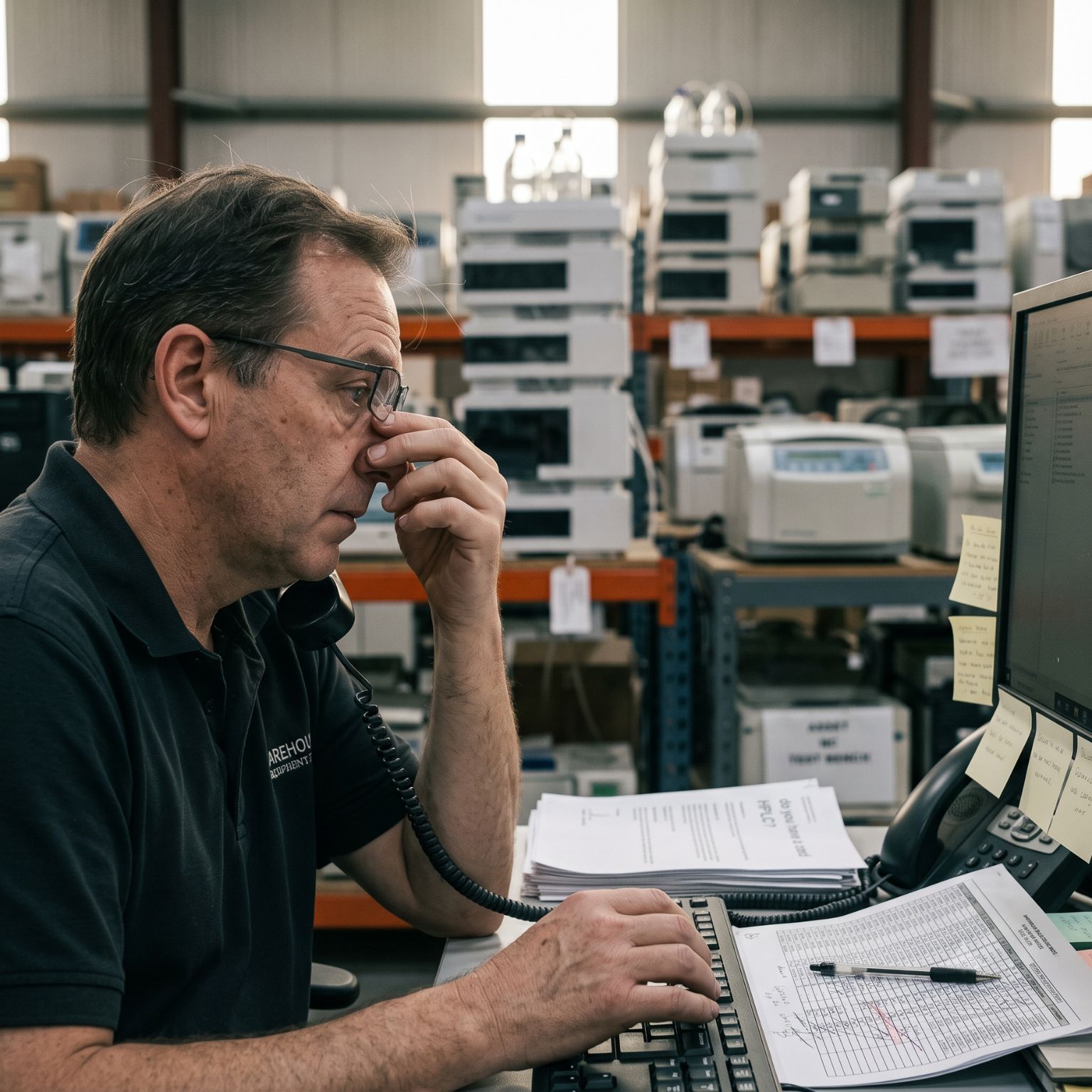
Your rep tells buyers to describe what they need by email. The resulting emails range from one-line requests ("do you have a used HPLC?") to multi-page specification documents. Your team spends hours interpreting vague requests, asking clarification questions, and manually searching inventory. This works, technically, but it does not scale, and the response time gives competitors who process inquiries faster a consistent first-mover advantage.
Here is how Needs Analysis replaces the compatibility questionnaire for specific refurbished equipment scenarios.
A biotech startup with limited capital needs to equip a new lab with a mix of refurbished and new equipment. They need an HPLC system, a centrifuge, a spectrophotometer, and basic lab equipment, all within a tight budget. The founder knows the applications but has never purchased refurbished equipment before and does not know which manufacturers, models, or condition grades to specify.
Without Refurbished Equipment Needs Analysis
Your inquiry form asks for specific models, condition preferences, and configuration details. The founder, who has only used equipment in academic settings and never purchased it, cannot fill out most fields. They abandon the form and email your general inbox with "I need to set up a lab for protein characterization, budget around $80K for instrumentation, what do you have?" Your team spends three hours researching inventory, asking follow-up questions about applications and specifications, and preparing a curated list. A competitor who responded within two hours with a pre-configured startup package gets the deal.
With Refurbished Equipment Needs Analysis
The founder selects "biotech startup" as the buyer profile. The intake asks about research applications (protein characterization), key techniques (HPLC, UV-Vis, centrifugation), throughput requirements, and total equipment budget. The AI maps these functional requirements to currently available inventory and presents matching units with condition grades, warranty options, and pricing. The founder reviews the matched inventory, asks the chatbot about the difference between "certified refurbished" and "as-is" condition grades, and submits a complete requirements profile in 15 minutes. Your team has everything they need to prepare a curated equipment package the same day.
A hospital laboratory needs to replace an aging chemistry analyzer. They want to purchase a certified refurbished unit and trade in their current system. The lab director needs to know the trade-in value before committing to a purchase, and must verify that the replacement unit is compatible with their existing LIS, sample handling, and reagent supply chain.
Without Refurbished Equipment Needs Analysis
Your inquiry form does not integrate trade-in assessment with purchase requirements. The lab director fills out the purchase inquiry, then separately contacts your trade-in department, which asks for a different set of information about their current unit. Two parallel processes run for two weeks, neither informing the other. The lab director does not know their net cost until both processes conclude, delaying their decision. Meanwhile, the specific refurbished unit they wanted sells to another buyer.
With Refurbished Equipment Needs Analysis
The lab director describes both their purchase needs (chemistry analyzer, specific test menu, LIS compatibility with their Epic Beaker system) and their trade-in (current model, age, condition, maintenance history) in a single guided session. The AI identifies LIS compatibility requirements, flags any firmware version considerations, and collects the trade-in details your team needs for valuation. The director submits a complete, unified purchase-plus-trade-in requirements package in one session. Your team can prepare a net-cost proposal within 24 hours while the desired unit is still available.
A university is refreshing equipment across four teaching laboratories. Budget is limited, so they want to maximize the number of functional stations by purchasing certified pre-owned equipment where possible. Requirements include consistency across stations (same model or equivalent), current safety certifications, and warranty coverage for the academic year.
Without Refurbished Equipment Needs Analysis
Your form is designed for single-unit inquiries. The lab coordinator submits four separate inquiries, each for a different equipment type, without a way to express the cross-inquiry budget constraint or the consistency requirement. Your team processes them independently. Two of the four equipment types are available in the consistent quantities needed. The other two are not, but nobody identifies this until a week of inventory searching has passed.
With Refurbished Equipment Needs Analysis
The lab coordinator creates a multi-category requirements session: four equipment types, quantity per type, consistency requirement (same model across all stations), safety certification requirement, and total project budget. The AI checks inventory availability for each category and flags where sufficient quantities of consistent units exist and where alternatives may be needed. The coordinator sees the complete picture in one session and can make informed decisions about where to buy refurbished and where to supplement with new equipment.
Most chatbot companies sell you a platform and wish you luck. AI companies sell you a model and tell you to figure out the rest. Needs Analysis is neither of those things.
We design, build, deploy, and continuously optimize your entire refurbished and pre-owned equipment intake process. The outcome you pay for is specific: qualified requirements data flowing into your CRM, collected automatically from your website visitors, without your sales team lifting a finger.
When AI handles the grind of requirements collection, your salespeople finally get to do the work they got into sales to do. They stop chasing spreadsheets and start building relationships. They stop being data entry clerks and start being trusted advisors. That is not a threat to your sales team. It is the biggest gift you can give them.

Our team studies your current refurbished and pre-owned equipment intake workflow, from the spreadsheet or form you send today to the back-and-forth emails that follow. We identify where prospects drop off, which questions cause confusion, and what data your configuration or engineering team actually needs versus what you are collecting out of habit. Then we rebuild the entire experience from scratch, optimized for completion, not just data collection.

Every Needs Analysis deployment is custom. Your fields, your product logic, your conditional rules, your document types, your CRM mapping. We structure the intake to align with your actual refurbished and pre-owned equipment configuration and quoting workflow, so the data that arrives in your CRM is immediately usable by your team. This is not a template. It is a custom-built intake system trained on your products, your industry terminology, and your sales process.
After launch, our team reviews completion data, identifies friction points, and refines the experience.


You get a sales channel that improves each month without taking up any of your team's time.
CAPABILITY
DIY APPROACH
NEEDS ANALYSIS
Design
Your team builds forms in-house
We design the entire intake experience
AI Training
You configure rules yourself
We train AI on your products and documents
Document Analysis
Not available
AI extracts data from uploaded current equipment specs, facility requirements, budget documents, and trade-in equipment information
Deployment
Your IT team integrates
We deploy within your ENGAGE chatbot
Monitoring
Your team reviews (if they have time)
Our team monitors completion rates daily
Optimization
Happens when someone has bandwidth
Continuous, data-driven improvement
CRM Integration
Your team maps fields
We configure routing, assignment, and field mapping
Follow-Up
Your team writes emails
We build targeted sequences for incomplete submissions
Accountability
Falls to whoever "owns" the form
We own the outcome: completed forms in your CRM
DIY APPROACH
Your team builds forms in-house
NEEDS ANALYSIS
We design the entire intake experience
DIY APPROACH
You configure rules yourself
NEEDS ANALYSIS
We train AI on your products and documents
DIY APPROACH
Not available
NEEDS ANALYSIS
AI extracts data from uploaded lab protocols, facility specifications, equipment inventories, and procedure documents
DIY APPROACH
Your IT team integrates
NEEDS ANALYSIS
We deploy within your ENGAGE chatbot
DIY APPROACH
Your team reviews (if they have time)
NEEDS ANALYSIS
Our team monitors completion rates daily
DIY APPROACH
Happens when someone has bandwidth
NEEDS ANALYSIS
Continuous, data-driven improvement
DIY APPROACH
Your team maps fields
NEEDS ANALYSIS
We configure routing, assignment, and field mapping
DIY APPROACH
Your team writes emails
NEEDS ANALYSIS
We build targeted sequences for incomplete submissions
DIY APPROACH
Falls to whoever "owns" the form
NEEDS ANALYSIS
We own the outcome: completed forms in your CRM
Your best refurbished equipment sales reps do not just move inventory. They understand the buyer's application well enough to recommend a unit the buyer would never have found on their own. They know which manufacturers hold up after refurbishment, which firmware versions to avoid, and which accessories are essential versus optional for a given application. They save buyers money not by selling cheap equipment, but by matching the right certified unit to the right application.

But they cannot provide that expertise if they are spending hours decoding vague email inquiries and manually searching inventory for every request.
Needs Analysis does not replace your equipment specialists. It gives them complete, application-specific requirements before they ever search inventory. When AI handles the grind of functional-to-model translation and compatibility verification, your specialists get to do the work they got into refurbished equipment sales to do: find the perfect match, build the buyer's confidence, and close deals that create repeat customers.
The specialist who always seems to find the ideal unit at the ideal price? That is not luck. That is someone whose intake process captures complete requirements so their inventory search is targeted, not exploratory.
AI does not shrink the refurbished equipment sales role. It elevates it. Better matches. Faster turnaround. Higher buyer confidence. Fewer returns. The specialist becomes the trusted advisor who buyers call first for every equipment need, because they know your team will find the right unit faster than anyone else.
Needs Analysis is an add-on to ENGAGE, so it inherits all of ENGAGE's integration capabilities and adds intake-specific connections for the refurbished and pre-owned equipment industry.


Installs through your existing ENGAGE chatbot. No additional code, no separate widget, no IT project. If ENGAGE is live on your site, you can activate Needs Analysis within it.
Learn more about the ENGAGE chatbot platform
IMPLEMENTATION
We do not hand you software and disappear. Here is what goes into building a Needs Analysis deployment that actually works.

Phase 1
Before we build anything, we study what you are doing today. We review your current refurbished and pre-owned equipment intake forms, spreadsheets, and questionnaires. We interview your sales and configuration teams about what data they actually need versus what they collect out of habit. We map the end-to-end process from inquiry to deliverable quote, identifying where prospects drop off, where data quality breaks down, and where your team spends the most time on back-and-forth.

Phase 2
We design the field sequence, conditional logic, and section grouping for optimal completion in your specific refurbished and pre-owned equipment context. Every field gets plain-language descriptions and help text so prospects know exactly what is being asked. We configure autocomplete libraries from your product catalog and known values. We train the document analysis AI on your industry's document formats, ensuring high extraction accuracy from day one.

Phase 3
We run hundreds of test scenarios across different refurbished and pre-owned equipment prospect types and use cases. We validate the accuracy of document analysis against your actual document formats. We test CRM integration and verify that data lands in the correct fields. We test follow-up workflows end-to-end. We provide a private preview for your team to try breaking it.
Phase 4
We activate Needs Analysis within your live ENGAGE chatbot, monitor real interactions during the first weeks, and make rapid adjustments based on actual prospect behavior. We establish baseline completion metrics and brief your sales team on the new lead flow.
Ongoing
We review completion data weekly, analyze performance monthly, and continuously train the AI as new document types and field patterns emerge. We update the intake as your products, pricing, or requirements change. Your needs analysis process stays current because we actively maintain it.
INVESTMENT
Needs Analysis is an add-on to Salesperson ENGAGE. Pricing is based on the complexity of your specific requirements collection process.

Number of equipment categories and product types in your inventory

Complexity of function-to-model matching logic

Document types that need AI analysis (equipment specs, facility details, method documents)

CRM and inventory system integration complexity

Trade-in assessment workflow requirements
Compatibility verification logic (electrical, software, physical, consumable)
Follow-up automation and inventory notification features
One-Time Setup
There is a one-time setup fee that covers the intake process audit, AI training, custom form design, CRM integration, and testing. This varies based on complexity, because a 15-field equipment sizing intake is fundamentally different from a 60-field technical assessment with document analysis.
Monthly Service
After launch, a monthly service fee covers continuous monitoring, optimization, AI retraining, follow-up automation, and ongoing support. This is not a software license that sits idle. It is an active service delivering completed intake forms into your CRM every month.
PROJECTED IMPACT
10-20% → 70-85%
Intake form completion rate
Before: 10-20%
3-10 business days → Under 15 min
Average time to complete intake
Before: 3-10 business days
3-6 per prospect → 0-1
Follow-up emails before completion
Before: 3-6 per prospect
2-4 hours → Near zero
Sales rep hours per intake
Before: 2-4 hours
5-15 business days → Same day to next business day
Time from inquiry to deliverable quote
Before: 5-15 business days
40-60% → Under 15%
Prospects lost to intake friction
Before: 40-60%
"This problem plagued our sales team for years. We knew AI could solve it, but we had no idea where to start. It honestly felt like a pipe dream. Then we started working with Salesperson Inc. and were shocked at how quickly they built it and how well it worked. Their team are seasoned sales funnel experts, not IT people or AI engineers. It is like talking to a colleague who actually cares about the results of your business."
Refurbished Laboratory Equipment Distributor
If most of your inquiries are one-line emails that require hours of back-and-forth before you can even search inventory, you already know the problem.
Needs Analysis replaces vague inquiries with complete, application-specific requirements profiles that your team can match to inventory immediately.
Right now, a budget-conscious lab manager is on your website looking for refurbished equipment. Will your intake process capture their complete requirements and guide them to the right unit, or will they email your competitor the same vague request and get a faster response?
Stop conducting a needs analysis the hard way. Let the AI handle the process while your team handles the deals.