Your Prospects Ghost You at the Equipment Wish List
Here is the most expensive moment in your veterinary equipment sales funnel: a practice owner, hospital administrator, or veterinary school department head contacts you about equipping a new clinic, renovating a surgical suite, or upgrading diagnostic capabilities. Your rep replies with a product inquiry covering exam room equipment, surgical tables and lighting, diagnostic imaging requirements, dental stations, anesthesia systems, monitoring equipment, and kennel/housing specifications.
The veterinarian opens the inquiry form, realizes they need input from their associate vet on diagnostic imaging preferences, from their practice manager on budget and financing, from the contractor on room dimensions and electrical capacity, and from their equipment financing company on lease terms. They set the form aside. They have patients to see.
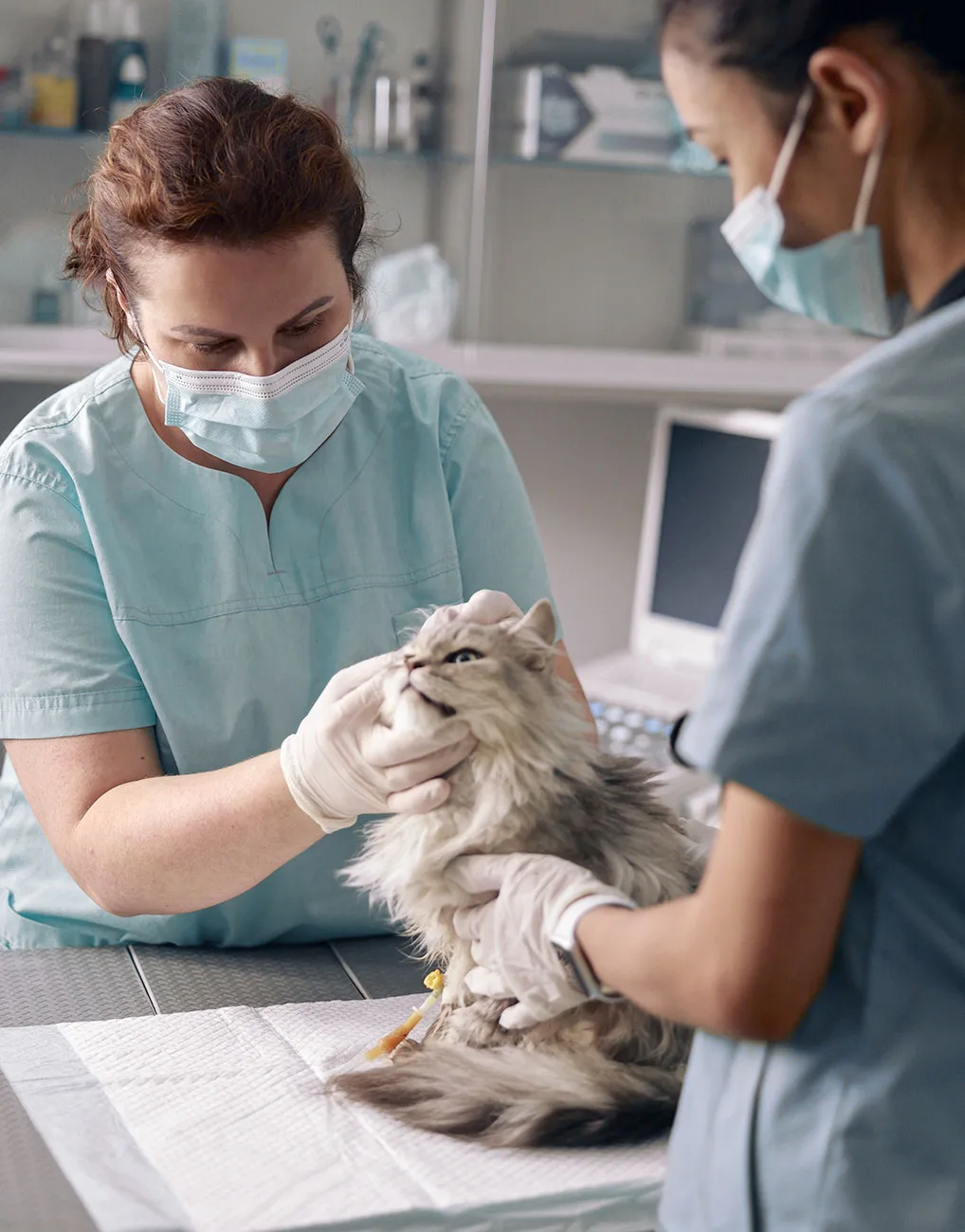
Your rep follows up. The vet is in surgery, then seeing patients, then on emergency call. Your equipment inquiry sits behind clinical responsibilities that always take priority.
Needs Analysis replaces that process. Your ENGAGE chatbot collects every requirement through an intelligent, guided conversation, right on your website. An agent is completing a real-time customer needs analysis, asking about species mix, case volume, diagnostic needs, surgical capabilities, and facility constraints, adapting to the practice's profile, and extracting data from uploaded documents such as clinic floorplans, current equipment inventories, or practice management system reports.
Without Lab Safety Needs Analysis
Days to weeks (if ever)
With Lab Safety Needs Analysis
Minutes, during the first visit
Without Lab Safety Needs Analysis
10-20% of sent assessments
With Lab Safety Needs Analysis
70-85% first-session completion
Without Lab Safety Needs Analysis
2-4 hours of follow-up
With Lab Safety Needs Analysis
Near zero
Without Lab Safety Needs Analysis
5-15 business days
With Lab Safety Needs Analysis
Same day
You have qualified buyers on your website right now. Practice owners building new clinics, hospital administrators upgrading surgical suites, and veterinary schools outfitting teaching hospitals. But between their intent and your quote lies the intake complexity that stalls veterinary equipment deals.
Veterinary practices vary enormously. A two-vet companion animal clinic has different equipment needs than a 15-vet multi-specialty hospital with oncology, cardiology, and orthopedic surgery departments. An equine ambulatory practice needs portable equipment. A large animal referral center needs hydraulic tables rated for 2,000-pound patients. A mixed practice serving both companion and large animals needs equipment that works across species.
Your equipment inquiry form was designed to cover all of these. The result is a form that asks every practice every question, regardless of their size, species mix, or specialty focus. A two-vet cat clinic sees fields about equine stocks and large animal radiology. An equine practice sees questions about dental stations and feline oxygen cages. The irrelevance creates confusion and drives abandonment.
Equipping a veterinary clinic involves multiple interconnected rooms: exam rooms, surgical suites, dental operatories, imaging suites (radiology, ultrasound, CT), treatment and prep areas, recovery and ICU, pharmacy, and kennel/housing areas. Each room has specific equipment, plumbing, electrical, and ventilation requirements.
Your inquiry form addresses equipment room by room, but veterinary practices often do not think about equipment in isolation. They think about workflow: a patient enters through the lobby, goes to an exam room, gets referred for imaging, moves to prep for surgery, recovers in ICU, and boards in the kennel. Equipment decisions in one room affect decisions in every other room.
A flat specification form cannot capture workflow-driven requirements. It collects equipment lists without understanding how the practice actually operates.
Veterinary equipment purchases are frequently financed through a combination of equipment leases, practice loans, and cash purchases. Different equipment categories may have different financing terms. The practice owner knows their total budget but not how to allocate it across your product catalog without configuration guidance.
Your form asks for a budget number. The practice owner either gives an aspirational figure that does not reflect their financing reality, or a conservative number that does not account for the financing options that would make a larger purchase feasible. Neither number helps your team configure the right solution.
Veterinarians are among the busiest professionals in any B2B sales cycle. They see patients during the day, handle emergencies on call, manage practice operations between appointments, and squeeze business decisions into whatever gaps remain. A 45-minute intake call or a 2-hour specification form simply does not fit into their schedule.
This time poverty means that your intake process competes not just with other vendors, but with every clinical and administrative task in the veterinarian's day. The vendor with the fastest, least burdensome intake process wins by default, because the veterinarian will complete whichever form demands the least time first.
Your veterinary prospects already have the data you need. It is in their practice management reports, clinic floorplans, equipment inventories, and AAHA accreditation documents. You are asking them to retype it into your inquiry form. They do not have time. Needs Analysis eliminates the retyping.
When a practice owner or administrator indicates they need equipment, Needs Analysis activates within the ENGAGE chat. The visitor fills out requirements through a guided, adaptive interface that understands veterinary practice workflows and translates clinical needs into equipment configurations.
Practice owners can upload clinic floorplans, current equipment inventories, practice management system reports, or AAHA self-assessment documents. The AI extracts room layouts, species mix data, case volumes, and existing equipment details, pre-filling the intake form.
For a full clinic buildout that would normally take weeks of manual specification, document upload reduces the data collection to under 15 minutes of review and confirmation.
Needs Analysis starts with the practice and derives the equipment list:
Instead of collecting isolated equipment lists, Needs Analysis maps the practice's clinical workflow and recommends equipment that fits how the practice actually operates. Patient flow from exam to imaging to surgery to recovery drives equipment placement, compatibility, and integration requirements. This workflow-aware approach catches configuration gaps that a flat equipment list misses.
The practice owner fills in clinical requirements. They share the workspace with the practice manager for budget and financing, with the contractor for facility specifications, and with associate veterinarians for specialty equipment preferences. Each stakeholder completes only their section.
STEP
1
A veterinarian chats with your ENGAGE chatbot about equipment options. The chatbot introduces the needs analysis, opening a guided panel tailored to veterinary practice requirements.
STEP
2
Clinic floorplans, equipment inventories, practice management reports, or AAHA documents are analyzed and used to pre-fill the intake.
STEP
3
The form guides through practice-driven configuration:
STEP
4
Complete practice equipment requirements summary before submission. Data routes to CRM with correct rep assignment.
STEP
5
Targeted follow-ups reference specific sections. Facility specs can be forwarded directly to the contractor for completion.
STEP
6
Our team monitors completion rates and refines practice-to-equipment mapping as your product catalog and veterinary practice trends evolve.
The veterinary market's unique characteristics, extreme time poverty among buyers, diverse practice profiles, and workflow-driven equipment decisions, make DIY intake solutions particularly ineffective.
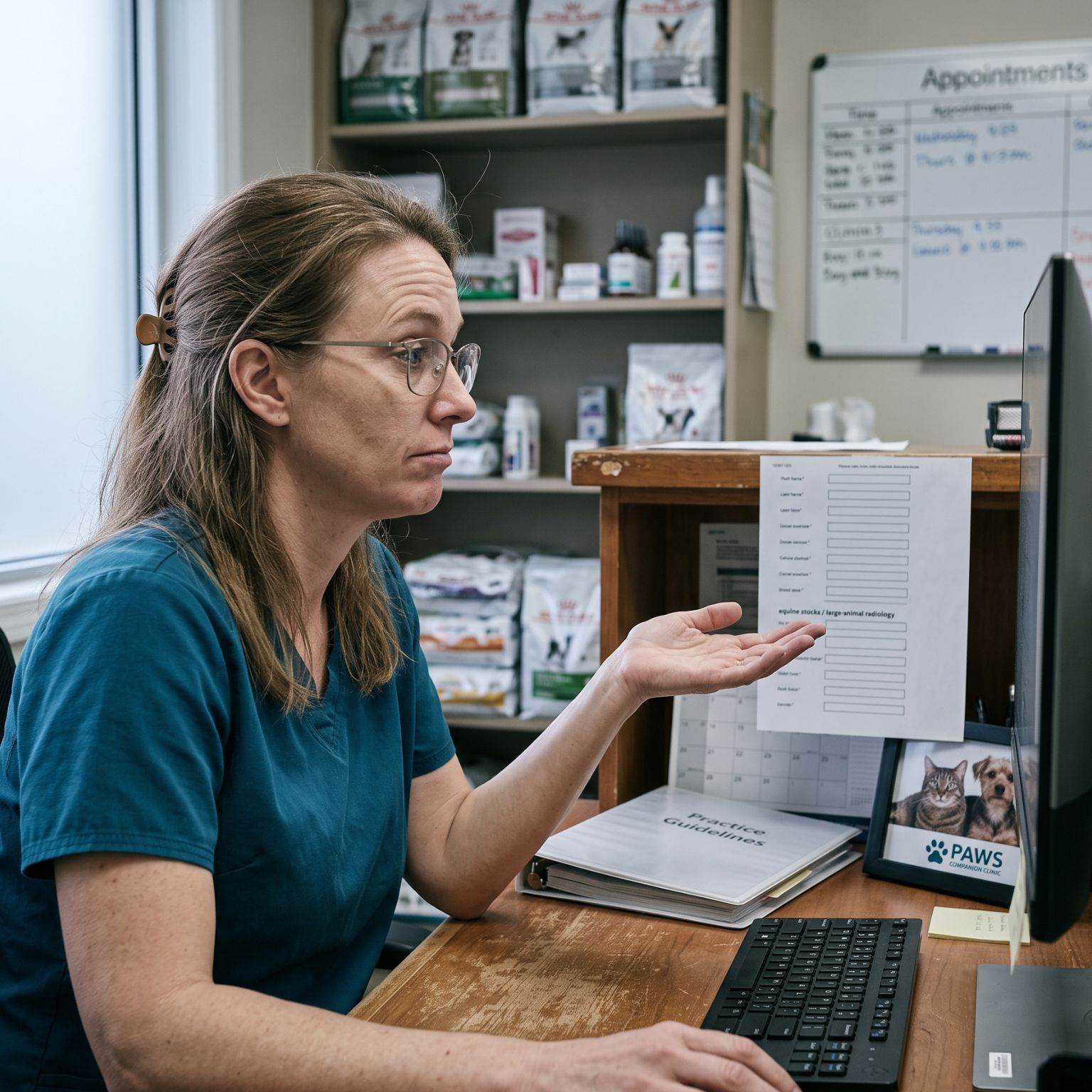
A web form that shows equine practice questions to cat-only clinics is not just inefficient, it signals that you do not understand veterinary practice types. No practice-aware conditional logic, no workflow-driven configuration, no clinical terminology that resonates with DVMs. The completion rate reflects the disconnect.
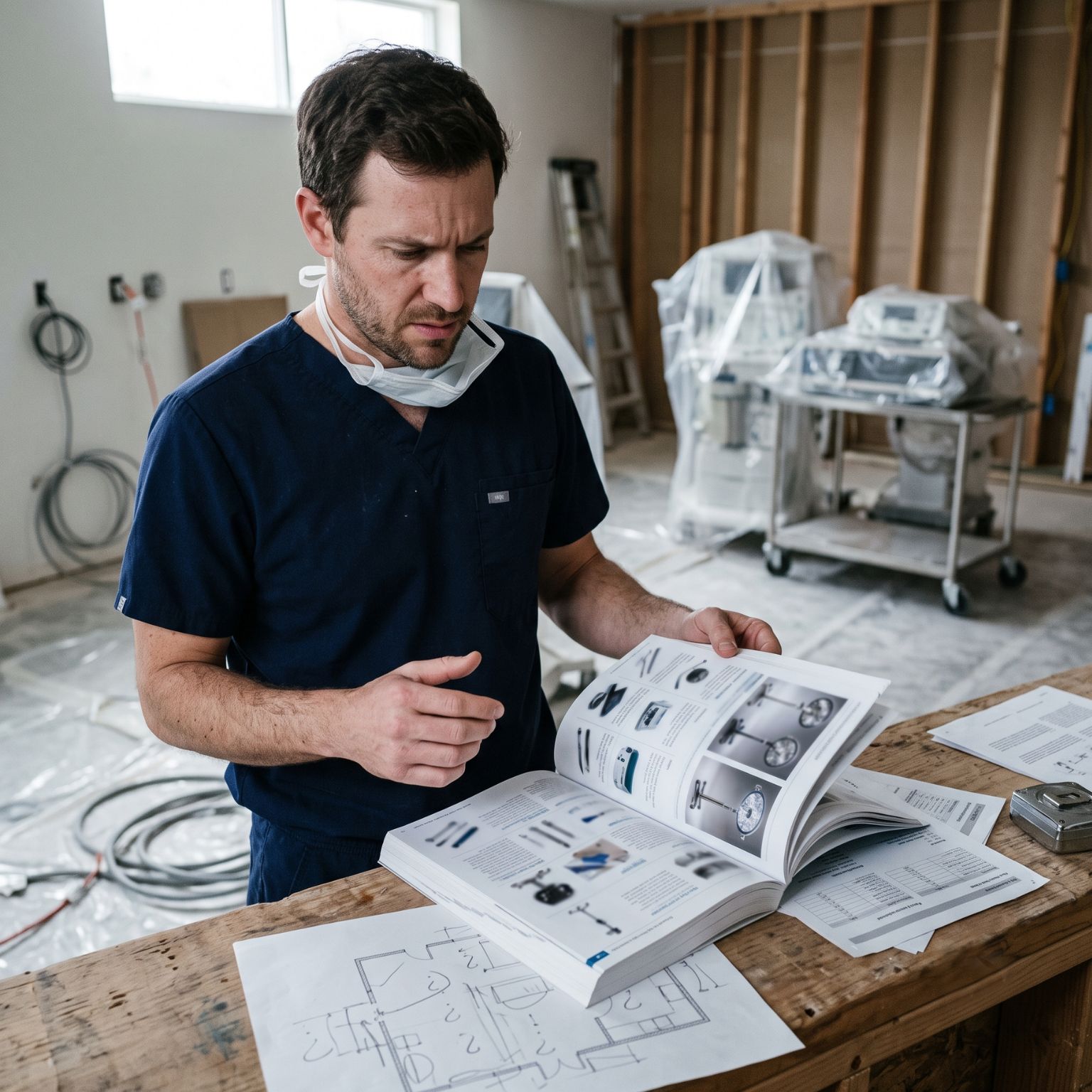
A browsable product catalog works for reordering known consumables. It fails completely for configuring a surgical suite, designing an imaging room, or equipping a new clinic where every decision is interconnected. The catalog shows products. It does not show how they fit together in a working veterinary practice.

Your territory rep visits the practice, walks the facility, takes measurements, and builds the equipment list over 2-3 site visits spanning weeks. This is thorough but slow. The practice owner who needs equipment for a clinic opening in 60 days cannot wait for a three-week specification process. And your rep has 30 other practices in their territory competing for the same attention.
Here is how Needs Analysis replaces the equipment inquiry for specific veterinary scenarios.
A veterinarian is opening a new 4-exam-room companion animal clinic with surgery, dental, and basic imaging capabilities. They need complete equipment for every room, from exam tables to surgical lights to an X-ray system, all within a startup budget funded by an SBA practice loan.
Without Veterinary Needs Analysis
Your rep sends the full equipment inquiry covering all practice types. The new practice owner, who has never equipped a clinic before, does not know where to start. They fill in the exam room section based on their residency experience but stall at imaging (digital vs. computed radiography vs. film), dental (which unit size for a 4-room clinic), and surgical equipment (what monitoring equipment for their case volume). The form sits 80% complete for three weeks while they try to research answers to questions they have never faced before.
With Veterinary Needs Analysis
The veterinarian selects "new companion animal clinic" and enters basic practice parameters: 4 exam rooms, one surgeon, approximately 25 patients per day, basic surgery and dental. The AI recommends equipment packages based on practice size and case volume. The veterinarian reviews the recommendations, adjusts based on preferences, and shares the facility section with their contractor and the financing section with their bank. Complete, practice-appropriate requirements in 20 minutes, including equipment they did not know they needed because the workflow-aware system identified gaps.
A veterinary school is upgrading diagnostic imaging and surgical equipment across their large animal and small animal teaching hospitals. The project involves multiple departments, each with different clinical and teaching requirements, and a state procurement process.
Without Veterinary Needs Analysis
Your rep coordinates with five department heads, each of whom completes a separate specification for their area. The specifications arrive over six weeks in different formats with inconsistent terminology. Two departments specify competing imaging technologies that cannot share a PACS system. Your team spends two weeks consolidating, identifying conflicts, and preparing clarification questions. The state procurement deadline approaches while the specification is still incomplete.
With Veterinary Needs Analysis
The project coordinator creates a multi-department session. Each department head receives a link with their relevant sections, pre-configured for their clinical focus (large animal surgery, small animal medicine, diagnostic imaging, anesthesiology, clinical pathology). The system identifies cross-department integration requirements (PACS compatibility, shared monitoring platforms) and flags conflicts before submission. Consolidated, department-validated requirements arrive in your CRM within two weeks.
A 24-hour emergency veterinary hospital is adding a dedicated ICU wing with advanced monitoring, ventilation, oxygen therapy, and emergency surgical capabilities. The equipment must support rapid patient turnover and integrate with their existing practice management system.
Without Veterinary Needs Analysis
Your inquiry form does not distinguish between outpatient and emergency/critical care requirements. The ER director fills in generic equipment fields but cannot express the ICU-specific needs: continuous monitoring for 12 simultaneous patients, centralized alarm management, rapid-access drug storage, emergency ventilator specifications, and oxygen delivery systems for patients ranging from 2kg cats to 60kg dogs. The form does not capture these workflow requirements. Three phone calls and two weeks of email follow.
With Veterinary Needs Analysis
The ER director selects "emergency and critical care" practice type with ICU expansion. The intake adapts to show ICU-specific fields: patient capacity, monitoring parameters per station, ventilator specifications, oxygen system requirements, and centralized alarm configurations. The director describes their clinical workflow and the AI maps it to equipment configurations. Complete ICU requirements, including integration with their existing PMS, submitted in one session.
Most chatbot companies sell you a platform and wish you luck. AI companies sell you a model and tell you to figure out the rest. Needs Analysis is neither of those things.
We design, build, deploy, and continuously optimize your entire veterinary equipment intake process. The outcome you pay for is specific: qualified requirements data flowing into your CRM, collected automatically from your website visitors, without your sales team lifting a finger.
When AI handles the grind of requirements collection, your salespeople finally get to do the work they got into sales to do. They stop chasing spreadsheets and start building relationships. They stop being data entry clerks and start being trusted advisors. That is not a threat to your sales team. It is the biggest gift you can give them.

Our team studies your current veterinary equipment intake workflow, from the spreadsheet or form you send today to the back-and-forth emails that follow. We identify where prospects drop off, which questions cause confusion, and what data your configuration or engineering team actually needs versus what you are collecting out of habit. Then we rebuild the entire experience from scratch, optimized for completion, not just data collection.
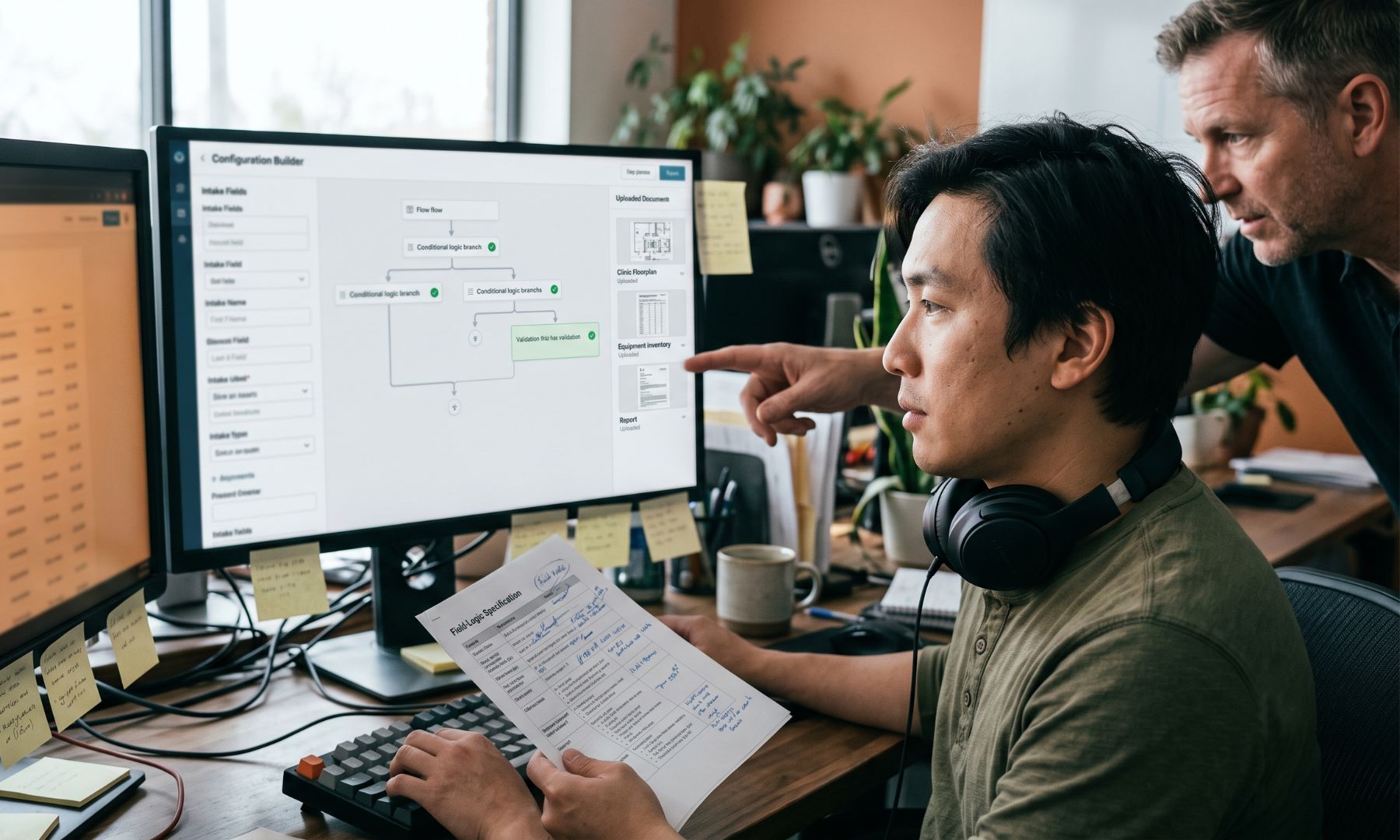
Every Needs Analysis deployment is custom. Your fields, your product logic, your conditional rules, your document types, your CRM mapping. We structure the intake to align with your actual veterinary equipment configuration and quoting workflow, so the data that arrives in your CRM is immediately usable by your team. This is not a template. It is a custom-built intake system trained on your products, your industry terminology, and your sales process.
After launch, our team reviews completion data, identifies friction points, and refines the experience.


You get a sales channel that improves each month without taking up any of your team's time.
CAPABILITY
DIY APPROACH
NEEDS ANALYSIS
Design
Your team builds forms in-house
We design the entire intake experience
AI Training
You configure rules yourself
We train AI on your products and documents
Document Analysis
Not available
AI extracts data from uploaded clinic floorplans, equipment lists, practice management reports, and AAHA accreditation documents
Deployment
Your IT team integrates
We deploy within your ENGAGE chatbot
Monitoring
Your team reviews (if they have time)
Our team monitors completion rates daily
Optimization
Happens when someone has bandwidth
Continuous, data-driven improvement
CRM Integration
Your team maps fields
We configure routing, assignment, and field mapping
Follow-Up
Your team writes emails
We build targeted sequences for incomplete submissions
Accountability
Falls to whoever "owns" the form
We own the outcome: completed forms in your CRM
DIY APPROACH
Your team builds forms in-house
NEEDS ANALYSIS
We design the entire intake experience
DIY APPROACH
You configure rules yourself
NEEDS ANALYSIS
We train AI on your products and documents
DIY APPROACH
Not available
NEEDS ANALYSIS
AI extracts data from uploaded lab protocols, facility specifications, equipment inventories, and procedure documents
DIY APPROACH
Your IT team integrates
NEEDS ANALYSIS
We deploy within your ENGAGE chatbot
DIY APPROACH
Your team reviews (if they have time)
NEEDS ANALYSIS
Our team monitors completion rates daily
DIY APPROACH
Happens when someone has bandwidth
NEEDS ANALYSIS
Continuous, data-driven improvement
DIY APPROACH
Your team maps fields
NEEDS ANALYSIS
We configure routing, assignment, and field mapping
DIY APPROACH
Your team writes emails
NEEDS ANALYSIS
We build targeted sequences for incomplete submissions
DIY APPROACH
Falls to whoever "owns" the form
NEEDS ANALYSIS
We own the outcome: completed forms in your CRM
Your best veterinary equipment sales reps do not just sell products. They understand the practice's clinical goals, patient flow, and growth plans. They recommend equipment layouts that improve case throughput. They identify surgical capabilities that the practice owner has not considered but that would open new revenue streams. They become the equipment partner that practices rely on for every expansion and upgrade.

But they cannot do any of that if they are spending 15 hours a week chasing equipment wish lists and coordinating between veterinarians, contractors, and financing companies.
Needs Analysis does not replace your territory sales team. It gives them complete, practice-validated requirements before they ever visit the clinic. When AI handles the grind of requirements collection and practice-to-equipment mapping, your reps get to do the work they got into veterinary equipment sales to do: consult on clinical workflows, design practice layouts, and build relationships with DVMs who will buy from them for the next 20 years.
Nobody gets into veterinary equipment sales to update spreadsheets. Your reps got into this because they care about animal health, they understand clinical workflows, and they know how the right equipment transforms a practice. Needs Analysis gives them the bandwidth to deliver on that promise.
When your reps have time to think strategically, they stop selling individual pieces and start designing complete practices. That is where the $200K deals live, and that is where your team earns the trust that turns one-time transactions into career-long relationships.
Needs Analysis is an add-on to ENGAGE, so it inherits all of ENGAGE's integration capabilities and adds intake-specific connections for the veterinary equipment industry.


Installs through your existing ENGAGE chatbot. No additional code, no separate widget, no IT project. If ENGAGE is live on your site, you can activate Needs Analysis within it.
Learn more about the ENGAGE chatbot platform
IMPLEMENTATION
We do not hand you software and disappear. Here is what goes into building a Needs Analysis deployment that actually works.

Phase 1
Before we build anything, we study what you are doing today. We review your current veterinary equipment intake forms, spreadsheets, and questionnaires. We interview your sales and configuration teams about what data they actually need versus what they collect out of habit. We map the end-to-end process from inquiry to deliverable quote, identifying where prospects drop off, where data quality breaks down, and where your team spends the most time on back-and-forth.

Phase 2
We design the field sequence, conditional logic, and section grouping for optimal completion in your specific veterinary equipment context. Every field gets plain-language descriptions and help text so prospects know exactly what is being asked. We configure autocomplete libraries from your product catalog and known values. We train the document analysis AI on your industry's document formats, ensuring high extraction accuracy from day one.

Phase 3
We run hundreds of test scenarios across different veterinary equipment prospect types and use cases. We validate the accuracy of document analysis against your actual document formats. We test CRM integration and verify that data lands in the correct fields. We test follow-up workflows end-to-end. We provide a private preview for your team to try breaking it.

Phase 4
We activate Needs Analysis within your live ENGAGE chatbot, monitor real interactions during the first weeks, and make rapid adjustments based on actual prospect behavior. We establish baseline completion metrics and brief your sales team on the new lead flow.
Ongoing
We review completion data weekly, analyze performance monthly, and continuously train the AI as new document types and field patterns emerge. We update the intake as your products, pricing, or requirements change. Your needs analysis process stays current because we actively maintain it.
INVESTMENT
Needs Analysis is an add-on to Salesperson ENGAGE. Pricing is based on the complexity of your specific requirements collection process.

Number of equipment categories and practice types covered

Complexity of practice-to-equipment mapping logic

Document types that need AI analysis (floorplans, equipment inventories, PMS reports, AAHA documents)

CRM integration complexity

Multi-room and multi-department workflow requirements
Follow-up automation and collaborative workspace requirements
One-Time Setup
There is a one-time setup fee that covers the intake process audit, AI training, custom form design, CRM integration, and testing. This varies based on complexity, because a 15-field equipment sizing intake is fundamentally different from a 60-field technical assessment with document analysis.
Monthly Service
After launch, a monthly service fee covers continuous monitoring, optimization, AI retraining, follow-up automation, and ongoing support. This is not a software license that sits idle. It is an active service delivering completed intake forms into your CRM every month.
PROJECTED IMPACT
10-20% → 70-85%
Intake form completion rate
Before: 10-20%
3-10 business days → Under 15 min
Average time to complete intake
Before: 3-10 business days
3-6 per prospect → 0-1
Follow-up emails before completion
Before: 3-6 per prospect
2-4 hours → Near zero
Sales rep hours per intake
Before: 2-4 hours
5-15 business days → Same day to next business day
Time from inquiry to deliverable quote
Before: 5-15 business days
40-60% → Under 15%
Prospects lost to intake friction
Before: 40-60%
"This problem plagued our sales team for years. We knew AI could solve it, but we had no idea where to start. It honestly felt like a pipe dream. Then we started working with Salesperson Inc. and were shocked at how quickly they built it and how well it worked. Their team are seasoned sales funnel experts, not IT people or AI engineers. It is like talking to a colleague who actually cares about the results of your business."
Veterinary Equipment Distributor
If the answer involves weeks of chasing busy veterinarians who have patients to see, you already know the problem.
Needs Analysis replaces the multi-week equipment inquiry with an intelligent, practice-aware system that collects requirements in the few minutes a DVM can spare between appointments.
Right now, a practice owner is on your website planning a new clinic or an expansion. Will your intake process capture their requirements in the 20 minutes they have available, or will they call the equipment company whose rep happens to visit next?
Stop conducting a needs analysis the hard way. Let the AI handle the process while your team handles the deals.