Most people think a chatbot's tone is a finishing touch, a bit of personality you sprinkle on at the end. In B2B it is closer to the opposite. How your chatbot sounds is one of the first signals a serious buyer uses to decide whether your company is credible, often before they read a single answer.
Key Takeaways
How human and how formal your chatbot sounds is a brand decision, not a cosmetic one. In B2B, tone is part of how a buyer judges whether you are credible.
The default is whatever voice the tool ships with, usually a breezy, over-friendly consumer tone that feels wrong the moment a technical buyer reads it.
Too casual reads as unserious in a market where precision matters. Too robotic reads as cold and unhelpful. Both quietly cost you trust, even when the answers are correct.
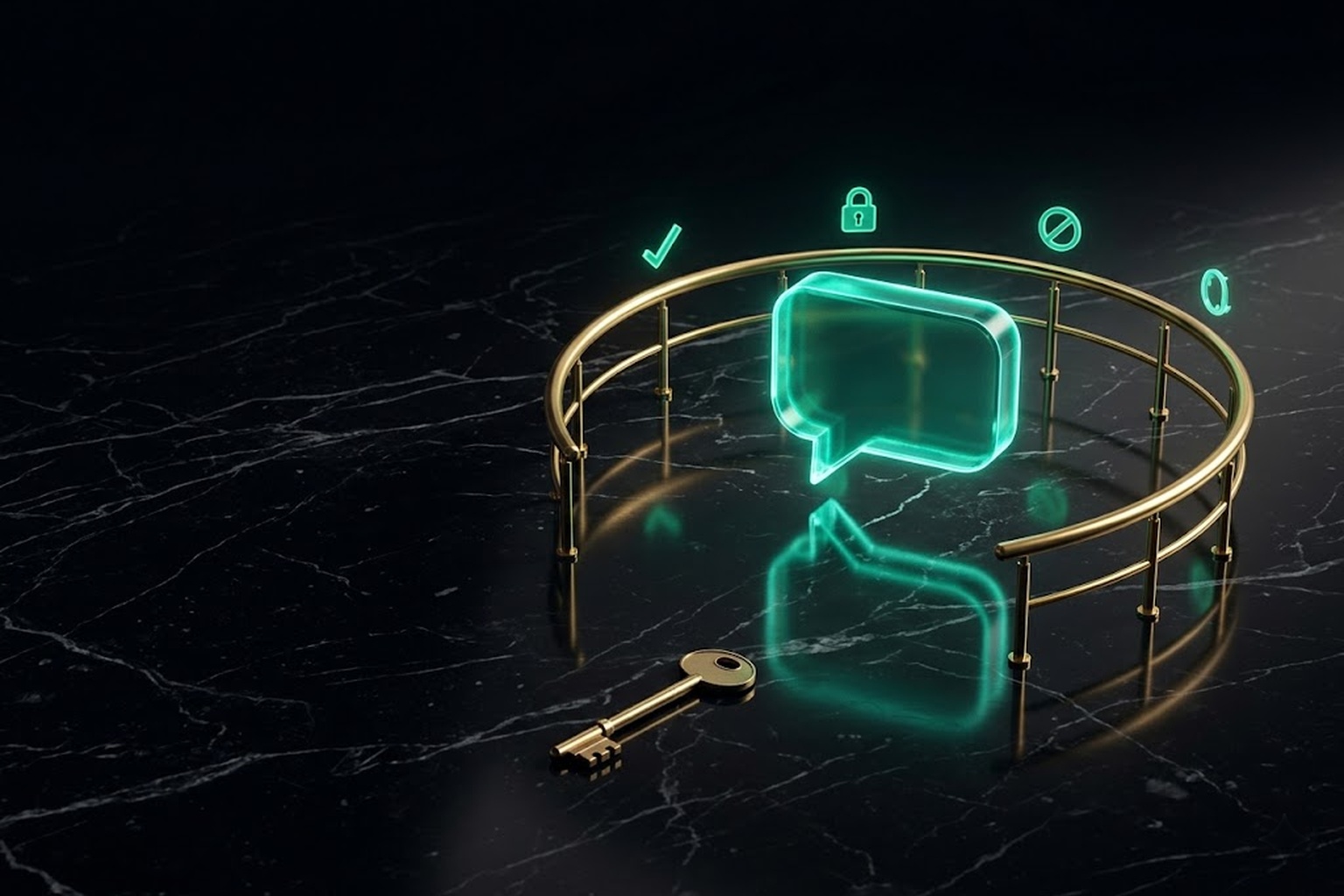
We treat tone as a brand guardrail: a deliberate voice that sounds like a knowledgeable member of your team, calibrated to your market and consistent everywhere it speaks.
The wrong tone fails silently. The buyer does not complain. They just quietly decide you are not for them, and you never find out why.
The decision everyone hits
Somewhere in setting up a chatbot, someone decides how it talks. Often that decision is made by not making it: the tool comes with a default voice, it sounds friendly enough, and nobody stops to ask whether that voice is right for the people who will actually be reading it. The tone gets set by accident.
In B2B, that accident is expensive, because tone does work that has nothing to do with the words. Before a buyer has evaluated a single answer, the voice has already told them something: whether this company feels like a serious peer or a flimsy operation, whether the people behind it understand a market like theirs, whether they belong in the same room as the buyer's problem. A procurement lead at a pharmaceutical company and a casual shopper buying sneakers are reading the same chatbot through completely different eyes, and a voice that delights one can quietly insult the other.
So the decision is real, even when it is made by default: what does your chatbot sound like, and is that voice calibrated to the buyer you are actually trying to win? Get it right and the tone disappears into a smooth, credible experience. Get it wrong and the tone becomes the loudest thing in the conversation, for all the wrong reasons.
The real question is not "should the chatbot sound friendly." It is "does this voice make our specific buyer trust us more or less." Friendliness is not universally good. In a technical or regulated market, the wrong kind of friendly is a credibility leak.
The default most people pick
The default is the out-of-the-box voice, and that voice is almost always tuned for consumer friendliness. Bright, breezy, eager, full of exclamation points and reassuring chirpiness. It is designed to feel approachable to the widest possible audience, which means it is designed for nobody in particular.
For a consumer brand, that can work fine. For a serious B2B buyer evaluating a technical purchase, it lands wrong in ways that are easy to feel and hard to articulate:
The buyer
What the over-friendly default does
What they conclude
An engineer asking a precise question
Answers with chirpy enthusiasm and emoji
"This company is not on my level"
A compliance lead on a regulated topic
Stays breezy and casual about something serious
"They do not understand the stakes"
A procurement professional comparing vendors
Sounds like a consumer app, not a peer
"This feels less credible than the others"
The other failure runs the opposite direction. Some teams, wary of sounding unserious, swing to a stiff, robotic, corporate register that reads as cold and bureaucratic, the verbal equivalent of a terms-and-conditions page. That voice does not insult the buyer's intelligence, but it does make the experience feel lifeless and unhelpful, which is its own kind of trust problem.
Either way, the default optimizes for a generic idea of "professional" or "friendly" rather than for the specific buyer in your specific market. And because tone is felt rather than analyzed, the damage never announces itself. The buyer just forms a quiet impression and acts on it.
Why we pick differently
When we set up ENGAGE, we treat the chatbot's voice as a brand guardrail, the same deliberate discipline we apply to what the bot is allowed to say. The voice is not left to a default. It is defined: who the bot sounds like, how formal it is, what register it uses, and what it will and will not do with tone.
The principle is simple: the chatbot should sound like a knowledgeable member of your team, not like a generic bot wearing your logo. That means calibrating the voice to your market and your buyer, not to a one-size consumer default. For a technical audience, that usually means a tone that is warm but precise, confident without being chummy, the way a good technical salesperson talks: human and easy to deal with, but clearly someone who knows the domain and takes the buyer's problem seriously.
This is the part that is invisible from the outside. Two chatbots can give the identical answer to the identical question, and one builds trust while the other erodes it, purely on how the answer sounds. That voice is a decision made before launch, about who your brand is allowed to sound like. It is not a slider you nudge at random.
There is calibration within this, not just one fixed setting. The core voice stays consistent, because consistency is part of how a brand earns trust, but the register flexes with the moment. Around a technical specification or a compliance question, the tone gets more careful and precise, because that is what the subject demands and what the buyer expects. In an early, exploratory conversation, it can be a touch warmer and more open. One identity, dialed to the context, never a different personality on every page.
This is also why tone belongs alongside the other guardrails rather than off on its own. The factual guardrail governs what the bot may treat as true. The brand guardrail governs how it sounds and what it will and will not say in your name. Together they are what keep the chatbot recognizably, reliably yours. You can read more about the full system in our overview of the guardrails we build into every B2B chatbot.
What it costs you to get wrong
Here is the trap. A tone problem produces no error, no complaint, no obvious failure. Nobody emails to say "your chatbot felt too casual for a company I would trust with this." They simply read the voice, form an impression, and act on it without ever telling you. The cost is a verdict you never hear.
And it is a verdict that contaminates everything else. A buyer who decides, from the tone, that your company is not a serious peer will read your correct answers with less trust, your guarantees with more skepticism, and your competitors with more interest. The wrong voice does not just cost you the buyers who needed exactly the right tone. It taxes every interaction, because once the voice has signaled "not quite credible," the buyer discounts what follows. In a market where the purchase is high-stakes and the buyer is an expert, that discount is often the difference between making the shortlist and quietly falling off it.
The default
Accept the tool's out-of-the-box voice, usually a breezy consumer tone, or overcorrect into a cold, robotic one. Neither fits your buyer.
Why we pick differently
Define the voice as a brand guardrail: a knowledgeable member of your team, calibrated to your market, consistent everywhere, flexing with context.
The cost of wrong
A silent verdict you never hear. The buyer decides you are not a serious peer and discounts every answer that follows.
This is why tone deserves deliberate design rather than a default voice. The wrong tone does not announce itself, and that is exactly what makes it dangerous: you cannot fix a problem your buyers will never tell you about. The more technical and high-stakes your sale, the more the voice is doing quiet, constant work to either build your credibility or chip away at it.
Done-for-you results, the way we think about it at Salesperson.com, means we define the voice to match your market and your brand, hold it consistent as a guardrail, and calibrate the register to the moment, so the chatbot sounds like the company a serious buyer wants to work with. If you run a chatbot yourself, the same standard applies: read your bot's replies as your hardest-to-impress buyer would, and ask whether the voice is earning trust or quietly spending it.
How to calibrate your own tone
You do not need our service to act on this. If you run any website chatbot, here is the decision in a usable form:
Stop accepting the default voice. Read your chatbot as your toughest buyer would. Pull up a few real transcripts and ask honestly: does this sound like a credible peer in our market, or like a consumer app that wandered onto a technical site? The gap between those two is your tone problem.
A few guardrails worth keeping. Calibrate to your buyer, not to a generic notion of friendly, because the right tone for a sneaker store is the wrong tone for a diagnostics manufacturer. Keep the core voice consistent everywhere, since consistency is part of trust, while letting the register tighten around technical and compliance topics. And treat the voice as a defined guardrail, not a vibe, so it stays recognizably yours instead of drifting into generic-bot territory over time.
This is decision seven of ten in how we stand up an AI sales layer. The next one is the one most vendors avoid: what a good chatbot should deliberately never automate, and why arguing for less automation is the most honest thing an AI company can do.
For neutral, well-grounded background on voice and tone as a design discipline, the Nielsen Norman Group has extensive research on tone of voice and how it shapes user trust, and the NIST AI Risk Management Framework is a useful reference for thinking about trustworthy, well-governed AI systems.
Frequently asked questions
How human should a B2B sales chatbot sound?
Human enough to feel natural and easy to talk to, but matched to your market and your buyer. In technical or regulated B2B, an overly casual, chatty tone can read as unserious and erode trust, while a stiff, robotic tone feels cold and unhelpful. The right answer is a tone that sounds like a knowledgeable member of your team, calibrated to how your actual buyers expect to be spoken to.
Is chatbot tone really that important?
Yes. Tone is not cosmetic, especially in B2B. It is part of how a buyer decides whether your company is credible before they ever speak to a person. A chatbot that sounds wrong for your market can undermine trust even when every answer it gives is factually correct, because the buyer reads the voice as a signal about the company behind it.
What is a chatbot persona or personality?
A chatbot persona is the defined character and voice the chatbot uses: how formal or casual it is, what it sounds like, what it will and will not say, and how it carries your brand. Setting the persona deliberately, rather than accepting a generic default, is what keeps the chatbot sounding like your company instead of like every other bot.
Should the chatbot have the same tone everywhere?
Mostly the core voice should stay consistent, because consistency is part of brand trust. But the register can flex with context: more precise and careful around technical or compliance topics, a little warmer in early, exploratory conversation. The voice is one identity, calibrated to the moment, not a different personality on every page.
We make your chatbot sound like a peer, not a bot.
ENGAGE gives your chatbot a defined brand voice, calibrated to your market, held consistent as a guardrail, and tuned to sound like a knowledgeable member of your team. Done-for-you results, not another tool to configure.
Managed AI Chatbot vs DIY Platform: The Real B2B Cost of "Build It Yourself"
Across this series we have walked through nine decisions that determine whether a B2B sales chatbot works or quietly fails. Here is the one that ties them all together: who makes those decisions, and who keeps making them. Because a DIY platform hands every one of them to you, and that is the real difference between a tool and a result.
John Buie | Founder and CEO
Scripted vs Conversational Chatbot: Why B2B Buyers Break Decision Trees (and What to Do Instead)
A scripted chatbot, the kind with neat buttons and preset paths, feels safe. You control every word. The problem is that real B2B buyers do not stay on the path. They ask the specific, off-menu question the script never anticipated, and that is the exact moment a rigid bot fails the buyer you most wanted to keep.
John Buie | Founder and CEO
Should You Trust a Sales Chatbot to Run Itself? The Human-in-the-Loop Decision for B2B
A modern AI chatbot is capable enough that it is tempting to flip it on and walk away. That temptation is the mistake. What makes an AI sales agent trustworthy is not the model. It is the human work that surrounds it: people writing the guardrails, testing them before launch, and reading the conversations after.
John Buie | Founder and CEO
Your Chatbot Captured a Lead. Now What? The Speed-to-Lead Decision Most B2B Teams Get Wrong
Capturing a lead is the part everyone obsesses over. What happens in the next sixty seconds, who gets told, how fast, and through what channel, is the part almost nobody designs. And that is exactly where most captured leads quietly die.
John Buie | Founder and CEO
Needs Analysis or Instant Quote: Build the Agent Your Real Sales Process Requires
Some things you sell cannot be quoted on the spot. Before a price can even exist, the buyer has to clear a step, a requirements assessment, a compatibility check, a configuration. That step is almost always where an interested buyer goes quiet. The real decision is whether your website actually does it, or just leaves it sitting offline like everyone else does.
John Buie | Founder and CEO
The Guardrails We Build Into Every B2B Sales Chatbot
An AI sales chatbot is only as safe as the rules you put around it. Those rules are called guardrails, and they are the difference between a chatbot you can trust on your homepage and one that quietly creates risk every time it speaks. Here is the full system of guardrails we build into every B2B deployment, and why the off-limits list matters as much as the answers.


.png)