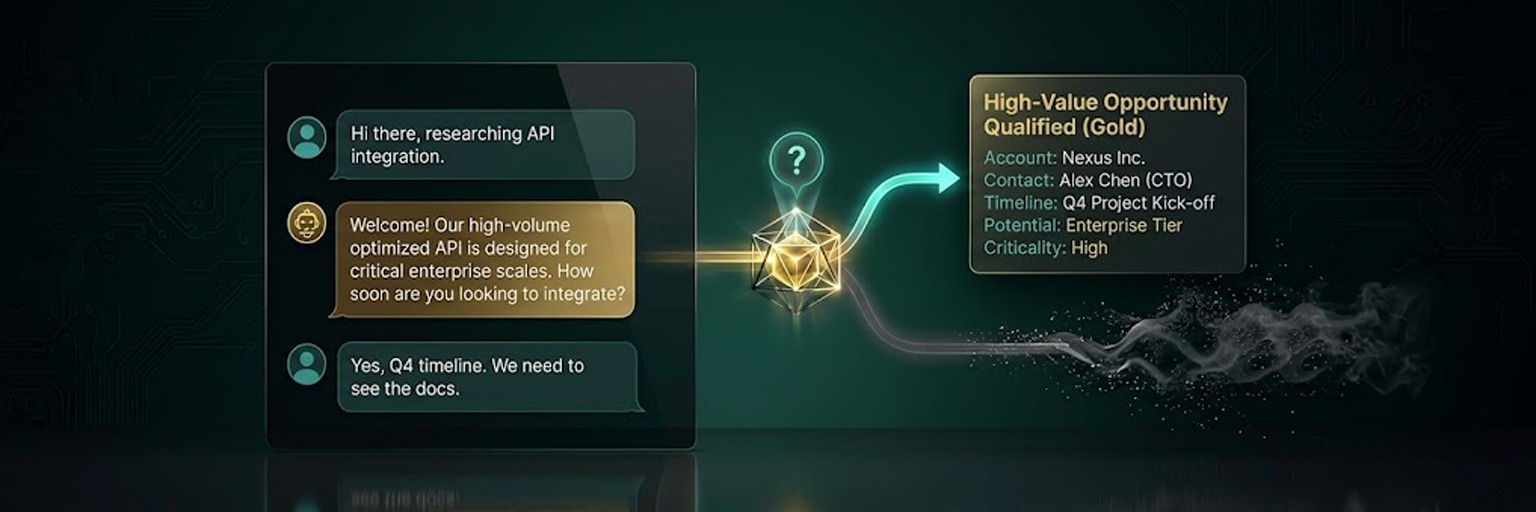
Every B2B team's instinct is to grab the lead as fast as possible, so the chatbot fires the form early. For some product lines that is exactly right. For others it is the fastest way to send a buyer to a competitor. The handoff is a timing decision, and the line is more delicate than it looks.
Key Takeaways
The chatbot-to-human handoff is a timing decision, not a button you switch on. When the bot passes the lead to sales decides how many leads you actually get.
The default is to fire the lead form early, because every B2B team wants the visitor in their sales team's hands as fast as possible. Sometimes that is right. Often it is not.
For commoditized products, an early form scares the buyer off. They still want information, so they leave to get it elsewhere and pencil a competitor's product into their plans instead of yours.
The better play is often to win mindshare first: show authority in the visitor's specific application, give them what they came for, then hand off. Where it lands varies by product line, and we set it from data, not gut.
Most handoffs are a form to a rep or CRM, not a live transfer. ENGAGE does both, captures the lead organically in-chat where possible, and triages sales from support so your pipeline stays clean.
The decision everyone hits
Every chatbot reaches a moment where it has to decide what to do with a visitor who is worth passing to your team. Usually that means showing a lead capture form, or, better, gathering the contact details inside the conversation itself. The question that nobody really sits with is: when?
It feels like a small timing tweak. It is actually the setting that decides how many leads your chatbot produces and how much influence you get over what the buyer does next. Fire the handoff at the right moment and the visitor gives you their details willingly because you have earned it. Fire it at the wrong moment and you interrupt a buyer who was not ready, and watch them leave to find what they needed somewhere else.
This is not a question of whether to capture the lead. Of course you want the lead. It is a question of whether you grab for it before you have given the visitor a reason to want to keep talking to you. And the honest answer to "when should we hand off" is the one nobody likes: it depends on what you sell.
The real question is not "how fast can we capture the lead." It is "at what point has this visitor gotten enough value that handing off feels welcome instead of pushy." For some products that point comes early. For others it comes much later. Treating it as one fixed setting is the mistake.
The default most people pick
The default is to hand off early. The instinct is completely understandable, and almost every B2B company has it: get the visitor in front of the sales team as fast as humanly possible. Leads are the whole point. So the chatbot is set to surface the form the moment a visitor shows the faintest flicker of interest.
For some product lines, this is genuinely the right call. If you sell a technical, application-specific product, the buyer often wants expert contact. A chatbot that establishes authority in their exact use case and then guides them to your sales team is doing them a favor, and the early handoff converts.
But applied as a blanket rule, early handoff quietly backfires on a whole category of products, and this is the part the default misses:
Product type
What an early handoff does
Result
Technical, application-specific
Establishes authority, then offers expert contact
Often converts. Early handoff fits.
Commoditized, widely available
Asks for details before the visitor has answers
They leave to get info elsewhere
Considered, research-heavy
Interrupts the research the visitor came to do
You lose the conversation and the mindshare
Here is the failure mode that the "capture fast" instinct creates for a commoditized product. The visitor is comparing options. They came to your site for information. If your chatbot demands their contact details before giving them what they came for, they do not fill in the form. They simply go to the next site, get the information there, and start mentally penciling that competitor's product into their plans. You did not capture a lead early. You handed a competitor the mindshare.
Why we pick differently
When we set the handoff on an ENGAGE deployment, we treat the timing as a decision to be made per product line, from evidence, rather than a single instinct applied everywhere.
The principle is simple: hand off at the point where the visitor wants to keep talking to you, not the first second you could grab an email. For some clients that means exactly the aggressive, early approach: open by asking about the application, demonstrate real authority in that specific area, and guide confidently to a sales handoff. That wins for the right product.
For others, especially more commoditized lines, the winning move is the patient one. Let the chatbot be genuinely useful first. Answer the real questions. Position the brand as the one that actually helped. Win the mindshare while the visitor is still deciding, and only then move toward capturing the lead, often by working the contact details into the natural flow of the conversation rather than throwing up a form at all. The form stays as the fallback, not the opener.
This is the part that is invisible from the outside. Two chatbots can both "capture leads." The difference is a judgment made before anyone visits the site, about how delicate the timing line is for your specific products, and a willingness to keep testing and moving it. The handoff timing is not a feature you toggle. It is a call that decides whether you win the buyer or fund a competitor's pipeline.
There is a structural piece underneath the timing that makes this work, and it is one of the things that genuinely sets ENGAGE apart: the AI triages sales from support before it decides what to do. A sales opportunity and an existing customer with a problem should never go down the same path. So the chatbot first works out which one it is talking to.
If it is a sales opportunity, the AI does the valuable work: recommends, guides, nurtures, builds authority in the visitor's application, and captures the lead, ideally organically inside the chat, with a form as the fallback. If it is an existing customer who needs help, the bot peels that conversation off cleanly so it never clogs the sales flow your reps work. Where a client runs a supported live-chat platform such as Zendesk, that support path can become a real-time handoff to live chat or a support ticket created directly in Zendesk. Most chatbots cannot tell the two apart, so every conversation lands in the same undifferentiated form. Separating them is what keeps your pipeline clean and your sales team focused on actual opportunities.
One more thing we have learned managing this across many clients: the handoff timing is one of the most political decisions inside an organization. Put the marketing manager, the sales manager, the customer success manager, and a VP in one room and ask when the chatbot should hand off, and you will get four passionate, conflicting answers, none of which reference the data or the visitor. Sales wants the lead now. Marketing wants engagement and brand. Customer success wants clean routing. Everyone argues for what they want. Part of what you are paying an outside operator for is a decision made from evidence and live experiments instead of from whoever argues hardest in the meeting.
What it costs you to get wrong
Here is the trap. When you hand off too early on the wrong product line, nothing looks broken. The chatbot loads. It engages. It offers the form. Some people even fill it in. Your dashboard shows leads coming in. Everything appears to be working.
What you never see is the larger group who hit that early form, were not ready, and quietly left to get their information from a competitor. They do not show up as a failed capture. They show up as nothing, while the competitor who let them keep reading earns the mindshare and, later, the purchase. You did not just miss a lead. You helped a rival get scoped into the buyer's plans.
The default
Fire the lead form early on every product, because the instinct is to get the visitor to sales as fast as possible.
Why we pick differently
Set the timing per product line from data. Win mindshare first where needed, capture organically in-chat, triage sales from support.
The cost of wrong
On commoditized lines, an early form sends the buyer to a competitor for the info, and that competitor wins the mindshare you paid to attract.
This is why the decision deserves more than a default setting and an internal opinion. The wrong timing does not just cost you the occasional lead. On the wrong product line it systematically trades away mindshare to competitors, because the visitors most likely to bolt from an early form are exactly the ones still forming their shortlist. The more your category looks like everyone else's, the more the timing line matters, and the more it pays to get it right.
Done-for-you results, the way we think about it at Salesperson.com, means someone owns this decision on your behalf, sets the timing per product line, runs the experiments, and moves the line as the data talks. If you run a chatbot yourself, the same standard applies: the handoff timing is not set-and-forget, and it is not a matter of who wins the internal argument. It is the line that decides whether your chatbot grows your pipeline or quietly feeds someone else's.
How to think about your own handoff
You do not need our service to act on this. If you run any website chatbot, here is the decision in a usable form:
Stop treating the handoff as one fixed, early trigger. Match the timing to the product. For technical lines where you can show real authority, an early, confident guide to sales often wins. For commoditized or research-heavy lines, be useful first, win the mindshare, and capture later, ideally inside the conversation rather than through a form thrown up too soon.
A few guardrails worth keeping. Do not let your internal politics set the timing; let the visitor's behavior and your conversion data set it. Separate support from sales so an existing customer's problem never lands in the same bucket as a fresh opportunity. And remember that a form is the fallback, not the goal; the smoothest captures happen when the contact details come up naturally because the visitor already wants to keep talking to you.
This is decision two of nine in how we stand up an AI sales layer. The next one runs in a different direction: what the chatbot should do at the edge of its own knowledge, and why one that admits "I don't know" earns more trust than one that answers confidently and wrong.
For the broader, vendor-neutral research on how reducing friction lifts conversion, the work on decision and form friction summarized by the Nielsen Norman Group is a solid starting point, and the Think with Google library has useful, neutral data on how B2B buyers research before they are willing to talk to sales.
Frequently asked questions
When should a B2B chatbot hand off the lead to sales?
It depends on the product. For technical or application-specific products, the chatbot can establish authority, answer deeply, and guide the visitor to a sales handoff early, because the buyer values expert contact. For commoditized products, handing off too early backfires: the visitor still wants information, and a premature form pushes them to a competitor's site to get it. The right moment is the point where the visitor has enough value to want to keep talking to you, not the earliest moment you can capture an email.
Is a chatbot handoff usually a live transfer or a form?
In most B2B chatbots the handoff is a form that gets emailed to a rep or dropped into a CRM, not a real-time transfer to a live person. True live handoff requires a connected live-chat platform. ENGAGE supports both: it can capture the lead through a form or organically inside the conversation, and where a client runs a supported live-chat platform such as Zendesk, it can also transfer in real time.
What is sales-versus-support triage in a chatbot?
It is the chatbot recognizing whether a visitor is a sales opportunity or an existing customer needing support, and routing each down a different path. Sales opportunities get guided, nurtured, and captured for the sales team. Support cases are peeled off to a ticket or live-chat queue. The triage keeps your sales pipeline clean and ensures support requests never dilute or clog the lead flow your reps work.
Why does the handoff timing cause internal disagreement?
Because every function wants something different. Sales wants the lead as fast as possible, marketing wants engagement and brand mindshare, and customer success wants clean routing. Put them in a room and each argues for their own preference rather than for what the data and the visitor's behavior actually support. That is why the timing call is best made from evidence and testing, not from whoever argues hardest.
We set the handoff timing for you, per product line, from the data.
ENGAGE is a fully managed AI sales agent for your website. We decide when to capture and when to keep building mindshare, capture leads organically in-chat, and triage sales from support so your pipeline stays clean. Done-for-you results, not another tool to configure.
Managed AI Chatbot vs DIY Platform: The Real B2B Cost of "Build It Yourself"
Across this series we have walked through nine decisions that determine whether a B2B sales chatbot works or quietly fails. Here is the one that ties them all together: who makes those decisions, and who keeps making them. Because a DIY platform hands every one of them to you, and that is the real difference between a tool and a result.
John Buie | Founder and CEO
Scripted vs Conversational Chatbot: Why B2B Buyers Break Decision Trees (and What to Do Instead)
A scripted chatbot, the kind with neat buttons and preset paths, feels safe. You control every word. The problem is that real B2B buyers do not stay on the path. They ask the specific, off-menu question the script never anticipated, and that is the exact moment a rigid bot fails the buyer you most wanted to keep.
John Buie | Founder and CEO
Should You Trust a Sales Chatbot to Run Itself? The Human-in-the-Loop Decision for B2B
A modern AI chatbot is capable enough that it is tempting to flip it on and walk away. That temptation is the mistake. What makes an AI sales agent trustworthy is not the model. It is the human work that surrounds it: people writing the guardrails, testing them before launch, and reading the conversations after.
John Buie | Founder and CEO
How Human Should a B2B Sales Chatbot Sound? Tone Calibration in Technical and Regulated Markets
Most people think a chatbot's tone is a finishing touch, a bit of personality you sprinkle on at the end. In B2B it is closer to the opposite. How your chatbot sounds is one of the first signals a serious buyer uses to decide whether your company is credible, often before they read a single answer.
John Buie | Founder and CEO
Your Chatbot Captured a Lead. Now What? The Speed-to-Lead Decision Most B2B Teams Get Wrong
Capturing a lead is the part everyone obsesses over. What happens in the next sixty seconds, who gets told, how fast, and through what channel, is the part almost nobody designs. And that is exactly where most captured leads quietly die.
John Buie | Founder and CEO
Needs Analysis or Instant Quote: Build the Agent Your Real Sales Process Requires
Some things you sell cannot be quoted on the spot. Before a price can even exist, the buyer has to clear a step, a requirements assessment, a compatibility check, a configuration. That step is almost always where an interested buyer goes quiet. The real decision is whether your website actually does it, or just leaves it sitting offline like everyone else does.