Your Prospects Ghost You at the Room Data Sheet
Here is the most expensive moment in your lab furniture and casework sales funnel: an architect, lab planner, or facility manager contacts you about furnishing a new laboratory or renovating an existing one. Your rep replies with a room-by-room specification package covering bench types (fixed vs. adjustable vs. mobile), casework configurations, countertop materials, sink and plumbing requirements, fume hood integration, electrical and data service locations, ADA compliance, and chemical resistance ratings.
The architect opens the specification package, realizes they need input from the end-user scientists on workflow and equipment placement, from the mechanical engineer on fume hood integration, from the owner's project manager on budget, and from the general contractor on structural load capacity. The specification becomes a coordination exercise across five organizations, and nobody has time to manage it through your spreadsheet.
Your sales team follows up. The architect has 12 active projects. Your lab furniture specification competes with structural steel deadlines and MEP coordination meetings. It loses.
Needs Analysis replaces that process. Your ENGAGE chatbot collects every lab design requirement through an intelligent, guided conversation, right on your website. An agent is completing a real-time customer needs analysis, asking about lab function, workflow, chemical exposure, ergonomics, and building constraints, adapting to the project type, and automatically extracting data from uploaded documents such as architectural drawings, lab programming documents, and equipment schedules.
Without Lab Safety Needs Analysis
Days to weeks (if ever)
With Lab Safety Needs Analysis
Minutes, during the first visit
Without Lab Safety Needs Analysis
10-20% of sent assessments
With Lab Safety Needs Analysis
70-85% first-session completion
Without Lab Safety Needs Analysis
2-4 hours of follow-up
With Lab Safety Needs Analysis
Near zero
Without Lab Safety Needs Analysis
5-15 business days
With Lab Safety Needs Analysis
Same day
You have qualified projects in your pipeline right now. New lab construction, renovations, and refurbishments where architects, lab planners, and facility managers need casework, benches, and integrated furniture systems. But between their interest and your proposal lies the most complex specification process in any B2B equipment category: collecting the room-by-room, bench-by-bench requirements needed to furnish a functioning laboratory.
Lab furniture projects involve more stakeholders than almost any other B2B equipment purchase. The architect designs the space. The end-user scientists define the workflow. The mechanical engineer specifies fume hood integration. The electrical engineer locates services. The owner's representative controls the budget. The general contractor manages the build schedule. The EHS department verifies chemical compatibility and ADA compliance.
Your room data sheet requires input from all of them, but you sent it to one person, usually the architect or lab planner. That person now has to coordinate across four or five other organizations, consolidate their input, reconcile conflicts, and send everything back in one document. Most of them will not do it. The specification stalls, your proposal is delayed, and the project schedule tightens around you.
Lab furniture material selection depends on the chemicals and processes in each specific lab space. A chemistry lab needs chemical-resistant countertops (epoxy resin or phenolic) and acid-resistant casework. A biology lab needs stain-resistant, easily decontaminated surfaces. A cleanroom requires non-porous, particle-shedding-resistant materials with specific surface finishes.
Your specification form asks architects to select materials, but architects often do not know the chemical exposure profile of each lab until the end-user scientists are consulted. The scientists know their chemicals but do not know which countertop material resists which chemical families on your product line. The gap between who knows the chemicals and who selects the materials is where specification errors happen, and specification errors in lab furniture mean change orders, delays, and project cost overruns.
Modern laboratory furniture integrates with building services: electrical outlets, data/communications, plumbing (water, gas, vacuum, compressed air), and ventilation (fume hood connections, snorkel exhaust). The location, quantity, and specification of these services must be coordinated between the furniture layout and the building's mechanical, electrical, and plumbing (MEP) systems.
Your specification form asks for service locations, but at the early project stages when furniture is being specified, MEP drawings may not be finalized. The furniture specification and the MEP design need to develop in parallel, each informing the other. A static specification form captures a snapshot, not a process, and that snapshot is usually incomplete or already outdated by the time it reaches your design team.
Lab furniture budgets are frequently misaligned with project expectations. An architect specifies adjustable-height workstations, custom-color casework finishes, and integrated cable management without understanding the cost implications. The owner's budget assumes standard fixed casework at commodity pricing.
Your specification form collects the wish list without providing budget context. The resulting proposal comes in 40% over budget, triggering a redesign cycle, a new specification, and a revised proposal. Two months of work for both teams, all because the initial specification did not align requirements with budget reality from the start.
Your lab furniture prospects already have the data you need. It is in their architectural drawings, lab programming documents, equipment schedules, and room data sheets from previous projects. You are asking them to consolidate it into your specification format. They do not have time. Needs Analysis eliminates the consolidation burden.
When an architect, lab planner, or facility manager indicates they need lab furniture, Needs Analysis activates within the ENGAGE chat. The visitor fills out requirements through a guided, adaptive interface designed for how lab furniture is actually specified, while the ENGAGE chatbot provides real-time guidance on materials, configurations, and design standards.
Architects and lab planners can upload architectural drawings, lab programming documents, equipment schedules, room data sheets, or specifications from previous projects. The AI extracts room types, dimensions, bench counts, service requirements, and material specifications, pre-filling the intake form.
For a 20-room lab renovation that would normally take weeks of room-by-room specification, document upload reduces the initial data collection to under 20 minutes of review and refinement.
Needs Analysis starts with the lab's function and derives the furniture specification:
The architect completes room layouts and dimensional requirements. They share the collaborative workspace with end-user scientists for workflow and chemical exposure details, with MEP engineers for service coordination, with the owner's PM for budget parameters, and with the GC for structural and scheduling constraints. Each stakeholder completes only their section. Conflicts between stakeholder inputs are flagged automatically.
Needs Analysis captures budget parameters early in the specification process. As the specification develops, the system provides directional cost implications for material upgrades, custom features, and configuration choices. This alignment prevents the common scenario where the specification arrives over budget and triggers a full redesign cycle.
STEP
1
An architect or lab planner chats with your ENGAGE chatbot about a lab project. The chatbot introduces the needs analysis, opening a guided, project-aware specification panel.
STEP
2
Architectural drawings, lab programming documents, equipment schedules, or previous project specifications are analyzed by the AI and used to pre-fill the room-by-room specification.
STEP
3
The form guides through function-driven specification:
STEP
4
Complete project specification summary before submission. Data routes to CRM with correct assignment for your design team.
STEP
5
Targeted sequences for incomplete sections route directly to the relevant stakeholder: MEP specs to the engineer, chemical profiles to the end-user, budget to the owner's PM.
STEP
6
Our team monitors completion rates, refines lab-function-to-specification mapping, and updates material recommendation logic as your product line evolves.
Lab furniture specification involves more stakeholders, more interdependencies, and longer design cycles than most B2B equipment categories. DIY intake solutions consistently fail to manage this complexity.

An Excel room data sheet template works for experienced lab planners who have specified your products before. It fails for architects who are new to lab design, for owner-managed projects without a dedicated lab planner, and for renovation projects where the existing conditions data is incomplete. The template captures what the specifier already knows. It does not help them figure out what they need.

A web-based furniture configurator lets users drag and drop casework modules in a room layout. It works for simple rooms but breaks down when services integration, chemical compatibility, and multi-stakeholder coordination are required. The configurator handles product selection. It does not handle the specification process.
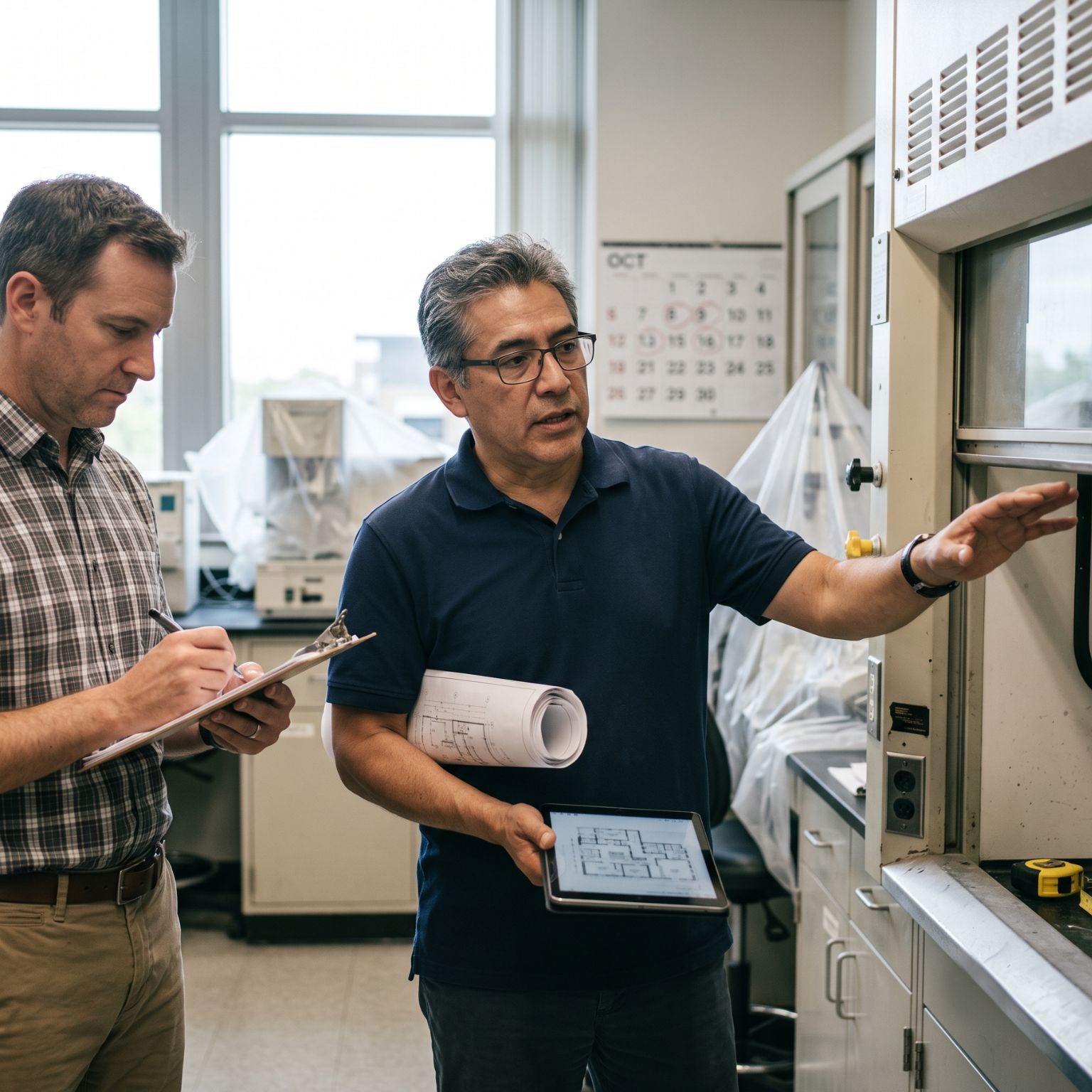
Your lab design consultant visits the site, meets with stakeholders, walks the existing space, and develops a specification over 3-4 weeks. This produces excellent results but does not scale. You have a limited number of design consultants, and dedicating one to every specification inquiry means you cannot respond to time-sensitive projects or smaller opportunities that still represent real revenue.
Here is how Needs Analysis replaces the room data spreadsheet for specific laboratory furniture scenarios.
A university is constructing a new science building with 40 teaching and research laboratories across chemistry, biology, physics, and engineering departments. The architect needs complete furniture specifications coordinated with five department chairs, the university facilities department, and the MEP engineering firm.
Without Lab Design Needs Analysis
Your design rep sends 40 room data sheets to the architect, who distributes them to five department chairs. Two chairs respond in a week with detailed requirements. One responds with "same as our current labs." Two never respond. The architect spends a month chasing responses and consolidating input. The MEP engineer's service locations do not match the furniture layout because the specifications were developed sequentially, not collaboratively. Two redesign cycles follow. Total specification time: four months.
With Lab Design Needs Analysis
The architect uploads the building floor plans and lab programming document. The AI creates room-by-room intake forms pre-populated with dimensions, room types, and default furniture configurations based on lab function. Each department chair receives a link showing only their labs, with lab-function-appropriate questions about workflow, chemical exposure, and special equipment. The MEP engineer receives service coordination sections linked to the furniture layout. All inputs sync to one consolidated project record. Complete specification from all stakeholders within six weeks.
A pharmaceutical company is renovating six QC laboratories to accommodate new testing capabilities. The renovation must maintain GMP compliance throughout, with chemical-resistant surfaces, specific cleanability ratings, seamless construction where required, and integration with existing HVAC and plumbing infrastructure.
Without Lab Design Needs Analysis
Your specification form covers general lab furniture options. The QC director fills in the testing capabilities but cannot specify the GMP surface requirements without guidance from your team. The facilities engineer has the existing MEP infrastructure details but does not know which services the new furniture configurations require. Three rounds of back-and-forth over six weeks to align furniture specifications with both GMP compliance and existing infrastructure.
With Lab Design Needs Analysis
The QC director selects "pharmaceutical QC lab" as the room function. The AI defaults to GMP-appropriate materials (chemical-resistant, seamless, cleanable surfaces) and generates the correct compliance fields. The director reviews, adjusts for specific chemical exposures in each lab, and shares the facilities section with the engineering team. The chatbot explains the difference between seamless and standard casework construction in terms of GMP cleaning requirements. Complete, GMP-aligned specification in two weeks.
A school district is modernizing science classrooms across eight middle and high schools. Requirements include student workstations, demonstration stations, chemical storage, ADA-compliant height adjustment, and durability standards appropriate for a K-12 environment.
Without Lab Design Needs Analysis
Your product spec sheets cover commercial and institutional lab furniture but do not address K-12 specific requirements: vandal-resistant construction, specific ADA requirements for student-height workstations, simplified utility connections for classroom settings, and chemical storage minimums for teaching labs. The district facilities manager cannot find answers to their specific questions in your general specification form. They contact three vendors. The vendor with the most education-specific intake process gets the specification first.
With Lab Design Needs Analysis
The facilities manager selects "K-12 science classroom" as the project type. The intake adapts to show education-specific fields: student vs. teacher workstation counts, age-appropriate height ranges, ADA student workstation requirements, durability ratings, simplified utility configurations, and chemical storage code requirements for educational facilities. The AI provides budget-appropriate material recommendations based on K-12 lifecycle expectations. Multi-school specification consolidated in one session.
Most chatbot companies sell you a platform and wish you luck. AI companies sell you a model and tell you to figure out the rest. Needs Analysis is neither of those things.
We design, build, deploy, and continuously optimize your entire laboratory furniture and casework intake process. The outcome you pay for is specific: qualified requirements data flowing into your CRM, collected automatically from your website visitors, without your sales team lifting a finger.
When AI handles the grind of requirements collection, your salespeople finally get to do the work they got into sales to do. They stop chasing spreadsheets and start building relationships. They stop being data entry clerks and start being trusted advisors. That is not a threat to your sales team. It is the biggest gift you can give them.

Our team studies your current laboratory furniture and casework intake workflow, from the spreadsheet or form you send today to the back-and-forth emails that follow. We identify where prospects drop off, which questions cause confusion, and what data your configuration or engineering team actually needs versus what you are collecting out of habit. Then we rebuild the entire experience from scratch, optimized for completion, not just data collection.

Every Needs Analysis deployment is custom. Your fields, your product logic, your conditional rules, your document types, your CRM mapping. We structure the intake to align with your actual laboratory furniture and casework configuration and quoting workflow, so the data that arrives in your CRM is immediately usable by your team. This is not a template. It is a custom-built intake system trained on your products, your industry terminology, and your sales process.
After launch, our team reviews completion data, identifies friction points, and refines the experience.


You get a sales channel that improves each month without taking up any of your team's time.
CAPABILITY
DIY APPROACH
NEEDS ANALYSIS
Design
Your team builds forms in-house
We design the entire intake experience
AI Training
You configure rules yourself
We train AI on your products and documents
Document Analysis
Not available
AI extracts data from uploaded architectural drawings, lab programming documents, equipment schedules, and room data sheets
Deployment
Your IT team integrates
We deploy within your ENGAGE chatbot
Monitoring
Your team reviews (if they have time)
Our team monitors completion rates daily
Optimization
Happens when someone has bandwidth
Continuous, data-driven improvement
CRM Integration
Your team maps fields
We configure routing, assignment, and field mapping
Follow-Up
Your team writes emails
We build targeted sequences for incomplete submissions
Accountability
Falls to whoever "owns" the form
We own the outcome: completed forms in your CRM
DIY APPROACH
Your team builds forms in-house
NEEDS ANALYSIS
We design the entire intake experience
DIY APPROACH
You configure rules yourself
NEEDS ANALYSIS
We train AI on your products and documents
DIY APPROACH
Not available
NEEDS ANALYSIS
AI extracts data from uploaded lab protocols, facility specifications, equipment inventories, and procedure documents
DIY APPROACH
Your IT team integrates
NEEDS ANALYSIS
We deploy within your ENGAGE chatbot
DIY APPROACH
Your team reviews (if they have time)
NEEDS ANALYSIS
Our team monitors completion rates daily
DIY APPROACH
Happens when someone has bandwidth
NEEDS ANALYSIS
Continuous, data-driven improvement
DIY APPROACH
Your team maps fields
NEEDS ANALYSIS
We configure routing, assignment, and field mapping
DIY APPROACH
Your team writes emails
NEEDS ANALYSIS
We build targeted sequences for incomplete submissions
DIY APPROACH
Falls to whoever "owns" the form
NEEDS ANALYSIS
We own the outcome: completed forms in your CRM
Your best lab design consultants do not just sell casework. They understand laboratory workflow at a level that transforms how scientists work. They redesign bench layouts that eliminate bottlenecks. They specify materials that prevent failures the client would never anticipate. They design labs that faculty members brag about to their peers, which generates referrals that no marketing campaign can replicate.

But your design consultants cannot do any of that if they are spending weeks coordinating room data sheets between architects, scientists, engineers, and project managers.
Needs Analysis does not replace your design expertise. It streamlines the data collection that precedes the design work. When AI handles the grind of multi-stakeholder coordination and room-by-room specification, your consultants get to do the work they got into lab design to do: create laboratories that advance science.
The consultant who walks into the design meeting already knowing the chemical profiles, the workflow patterns, the service requirements, and the budget constraints? That is not someone with an extraordinary ability to manage spreadsheets. That is someone whose intake process delivers the complete project picture before the first design session.
When your design team has bandwidth to think creatively, they do not just furnish rooms. They design research environments that attract faculty, win grants, and generate institutional loyalty. That is the work that turns one lab renovation into a 20-year institutional relationship.
Needs Analysis is an add-on to ENGAGE, so it inherits all of ENGAGE's integration capabilities and adds intake-specific connections for the laboratory furniture and casework industry.


Installs through your existing ENGAGE chatbot. No additional code, no separate widget, no IT project. If ENGAGE is live on your site, you can activate Needs Analysis within it.
Learn more about the ENGAGE chatbot platform
IMPLEMENTATION
We do not hand you software and disappear. Here is what goes into building a Needs Analysis deployment that actually works.

Phase 1
Before we build anything, we study what you are doing today. We review your current laboratory furniture and casework intake forms, spreadsheets, and questionnaires. We interview your sales and configuration teams about what data they actually need versus what they collect out of habit. We map the end-to-end process from inquiry to deliverable quote, identifying where prospects drop off, where data quality breaks down, and where your team spends the most time on back-and-forth.

Phase 2
We design the field sequence, conditional logic, and section grouping for optimal completion in your specific laboratory furniture and casework context. Every field gets plain-language descriptions and help text so prospects know exactly what is being asked. We configure autocomplete libraries from your product catalog and known values. We train the document analysis AI on your industry's document formats, ensuring high extraction accuracy from day one.

Phase 3
We run hundreds of test scenarios across different laboratory furniture and casework prospect types and use cases. We validate the accuracy of document analysis against your actual document formats. We test CRM integration and verify that data lands in the correct fields. We test follow-up workflows end-to-end. We provide a private preview for your team to try breaking it.

Phase 4
We activate Needs Analysis within your live ENGAGE chatbot, monitor real interactions during the first weeks, and make rapid adjustments based on actual prospect behavior. We establish baseline completion metrics and brief your sales team on the new lead flow.
Ongoing
We review completion data weekly, analyze performance monthly, and continuously train the AI as new document types and field patterns emerge. We update the intake as your products, pricing, or requirements change. Your needs analysis process stays current because we actively maintain it.
INVESTMENT
Needs Analysis is an add-on to Salesperson ENGAGE. Pricing is based on the complexity of your specific requirements collection process.

Number of room types and casework configurations covered

Complexity of material selection and chemical compatibility logic

Document types that need AI analysis (architectural drawings, programming documents, equipment schedules)

CRM integration complexity

Multi-stakeholder workflow requirements (architect, scientist, MEP, owner, GC)
Budget alignment and cost estimation features
Follow-up automation and collaborative workspace requirements
One-Time Setup
There is a one-time setup fee that covers the intake process audit, AI training, custom form design, CRM integration, and testing. This varies based on complexity, because a 15-field equipment sizing intake is fundamentally different from a 60-field technical assessment with document analysis.
Monthly Service
After launch, a monthly service fee covers continuous monitoring, optimization, AI retraining, follow-up automation, and ongoing support. This is not a software license that sits idle. It is an active service delivering completed intake forms into your CRM every month.
PROJECTED IMPACT
10-20% → 70-85%
Intake form completion rate
Before: 10-20%
3-10 business days → Under 15 min
Average time to complete intake
Before: 3-10 business days
3-6 per prospect → 0-1
Follow-up emails before completion
Before: 3-6 per prospect
2-4 hours → Near zero
Sales rep hours per intake
Before: 2-4 hours
5-15 business days → Same day to next business day
Time from inquiry to deliverable quote
Before: 5-15 business days
40-60% → Under 15%
Prospects lost to intake friction
Before: 40-60%
"This problem plagued our sales team for years. We knew AI could solve it, but we had no idea where to start. It honestly felt like a pipe dream. Then we started working with Salesperson Inc. and were shocked at how quickly they built it and how well it worked. Their team are seasoned sales funnel experts, not IT people or AI engineers. It is like talking to a colleague who actually cares about the results of your business."
Laboratory Furniture and Casework Manufacturer
If the answer involves months of coordinating room data sheets between architects, scientists, and engineers, you already know the problem.
Needs Analysis replaces the multi-month specification process with an intelligent, multi-stakeholder system that collects, coordinates, and validates lab furniture requirements automatically.
Right now, an architect is on your website with a 30-lab science building project. Will your intake process capture the specification, or will the architect specify a competitor whose process moves faster?
Stop conducting a needs analysis the hard way. Let the AI handle the process while your team handles the deals.