The managed revenue operating system for lab equipment and consumables companies. Powered by Salesperson AI.
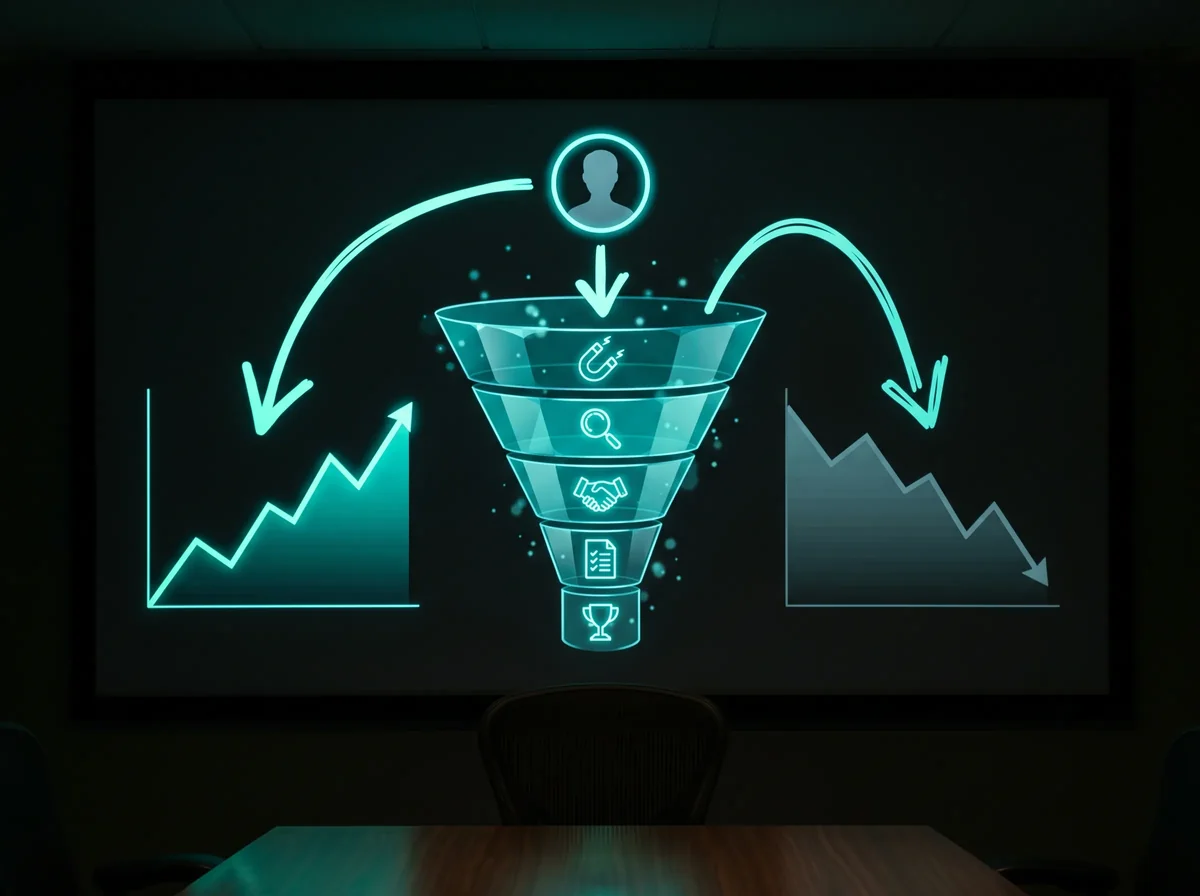
Salesperson OS turns the data scattered across your ERP, CRM, quotes, and inboxes into one reviewed action plan: which customer to contact, which promise is due, which deal actually moved, what it's all worth, and whether the action happened.
Real-time response. Daily execution. Weekly revenue control.
Built exclusively for lab equipment, scientific instrument, reagent, and consumables manufacturers and distributors. And built now for a reason: a system this sophisticated was not possible before mid-2026. Your competitors are not using it yet.

15 years in lab-sector commerce
Rules-governed AI with human oversight
First actionable reports in 30 days
Measured in won revenue and gross profit

Salesperson OS is a managed revenue operating system for laboratory equipment and consumables companies with $10 million to $250 million in annual sales. It connects a company's ERP, CRM, quoting, and activity data, finds the revenue signals hiding in that history, verifies each one against counter-evidence, assigns every action an owner and a due date, and reports whether the action happened and what revenue resulted. Salesperson builds and operates the entire system; the client's sales team receives finished, verified work, not another software login.
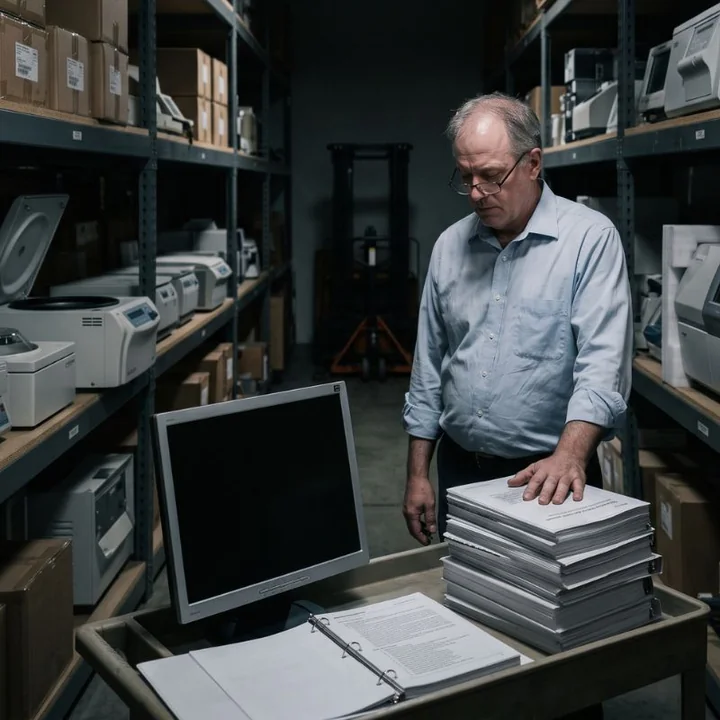
Sales-analysis tools for lab and distribution ERPs are not new. Bolt-on BI packages for systems like Epicor Prophet 21 have existed for years, some for a decade. Ask around your industry and you will find the same story everywhere: the company bought one, the COO or Sales Director spent months configuring, testing, and building reports, adoption never came, and the license quietly lapsed. The tools put the mountain of work on the buyer. That is why they fail.
Salesperson OS is different in two ways, and both matter.
1
First, it is managed. Salesperson configures, tests, operates, and improves the system. Your team's job is to work the actions and tell us what happened.
2
Second, it is new because it had to be. The counter-evidence review at the core of OS, where every candidate opportunity is checked against open orders, converted quotes, replaced items, account reclassifications, and years of messy CRM notes before a rep ever sees it, demands a level of AI reasoning that did not exist before mid-2026. This system could not have been built a year ago. The decade-old bolt-ons were not lazy; they were early.
Which means right now, Q3 2026, there is a window. Your competitors are running the same aging reports they ran five years ago. The companies that put an operating system on their revenue first will take share from the ones that wait, one recovered reorder and one rescued quote at a time. Opportunities to buy an advantage this unfair, this early, come along about once in a career.
OS is built for a specific kind of company. If this is you, the fit is strong:
Lab-industry sellers:
manufacturers and distributors of laboratory equipment, analytical instruments, clinical analyzers, life-science tools, reagents, standards, controls, calibrators, consumables, parts, and related service.
$10M to $250M in annual sales.
Below $10M, one strong owner-operator can usually hold the commercial picture in their head. Above $250M, see our Enterprise engagement below.
Five or more salespeople
who can work the actions OS produces. The system generates a ranked queue for every rep; it needs reps to execute.
At least two years of sales history.
Reorder cadence, account-risk baselines, and quote-conversion patterns are modeled from your actual transactions. Two years is the floor for trustworthy signals.
An ERP or CRM system of record.
We work with NetSuite, SAP Business One, Microsoft Dynamics 365, Epicor Prophet 21, Infor, Sage, Acumatica, Odoo, Fishbowl, OrderTime, and QuickBooks on the ERP and order side, and Salesforce, HubSpot, Microsoft Dynamics 365 Sales, Zoho, and Pipedrive on the CRM side. Your systems do not need to talk to each other. Many clients run an ERP, a separate CRM, and separate invoicing or accounting software; OS ties the data together into one commercial model.
OS is probably not your first step if you have under two years of clean history, fewer than five reps, no willingness to establish a recurring data feed, or if leadership mainly wants a call-count leaderboard. OS operates the commercial process; it is not employee surveillance software.
Here is what this week looks like inside most lab equipment and consumables companies.
Leads arrive through web forms, chat, trade shows, referrals, and phone calls. Order history lives in the ERP. Opportunities live in the CRM. Quote status lives somewhere else, or means something different to every rep. Product relationships live in the heads of product managers. Installed-base knowledge sits in a spreadsheet. Service history sits in another system. Contacts leave, item numbers get superseded, and one laboratory buys through three ship-to locations under two account numbers.
The data exists. The commercial decision does not.
So managers tell reps to "review their leads," "clean up the pipeline," and "follow up on quotes." Reps run aging reports and rely on memory. The best reps catch some of it. Busy reps catch less. Finance sees the miss after the revenue is gone.
Meanwhile, in the gaps between systems:

A serious buyer submits a request and gets an autoresponder, then silence.

A rep promises a revised quote for Friday. The promise dies in a call note.

Applications owes a compatibility answer, operations owes an ETA, and the customer waits while everyone assumes someone else owns it.

Five follow-up emails are logged on a deal that has not moved an inch.

A placed analyzer stops pulling through the consumables it should.

A reagent customer misses its reorder cycle and nobody calls.

A rep chases a "stalled" quote that already converted under different SKUs.

A late-stage deal stays in the forecast after its close date slips for the third time.
These are not dashboard problems. They are operating problems. OS closes the gap between the data your company has, the action someone should take, the commitment someone must own, and the outcome leadership needs to measure.
?
Which serious leads are still waiting for a real human response?
?
What did we promise customers last week, and what remains undelivered?
?
Where is the customer waiting on us?
?
Which deals are genuinely advancing, and which only contain activity?
?
Which quotes were actually delivered, followed up, and reviewed with the customer?
?
Which repeat purchases are due right now?
?
Which customers, sites, products, and analyzer platforms are quietly declining?
?
Which installed instruments are not producing the expected consumable and service revenue?
?
Which close dates moved, and what customer evidence caused the change?
?
Which situation deserves a manager, applications specialist, or executive this week?
?
What revenue and defensible gross profit should we expect, and what evidence supports it?
Salesperson OS answers these from one governed commercial model, every week.
We do not hand your team a login and ask them to build reports. Salesperson builds and runs the data model, the lab-specific product taxonomy, the opportunity and lead logic, the AI-assisted context review, the counter-evidence checks, the commitment tracking, the human quality control, and the weekly delivery.
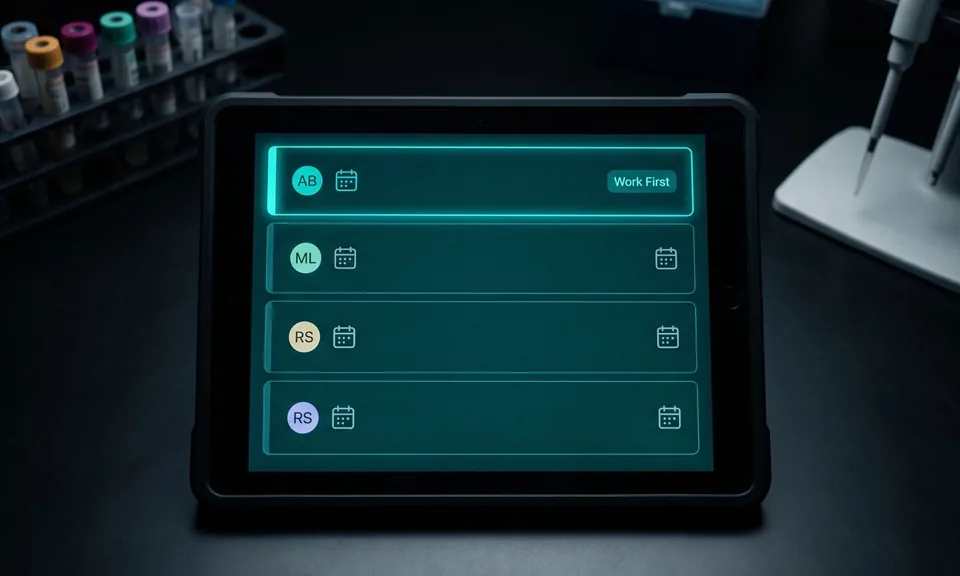
one prioritized queue across leads, commitments, quotes, reorders, account risk, expansion, and renewals; a "Work First" list that protects rep capacity; an owner, due date, evidence trail, and next action on every item; revenue and gross-profit ranges where the data supports them; suggested openers, emails, and discovery questions; customer briefs; and executive visibility into what was won, what was missed, and why.
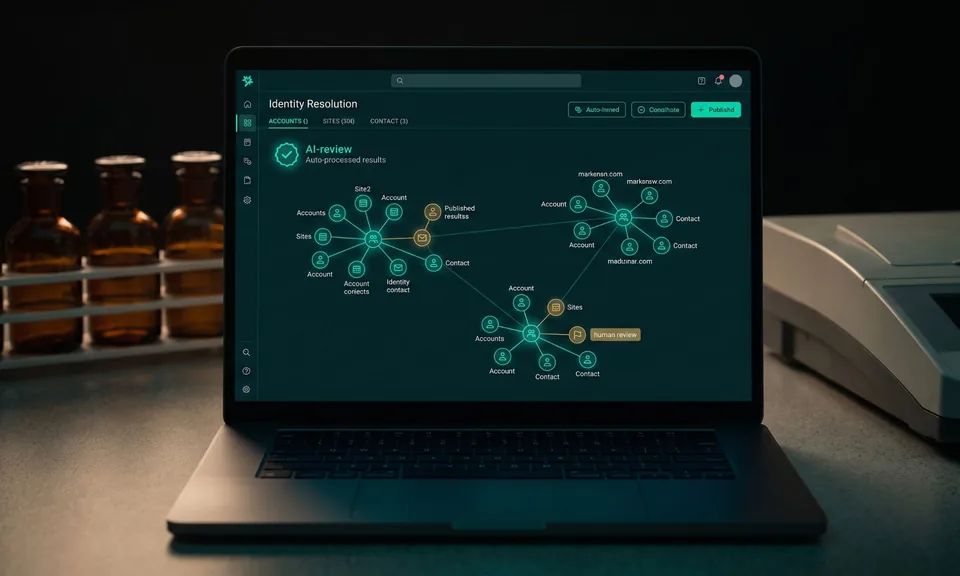
source-data profiling and reconciliation, identity resolution across accounts, sites, contacts, quotes, orders, items, and territories, product and platform relationship modeling, scoring and suppression rules, AI review, human review of ambiguous or high-risk items, QA that can stop publication, and the feedback loop that makes next week smarter than this week.
You are not buying revenue software. You are hiring a team to operate a commercial discipline on your behalf.
OS organizes the commercial operation into three connected layers. They share one identity model, one evidence standard, one commitment ledger, and one feedback loop.
1
Runs from the transaction history you already have.

Overdue reorders.
Site-level and product-level reorder cadence modeled from actual purchase history: intervals, variability, quantities, lead times, and the date the customer must act to avoid a stockout. Open orders, active quotes, and standing-order behavior are checked before anything reaches a rep.

Quote recovery.
Quote follow-up as reconciliation, not a date filter. Every aged quote is checked against linked orders, document totals, partial conversions, SKU substitutions, and later purchases under other accounts or sites. A won quote is never published as leakage.

Account risk.
Deterioration detected across revenue, gross profit, order count, SKU breadth, and platform breadth, compared against each account's own history, with the innocent explanations checked first: consolidation, open orders, analyzer replacement, seasonality.

Installed base growth.
A client-specific product-relationship layer built from verified platform relationships, equipment placements and their expected pull-through, and purchase behavior at comparable sites. Unverified relationships go to a validation queue, not to the field.

Lifecycle and renewal.
Warranties approaching expiration, service and reagent agreements up for renewal, instruments nearing end of life, rising service activity without contract coverage, and the date capital-budget conversations should begin.
2
Activates as lead and activity data connects.

Lead response.
Every legitimate inquiry matched to the right account, routed to the right owner, and answered by a real human inside an agreed SLA. An autoresponder does not count. OS distinguishes inquiry received, assigned, first human attempt, first useful response, and next step agreed.

The Commitment Ledger.
The easiest promise to miss is the one buried in a call note: "I'll send the revised quote Friday." "Applications will confirm compatibility." "Operations will confirm the ETA." OS turns those promises into structured commitments with an owner, a counterparty, a due date, a blocker, completion evidence, and an outcome. It becomes the shared execution spine across leads, quotes, reorders, and renewals.

Deal momentum.
Activity is not momentum. Five emails can leave a deal exactly where it started. OS looks for evidence the buyer moved: requirements confirmed, demo completed, quote reviewed, procurement engaged, decision event scheduled. Deals with activity but no progression, no dated next event, or slipping close dates are surfaced for intervention.

Territory development.
Uncovered sites and departments at high-value accounts, single-threaded relationships, orphaned demand, unaccepted partner referrals, and dormant accounts with a credible reason to re-enter. Development from known evidence, before anyone buys another list.
3

Forecast control.
OS reconciles the CRM pipeline with quotes, orders, buyer milestones, and commitments before leadership relies on it. Stages unsupported by evidence, close dates that slipped without a customer event, duplicate opportunities, and single-threaded late-stage deals are challenged. Forecast confidence comes from commercial evidence, not stage labels.

Manager interventions.
The short list of situations where management creates leverage: a high-intent lead unworked, a deal stalled on an internal approval, a pricing decision requiring authority, a sensitive account-risk conversation needing executive presence. Each intervention carries the value at stake, the evidence, the recommended action, and the result to inspect next week.
Module availability: every module above is live and demonstrable today; ask to see any of them on the demo. Which modules run for your company depends on which data sources you connect: the revenue-signal layer runs from history most companies already have, while execution and management modules use lead and activity data as it is validated. Where coverage is incomplete, OS reports "not measurable" instead of turning missing records into conclusions about employees.
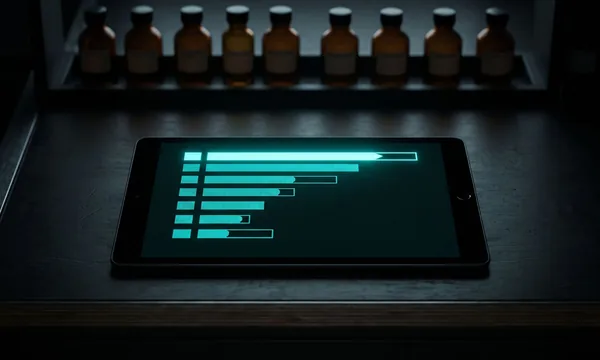
Repeatable, auditable models score every candidate on signal strength, value, recoverability, and actionability. Estimates use ranges built from your actual quantities, prices, and costs. When cost cannot be defended, margin is labeled unknown rather than invented.
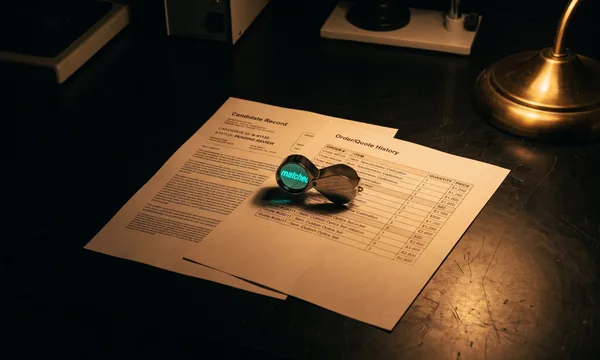
Before publication, the system asks what could make the signal wrong: open orders, converted quotes, account reclassification, retired analyzers, replaced items, territory conflicts, do-not-contact evidence, prior feedback. Candidates contradicted by stronger evidence are suppressed with the record kept for audit. Ambiguous or high-value items get human review before a rep ever sees them.
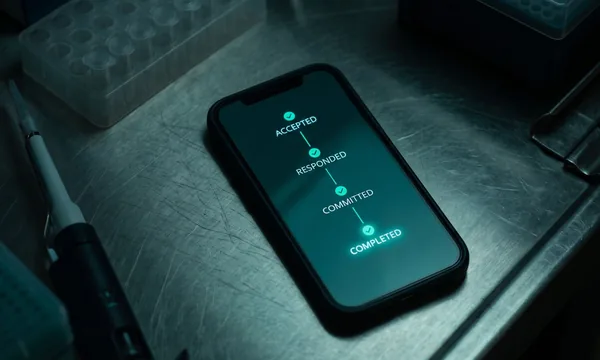
After publication, OS tracks whether the action happened: accepted by the owner, responded to by a human, committed to a dated next step, completed with evidence, and converted into revenue. This is the difference between producing recommendations and operating a commercial system.
Each rep receives one capacity-controlled daily plan across every module, arbitrated in a consistent order: urgent supply or analyzer continuity first, then leads approaching their response SLA, commitments due, time-sensitive quotes, overdue reorders and account risk, renewals, expansion, and development.
When several signals touch the same laboratory, OS combines them into one coordinated conversation plan. It never tells three people to call the same lab with three disconnected messages.
Everything a rep would otherwise spend 15 to 45 minutes assembling: the owner and why them, the reason to act now with its evidence and the counter-evidence that was checked, revenue and gross-profit ranges with confidence kept separate from priority, the recommended contact and backup with usable phone and email, a call opener, a short email, discovery questions, the known blocker, the next-best action, and the commitment created with its due date. Plus structured feedback fields, so an invalid signal never returns week after week.
The rep gets the action. The manager gets the reasoning and the exceptions. Finance gets the economics. The system gets the feedback it needs to improve.
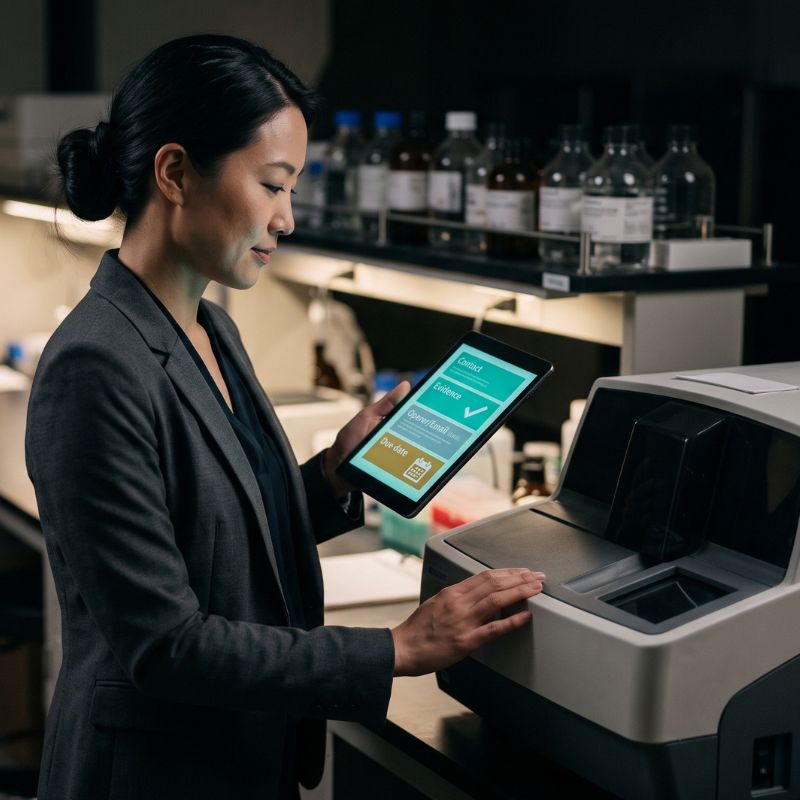

a daily flight plan with "Work First" marked, capped to protect capacity, with the full execution package on every row.

an exception-based control room showing SLA risk, overdue commitments, customers waiting on the company, activity without progression, deals needing approval, and rep-capacity conflicts. Coaching from exact evidence, not activity counts.

revenue protected, recovered, expanded, and renewed; actual won revenue and gross profit; forecast movement with reasons; value by rep, territory, product, platform, and channel; model accuracy and invalid rate.

stable identities, run lineage, a governed vocabulary for leads, commitments, and outcomes, and data-quality problems converted into visible, prioritized work queues.

which commitments depend on their teams, which product relationships need validation, and where platforms and installed assets are at risk.
The fastest way to kill a sales system is to make reps record the same information in two places. OS never requires double entry. Feedback flows one of two ways, chosen to match how your team already uses its CRM:
Reps record outcomes in a short structured note format inside the CRM they already use. OS extracts those notes before generating the next weekly run. Nobody opens a second tool.
Reps update status in the OS delivery itself, and OS writes the note back to your CRM the following week, so the CRM record stays complete without the rep touching it twice.
If your team lives in the CRM, we go CRM-first. If CRM hygiene has always been a struggle, we go OS-first and improve your CRM data as a side effect. Everything OS does is built for the sales team that has to use it, because forcing a dramatic change in daily working style is how bolt-on tools end up unadopted.
And if you are reading this thinking "our reps are terrible at CRM notes, this will never work for us": it will. OS does not depend on notes. The analysis is driven by your transaction data: orders, quotes, customers, items, and activity records that exist whether or not anyone writes a word. Where notes exist, OS absorbs them as additional context and the analysis gets sharper. Where they do not, the system runs at full strength on the data your business generates automatically. We know the realities of B2B sales teams; the system was designed around them, not around an idealized CRM that no company actually has.
Different commercial decisions run on different clocks.
Cadence
What runs
Real time (where integrated)
New lead assignment, response SLA alerts, urgent supply and analyzer-continuity issues
Daily
Commitments due, leads without a human response, quotes and deliverables due, manager interventions
Weekly
Revenue-signal generation, counter-evidence review, rep and manager prioritization, forecast-change review, outcome ingestion
Monthly and quarterly
Cohort conversion, recurring-revenue continuity, installed-base attachment, territory development, forecast accuracy, model calibration
Generic sales tools understand contacts, stages, and activity counts. Lab revenue depends on another layer: capital equipment that creates years of reagent, control, calibrator, service, and parts pull-through; reorder cadence that moves with test volume, pack size, lot dating, and budget timing; the same laboratory appearing as a distributor account, a direct account, a parent health system, and four ship-to sites; substitutions and supersessions that make naive SKU matching misleading; and channel structures where a distributor must separate end-user demand from reseller behavior while a manufacturer reads distributor-sourced signals without creating conflict.
For 15 years, Salesperson has worked with commercial teams at lab equipment, scientific instrument, and consumables companies. That experience is built into the questions OS asks before an action is published, not added to a prompt as vocabulary.
Salesperson OS is not a concept. It runs today in production for a US laboratory equipment and consumables distributor. The first deployment ingests, reconciles, and operates on:

(logs and emails), each cross-referenced to its customer and contact

with line items across more than three years of transaction history

with line items, reconciled against orders

across 48,000+ distinct accounts and 58,000+ ship-to and bill-to locations


mapped to product groups, vendors, and costs
between the OS data mirror and the source system, verified entity by entity, every night
That last line matters most. Before OS publishes a single recommendation, its copy of your commercial data is reconciled against your system of record down to the row. Analysis built on a drifting copy of the truth is how sales teams learn to ignore a tool.
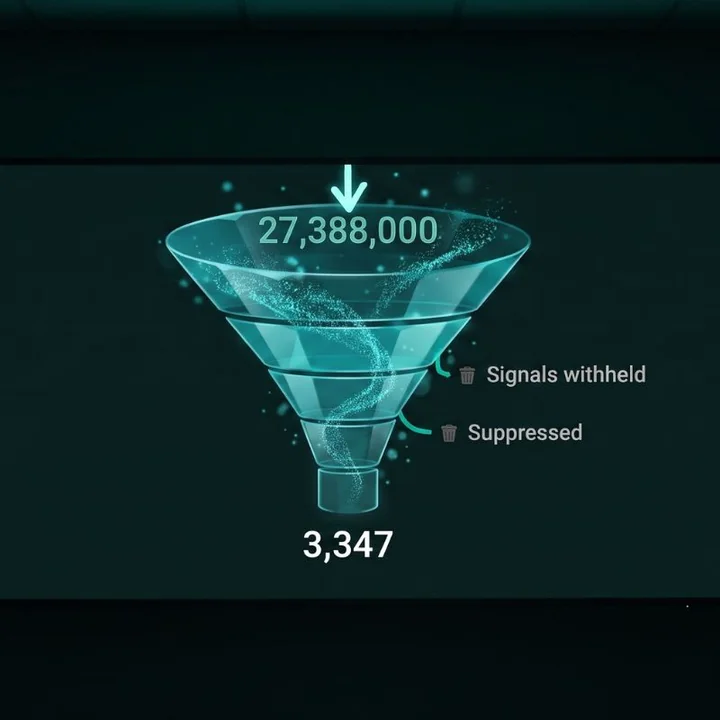
In one production weekly run, OS generated 697 candidate opportunities across reorders, quote recovery, account risk, and cross-sell from those records. The final rep queue contained 269 published actions, 97 at high confidence. Sixty-seven signals were withheld because an open order already covered the need. Twenty-four more were suppressed by counter-evidence. The final hard-guard violation count was zero.
More alerts are easy. Recommendations a sales team can trust are hard. The filtering is the product.
Aging reports and spreadsheets
Distributor sales intelligence software
Building it in-house
Salesperson OS
Who does the work
Your reps, manually
Your reps, inside another login
Your data team, indefinitely
Salesperson's team
Lab-industry product logic
None
Generic, horizontal
Only if you build and maintain it
Built in
Checks counter-evidence before recommending
No
Rarely
Depends on the build
Yes, every action
Tracks promises and next steps to completion
No
No
Rarely survives version two
Yes, the Commitment Ledger
Won quotes chased as "leakage"
Constantly
Sometimes
Depends
Never published
Human review of high-risk actions
No
No
Maybe
Yes
Improves from rep feedback
No
Limited
Depends
Weekly, by design
Reproducing OS internally means running data engineering, identity resolution, statistical modeling, lab-product taxonomy, quote forensics, execution telemetry, AI review, human QA, and closed-loop feedback at the same time, every week, after the excitement of the first dashboard wears off. That last part is where internal builds fail. The value is not one algorithm. It is the managed system around it.
$10M to $250M in annual sales

 6-month minimum commitment
OS starts at $7,500 per month with a six-month minimum commitment for companies at the smaller end of our range, around $10 million in annual sales with five reps. Pricing scales with data-source complexity, sales-team size, product-catalog complexity, and the modules in scope.
Put that number in context. $7,500 a month is what an entry-level SDR costs. For the same money, OS gives you a sales director with 20 years in lab-industry commerce, a data analyst who specializes in lab commercial data, and an AI and database engineering team, all working your revenue every week. You could not hire this team for ten times the price, and you do not have to.
Why six months? Two reasons. First, B2B lab sales cycles are long; six months is the honest window in which recovered reorders, converted quotes, and retained accounts show up as closed revenue you can attribute. Second, the foundation build is substantial: every company's data, product relationships, territories, and commercial definitions are unique, and we build the operating model around yours, not around a template. Your first actionable reports go live within 30 days; the system then collects outcomes and revises continuously through the built-in feedback loop.
OS is measured in won revenue, won gross profit, and invalid-signal rate, and those numbers appear on your own executive dashboard.
Over $250M in annual sales

 6-month co-implementation
Organizations at the scale of Thermo Fisher Scientific, Avantor (VWR), Thomas Scientific, or Grainger already have data analysts, IT departments, and revenue operations teams. For them, we run OS differently.
Enterprise starts at $20,000 per month and is a six-month co-implementation, not an open-ended subscription. We build the operating system with your in-house data and IT teams, on your infrastructure, under your security and governance standards. During the engagement we transfer the methodology: the identity models, the opportunity logic, the counter-evidence framework, the QA guards, and the operating cadence. By the end, a designated member of your revenue operations team runs the system independently, with Salesperson available for advisory support.
Framed as what it actually is, a roughly $120,000 investment that leaves you with custom-built software deployed on your own infrastructure and a trained team to run it, this is one of the smallest software purchases an organization your size will make this year, against the revenue it touches. You keep the system, the models, and the capability. We are not trying to become a permanent line item inside a company that already employs the people to run this.

You know revenue is slipping through the cracks; you just cannot see which cracks. OS finds it in the history you already have, without hiring analysts or making your reps part-time spreadsheet operators. Your Monday meeting changes from "did everyone review their book?" to a ranked list with owners and due dates.

You get one operating rhythm across lead response, pipeline, recurring revenue, and installed base, and a defensible answer to "what is the team actually working and why." Coaching moves from activity counts to exact evidence. Forecast conversations move from stage optimism to buyer milestones and kept commitments.

You see opportunity value and defensible gross profit together, with margin-unknown separated from margin-known. You see the internal blockers delaying revenue. You get opportunity-level lineage from signal to won dollars, which is what makes the ROI conversation an accounting exercise instead of an argument.

You inherit a governed commercial model with stable identities, documented definitions, and visible data-quality queues, instead of another undocumented spreadsheet empire. In the Enterprise engagement, you inherit the whole system and the training to run it.

The models differ and OS knows it. Manufacturers emphasize installed base, direct-versus-channel behavior, distributor lead follow-through, and equipment-to-consumable pull-through. Distributors emphasize multi-brand catalogs, substitution, share of wallet, availability, and end-user classification. OS classifies accounts so resellers, end users, and channel partners are never treated as the same kind of buyer.
quoted demand that never converts and never gets deliberately closed, leaving recoverable revenue unworked.
the structured record of every promise made to or by a customer, with an owner, due date, completion evidence, and outcome.
the recurring reagent, control, calibrator, and parts revenue an installed instrument should generate over its life.
the actual purchasing rhythm of a specific product at a specific customer site, measured from history rather than assumed from round numbers.
the time from a buyer's inquiry to the first useful human response. Autoresponders do not count.
the verification step that looks for reasons a sales signal is wrong before a rep acts on it, such as an open order that already covers an "overdue" reorder.
the portion of a customer's total category spend your company captures.
OS's answer when the data cannot support a conclusion. Missing activity records are never converted into claims that an employee failed to act.
Lab equipment, instrument, reagent, and consumables manufacturers and distributors with $10 million to $250 million in annual sales, five or more salespeople, and at least two years of sales history in an ERP or CRM. Companies above $250 million are served through the Enterprise co-implementation.
OS starts at $7,500 per month with a six-month minimum commitment for companies around $10 million in annual sales with five reps, scaling with data complexity, team size, and modules in scope. That is the cost of one entry-level SDR, for a seasoned lab-industry sales director, a specialized data analyst, and an AI engineering team working your revenue weekly. Enterprise co-implementations for companies over $250 million start at $20,000 per month for a six-month engagement, roughly $120,000 for custom-built software on your infrastructure plus a trained internal team.
A live walkthrough of the full operating system running on a complete synthetic company: a manufacturer that sells equipment, its consumables, and service contracts, with years of realistic data. Because the structure mirrors the lab market exactly (instruments, reagents and supplies, support), you will see precisely how every module applies to your own business, without waiting for your own data to be connected.
No. Either reps record outcomes in a short structured note in the CRM they already use and OS extracts it weekly, or reps update OS directly and it writes the note back to your CRM the following week. We pick whichever matches how your team already works.
Then you are like most B2B sales teams, and OS still works. The analysis runs on transaction data that exists regardless of note-taking discipline: orders, quotes, customers, items, and logged activity. Notes are additional context, not a requirement. When they exist, OS absorbs them and the recommendations get sharper; when they do not, the system runs at full strength on the data your business already generates.
NetSuite, SAP Business One, Microsoft Dynamics 365, Epicor Prophet 21, Infor, Sage, Acumatica, Odoo, Fishbowl, OrderTime, and QuickBooks on the ERP and order side; Salesforce, HubSpot, Microsoft Dynamics 365 Sales, Zoho, and Pipedrive on the CRM side. Your systems do not need to be integrated with each other. OS routinely ties together an ERP, a separate CRM, and a separate accounting or invoicing system into one commercial model.
No. A dashboard displays what has already been modeled. OS owns the work before and after the dashboard: reconciliation, identity resolution, opportunity detection, counter-evidence review, commitment tracking, prioritization, action creation, execution verification, QA, and recalibration.
OS operates the commercial process. It does not turn incomplete data into performance conclusions. Rep-level response and execution measures are published only when the relevant channels are properly instrumented, and missing evidence is labeled not measurable rather than counted as a miss. If leadership mainly wants a surveillance leaderboard, OS is the wrong product.
Cross-account, cross-site, quote-to-order, document-total, part-number, and substitution checks run before publication. A covered transaction is never sent to a rep as an opportunity simply because identifiers differ.
A customer-facing communication from a real person that addresses the inquiry or moves it toward a useful next step. Autoresponders, routing messages, and system confirmations do not count, and OS knows the difference.
From your actual historical quantities, prices, and finance-approved costs, shown as ranges. When cost data cannot be defended, the opportunity is still published where relevant, with margin labeled unknown. OS does not manufacture precision from bad data.
Most commercial data is messy. OS makes the problems visible and prevents known defects from silently becoming sales instructions. If your sources cannot yet support trustworthy operation, the first engagement is a data-readiness audit rather than a live service.
Your first actionable reports go live within 30 days. From there the system collects outcomes from your team and revises continuously through the built-in feedback loop; that is why the feedback mechanism exists. The six-month commitment exists so the ROI is measured in closed revenue across a real B2B sales cycle, not in a demo.
Concentrated input from commercial, data, finance, and product owners during the build. After launch: manager review, rep execution, and short structured feedback. Salesperson owns the weekly production.
A strong team can build pieces. The hard part is operating data engineering, lab-product taxonomy, quote forensics, execution telemetry, AI review, human QA, and feedback loops together, every week, indefinitely. If you have that team, look at the Enterprise engagement: we will build it with them and hand it over.
Not how many rows are in your CRM. Not how many calls were logged. How many serious leads reached a human. How many customer promises were kept. How many deals hit a real buyer milestone. How many evidence-backed actions reached the right rep with the right customer, timing, contact, value, and words.
That is what Salesperson OS operates.
On the call, we will walk you through the complete operating system live, running on a full synthetic company that sells equipment, consumables, and service, the exact structure of your business. You will see the rep queues, the evidence behind each action, the Commitment Ledger, and the executive view, on realistic data, applied directly to how a company like yours sells. Then bring the report your managers review every Monday, and we will show you where it breaks.
Not a slide deck. Not a generic AI pitch. The real system, on real data, for your exact type of company.