The receipts, the rewrites, and the reader stories that made the past 24 months feel like the book did the job we wrote it to do.
EXECUTIVE SUMMARY
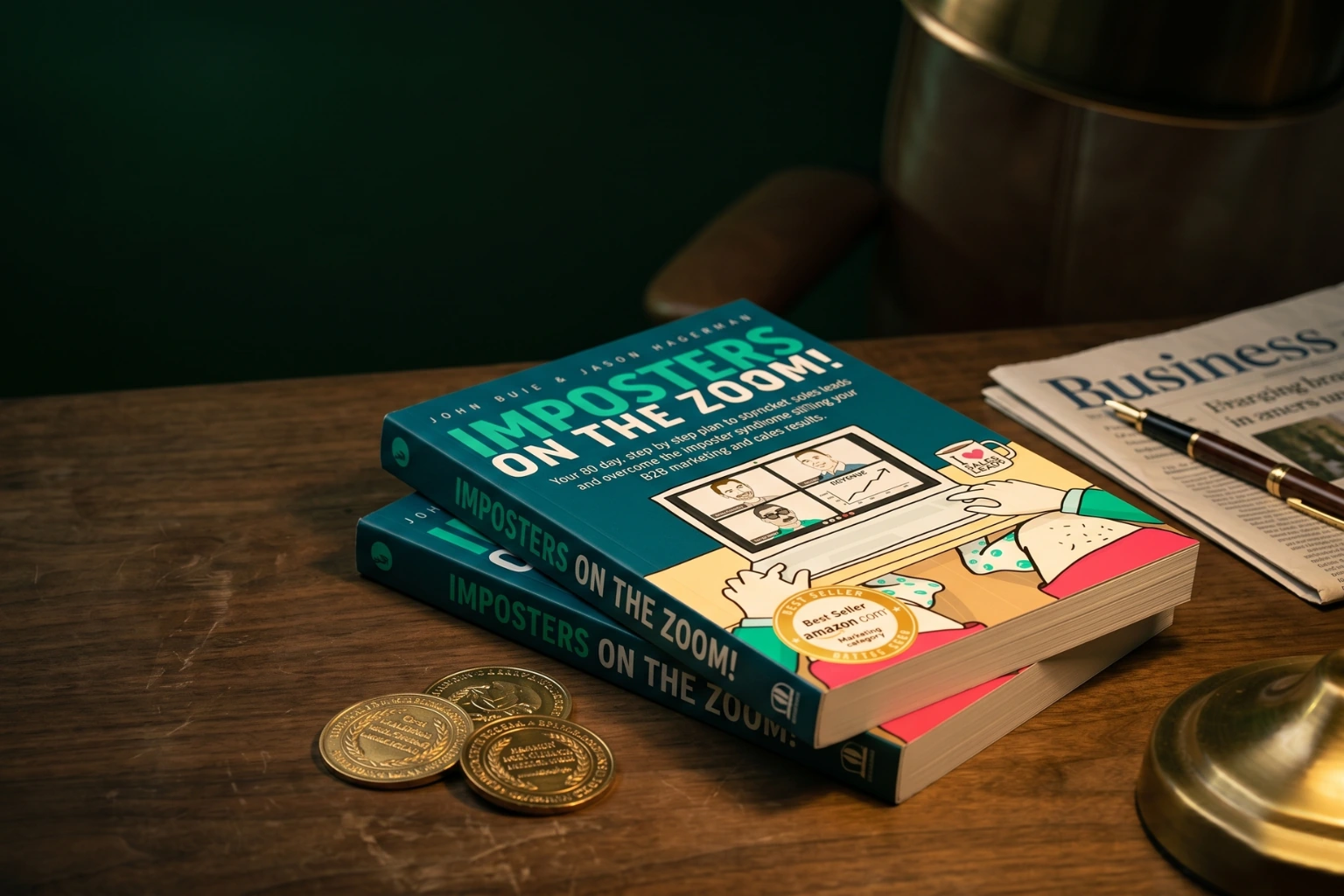
On June 1, 2024, Jason Hagerman and I published Imposters on the Zoom: The B2B Sales Lead Generation Methodology. Two years later, the book has hit Amazon Best Seller in the Marketing category, collected five major literary awards, been featured in five tier-one business publications, and maintains a 4.69 out of 5 rating across 24 written reviews on Goodreads. The methodology it documents continues to drive measurable results for the B2B operators who apply it. This anniversary retrospective covers the receipts the book has earned, the arguments inside it that held up, the predictions that got rewritten by the past 18 months, and the reader stories that confirmed the book is still doing its job, two years on, in rooms we will never be in.
Key Takeaways:
Amazon Best Seller in Marketing — Imposters on the Zoom hit Amazon Best Seller in the Marketing category during its 2024 launch window.
Five major book awards in year one — The book won five major book awards in its first year: Readers' Favorite Finalist, Literary Titan Gold, Nonfiction Authors Association Silver, BookAuthority Top 20 of 2024, and Pacific Book Review Notable Book.
Five tier-one press features — Five tier-one business publications covered the book and methodology: Entrepreneur Asia Pacific, Mashable, HackerNoon, TechTimes, and Fast Company SA covered the book and methodology.
4.69 out of 5 on Goodreads — The book maintains a 4.69 out of 5 rating on Goodreads across 26 ratings, with 24 readers taking the time to write a full review.
Core thesis held up — The core thesis (imposter syndrome in B2B sales and marketing is structural, not personal) has aged well across two years of reader feedback.
AI chapter aged best — The AI-for-buyer-personas chapter, considered a fringe argument in 2023, is now the default approach across B2B marketing teams in 2026.

The Two-Year Scorecard
Two years ago this week, Jason Hagerman and I published Imposters on the Zoom: The B2B Sales Lead Generation Methodology. The premise was direct. Imposter syndrome in B2B sales and marketing is not a confidence problem. It is a documentation problem. The cure is not affirmations. It is a six-step methodology written down clearly enough for any person on a B2B revenue team to follow on a Tuesday morning.
We were not sure who would read it.
Two years on, the answers are clearer than we expected.
The book hit Amazon Best Seller in Marketing during its launch window. It collected five major book awards in its first year. It was featured in five tier-one business publications. It holds a 4.69 out of 5 rating on Goodreads, with 24 of 26 readers taking the time to write a full review.
The deeper answer is in the reader stories. The marketing manager who used the book to defend her budget at a board meeting where she had previously felt outgunned. The procurement officer at a regional industrial distributor who used it to restructure how his company evaluated suppliers. The owner of a B2B chemical distributor who handed the book to his entire team and rebuilt their lead generation operation out of chapter four.
The book did its job.
This retrospective covers the receipts, the arguments that held up, the predictions that got rewritten, and where the methodology lives now.
Five Awards, In Detail
The awards are not the work. They are the signal that other people, with no skin in the game, validated the work. We are grateful for every one of them.

Amazon Best Seller in Marketing
The book reached bestseller status in the Marketing category on Amazon during its launch window in 2024. Bestseller status is short-lived by design, but the rank during launch is the rank that signals product-market fit to every reader, reviewer, and journalist who looks the book up afterward.

Readers' Favorite Finalist
Top five finalist in the 2024 International Book Awards, Non-Fiction: Marketing category. Reviewer K.C. Finn called the book a valuable resource for anyone looking to thrive in the competitive world of B2B marketing and sales and praised the authors' comprehensive approach to lead generation and overcoming imposter syndrome.

Literary Titan Gold Book Award
The organization's highest honor for nonfiction works that excel in writing, research, and presentation. Their reviewer praised the book's robust, detailed, and highly specific advice on practical implementation, from leveraging AI to create detailed buyer personas to handling the intricate dynamics of B2B sales.

Nonfiction Authors Association Silver Book Award
The NFAA recognized the book as an innovative approach for B2B businesses to increase their profits, with content that is compelling and rewarding, particularly for its target audience. They also added the book to their recommended reading list for B2B leaders.

BookAuthority Top 20
Selected for BookAuthority's list of the 20 Best New Sales Lead Generation Books to Read in 2024. BookAuthority's curation is driven by editorial review and reader sentiment, which made the inclusion especially meaningful.

Pacific Book Review Notable Book
Reviewer Christina Avina called the work a remarkable job of crafting a straightforward yet entertaining guide for readers in the B2B market and noted that the personable way the authors wrote this book allows readers to feel connected to the authors and their own experiences.
Five Press Features, In Detail
In the year after launch, the book was covered by five tier-one business publications.

Entrepreneur Asia Pacific
Ran "How to Treat Imposter Syndrome In B2B Marketing & Sales Roles" by Liam Keeney on September 20, 2024. The piece focused on the book's argument that imposter syndrome in B2B is structural rather than personal, and on the scaffolded learning approach the methodology uses to convert it into measurable competency.

Fast Company SA
Ran "Thriving in B2B Lead Generation Amid Remote Work" by Georgette Virgo on January 14, 2025. The angle was how the documented six-step methodology functions as a standard operating procedure for remote and hybrid B2B marketing and sales teams, with quotes from Jason and me on how documented systems replace in-office oversight.

TechTimes
Ran a feature by Georgette Virgo on January 30, 2025, on how the methodology in the book was redefining B2B customer engagement, with sections on relationship-building, KPI design, and AI-driven lead generation.

Mashable
Ran "High Sales Leads and Overcoming Imposter Syndrome: The New Marketing Sales Lead Book Imposters on the Zoom," covering the methodology and the people behind it.

HackerNoon
Published a feature on the B2B sales lead generation methodology behind the book and the platform built on top of it.

Forbes
Feature coverage by Fiona MacLeod, February 1, 2025.
What we learned from a year of press coverage: the journalists who took the book most seriously were the ones who quoted from it directly. The journalists who summarized from a press release barely moved the needle. The signal is in specificity. If a reporter pulls a sentence out of the manuscript and runs it in the headline, that piece of coverage will outperform every other piece for a year. We owe Liam Keeney and Georgette Virgo in particular for doing the slow work.
The Reviews (And the 4.69)
The awards make a book legitimate to people who haven't read it. The reviews tell you whether it's useful to the people who have.
Goodreads: 4.69 out of 5 stars. 26 ratings. 24 written reviews. Zero ratings below three stars across two years.
A few highlights from the editorial reviews:

Main Crest Media
Called the book a game-changing blueprint that empowers B2B marketers and sales professionals to conquer imposter syndrome and supercharge their lead generation.

OnlineBookClub.org
In a five-star review, wrote that the book is professionally edited, the length is perfect, and the book is very well-structured. They recommended the book to readers just starting leadership positions.

Pacific Book Review
Christina Avina noted: the personable way the authors wrote this book allows readers to feel connected to the authors and their own experiences.

Literary Titan
This book will particularly benefit people new to leadership positions or those looking to refresh their approach to sales lead generation.
We read every Goodreads review. Most of them came from people we will never meet. That's the part that mattered. A stranger at a B2B chemical distributor, a small life sciences manufacturer, or a regional industrial supplier can pick up the book and have it work on them. That's the test we wrote it to pass.

What the Book Got Right
Two years is enough time to know which arguments in a business book aged well. Here are the ones that did.
The thesis itself
Imposter syndrome in B2B sales and marketing is structural. It shows up at the gap between what a team did and what they can demonstrate. The cure is documentation. We are more convinced of this in 2026 than we were in 2024. Senior marketing leaders we talk to now describe imposter syndrome as the dominant emotion in their week. The gap between observable competence and demonstrable competence is wider than ever.
The six-step methodology
The structure of the system has not needed a meaningful revision. The templates and walkthroughs in the book are the same templates and walkthroughs we use with B2B clients today. The order of the steps still works. The templates still ship.
The AI argument
This is the one we expected to age the fastest because AI itself moves the fastest. It aged the best. The chapter argued that B2B marketing teams should use AI to do the work humans were not paid enough to do: buyer persona research, competitor analysis, content drafting, email personalization at scale. Two years later, that's the default behavior across the industry.
The three reader profiles
Claire the Creator, Charles the Conductor, and Chris the Curator have held up as audience archetypes. Every B2B team we work with maps cleanly to those three roles. BookAuthority cited the multi-reader structure as part of why they included the book in their Top 20 list.
The Tuesday morning test
The filter we used to decide what made it into the book (could a marketing manager apply this on a Tuesday morning without scheduling three internal meetings first) has held up as a publishing principle and as an operating principle. It is the same filter we apply to everything we build now.
What the Book Got Wrong
A few things in the book have aged less gracefully, and they are worth naming honestly.
Who would adopt AI first
We assumed AI adoption in B2B would be led by the larger companies. The ones with budgets, dedicated marketing operations teams, and technical sophistication to wire AI into existing workflows. The opposite happened. The fastest adopters in 2025 and 2026 were small B2B companies with one-person marketing teams. They had no procurement queue, no IT vendor approval list, and no committee that needed to bless the experiment. They opened ChatGPT, did the work, and shipped. Many of them are now running marketing motions that would have required 50-person departments two years ago.
The pace of credentialing
We thought it would take longer than it did for AI-fluency to become a hiring criterion in B2B marketing roles. By mid-2025, it was already standard language in job descriptions for senior marketing positions. The book treated AI fluency as a future-state advantage. By 2026, it is a baseline expectation.
Where remote and hybrid work would land
We wrote the book assuming a continuing hybrid arrangement. The reality has been messier. Some industries pulled hard back to in-office. Some went fully remote and never returned. The book's argument about documented methodology functioning as remote infrastructure has held up either way, but the surrounding context has been more uneven than we predicted.

The Chapter We Cut Three Weeks Before Shipping
Three weeks before the manuscript went to the printer, we cut 18,000 words.
Chapter 9 was about sales team management. How to structure a B2B sales team around an inbound-heavy methodology, how to compensate them, how to evaluate them. All the things a sales VP would want to read.
It was a good chapter. But sitting on a Zoom call doing a final read-through, we realized something simple. The audience for the book was Claire, Charles, and Chris: marketers, owners, and analysts. The sales VP audience reads different books, follows different LinkedIn voices, uses different vocabulary. Trying to serve them in the same book would have weakened everything we wrote for the readers we were actually writing for.
So we cut it. Eighteen thousand words. Three weeks of work. Out.
The book that shipped without Chapter 9 went on to win the Nonfiction Authors Association Silver Book Award, which recognized it as an innovative approach for B2B businesses to increase their profits. If we had kept Chapter 9, the book would have been longer and less focused. It probably would not have earned that recognition.
The lesson is one we keep coming back to. The thing that most often improves a book, a product, or a launch is not another feature. It is the removal of the feature that almost fits.

Three Reader Stories From the Past Two Years
The point of writing a book is to put it in the hands of strangers and let it do its job without you in the room. Three reader stories from the past two years confirmed the book is still doing exactly that.
The marketing manager defending her budget
A Goodreads reviewer who identified as a procurement manager at a regional industrial distributor wrote that the book gave him language to defend his marketing budget at a board meeting where he had previously felt outgunned. He had never met us. He didn't show up in our pipeline. The book did its job on him entirely without our involvement.
The B2B chemical distributor rebuild
A reader at a mid-sized B2B chemical distributor wrote to tell us he had handed copies of the book to his entire team and used the six-step methodology as the operating manual for rebuilding their lead generation. They moved from a chaotic, ad-hoc marketing operation to a documented system inside one quarter. We learned about it when he sent us a follow-up question about the AI chapter, almost a year after he had bought the book.
The marketing team of one
A Claire-the-Creator reader at a $15M B2B industrial distributor, the only marketer at her company, wrote that the book was the first business book she had read that didn't assume she had a team or a budget. She built her entire 2025 lead generation strategy from the book's six steps. She emailed us in January 2026 to say it had been her best year in the role.
The book has reached the three reader populations we expected: marketing managers, founders and CEOs, and analytical leads. It has also reached audiences we didn't expect: procurement officers, operations directors, and one-person marketing departments at companies we have never heard of.
The lesson: a B2B book written specifically enough finds its readers without needing to be promoted to them.

Where the Methodology Lives Now
The methodology in Imposters on the Zoom is also the methodology behind Salesperson.com.
The products on Salesperson.com trace directly back to chapters, templates, and worked examples in the book. The book is the documentation. The platform turns the methodology into delivered outcomes for B2B teams who don't have the bandwidth to run all six steps in house.
We give the book away for free because we'd rather you read the methodology before we get on a call. Every reader who finishes the book lands in a different conversation with us. They already know the language. They already know which step in the system applies to where their company is. The call is shorter, sharper, and more useful for both of us.
Two years on, the book has settled into the role it was always meant to play: the source material. It tells the story of why we believe what we believe and why the methodology is structured the way it is.
FAQ
What is Imposters on the Zoom about?
Imposters on the Zoom is a B2B sales and marketing book by John Buie and Jason Hagerman. Its core argument is that imposter syndrome in B2B sales and marketing roles is a structural problem (poor documentation, invisible work, weak measurement) rather than a personal one (low confidence, lack of skill). The book documents a six-step lead generation methodology designed to convert that gap into measurable, defensible competency. Free hardcopy at salesperson.com/book.
How can I get a free copy of the book?
The free hardcopy program runs through salesperson.com/book. Submit your name, email, company, and mailing address. We pay Amazon to ship a hardcopy to your door, no purchase required. Books ship within 5 business days. US and Canada addresses by default. International addresses are reviewed case by case.
What awards has Imposters on the Zoom won?
The book has won six recognitions in its first year. Amazon Best Seller in Marketing (during launch window 2024). Readers' Favorite Finalist (2024 International Book Awards, Non-Fiction: Marketing). Literary Titan Gold Book Award. Nonfiction Authors Association Silver Book Award (added to NFAA recommended reading list). BookAuthority Top 20 Sales Lead Generation Books of 2024. Pacific Book Review Notable Book.
What publications have featured the book?
Five tier-one business publications have featured the book or its methodology. Entrepreneur Asia Pacific, Fast Company SA, TechTimes, Mashable, and HackerNoon.
Where can I buy Imposters on the Zoom?
Hardcopy on Amazon and Barnes & Noble. Audiobook on Audible, Barnes & Noble, and Kobo. The book is also available free as a hardcopy at salesperson.com/book if you prefer not to pay.
Is the methodology still relevant in 2026?
Yes. Two years of reader feedback, reviews, and platform deployment have confirmed the six-step methodology continues to work. The AI chapter, which was a fringe argument in 2023, has aged especially well. The core thesis (imposter syndrome is structural, not personal) has held up across both small and large B2B operations.
Who are the authors of Imposters on the Zoom?
John Buie and Jason Hagerman. John is the founder and CEO of Salesperson Inc. and has spent two decades building B2B sales lead generation systems for laboratory equipment manufacturers, scientific suppliers, and industrial distributors. Jason is the Chief Customer Officer of Salesperson Inc. and co-authored the methodology that the book documents.
What is the connection between Imposters on the Zoom and Salesperson.com?
The book is the source material for Salesperson.com. The platform's products are direct productized translations of chapters, templates, and worked examples from the book. Readers who want to apply the methodology themselves can do so from the book alone. B2B teams who want the methodology run for them as a managed service do that through Salesperson.com.
How long does it take to read?
Most readers finish the book in a single sitting, about a day of reading time. The structure allows you to read only the sections that match your role first (Claire the Creator, Charles the Conductor, or Chris the Curator) and expand from there as needed.
Does the book cover AI in B2B sales?
Yes. There is a full section on using AI to build deep buyer personas, accelerate content production, and run lower-risk AI applications inside a B2B sales workflow without requiring anyone on the team to be an AI expert. Literary Titan's award citation specifically singled out this section.
What's the Goodreads rating?
4.69 out of 5 stars across 26 ratings and 24 written reviews. No rating below three stars across two years. View the Goodreads page.

The free hardcopy program for Imposters on the Zoom is at salesperson.com/book. Tell us where to send it and we will ship a hardcopy to your door within 5 business days.