AGENTS
ENGAGE does not stop at capturing leads. Our add-on Agents extend the platform deeper into your lab safety sales funnel, handling work that used to require dedicated application engineers.
ENGAGE Agent
Turns your chatbot into a consultative selling tool for laboratory safety equipment. When a prospect describes their chemical hazards, laboratory layout, ventilation infrastructure, and compliance requirements, the AI runs a structured needs analysis covering containment type, airflow configuration, filtration compatibility, and regulatory standards. It delivers a detailed recommendation report to your sales team. Your rep walks into the conversation already knowing whether the prospect needs a ducted or ductless solution, what face velocity their EHS team requires, and what their project timeline looks like.
Learn more about Needs Analysis →ENGAGE Agent
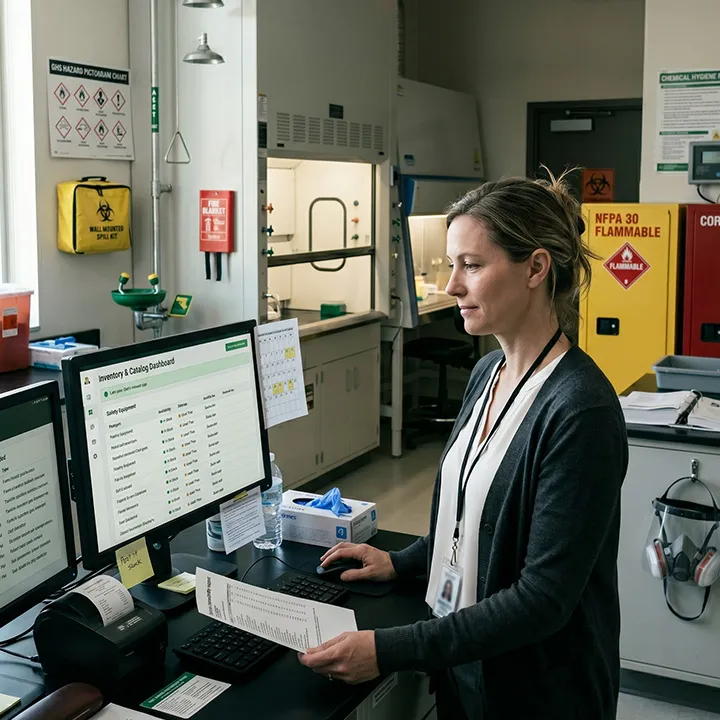
Replaces the manual quote desk for filters, accessories, replacement parts, and standard-configuration equipment. A facilities manager selects carbon filters, HEPA filters, replacement sash components, or standard fume hoods from your catalog, and the system generates a branded PDF quote with real-time shipping and accessory recommendations.
Learn more about Instant Quote →ENGAGE is not just a chatbot. It is a platform you grow on.
WHO THIS IS FOR
ENGAGE is purpose-built for B2B companies in the laboratory safety, controlled environment, and environmental monitoring space. If your sales team sells containment, purification, monitoring, environmental control, or emergency safety equipment to laboratories and cleanrooms, this is built for you.
Cleanroom equipment and environmental monitoring companies (particle counters, viable air samplers, differential pressure monitors, ISO 14644 validation systems)
Laboratory water purification system manufacturers (Type I/II/III ultrapure, RO/DI, clinical, TOC monitoring, ASTM/CAP/CLSI compliant)
Chemical fume hood manufacturers (ducted, ductless, low-flow/high-performance, walk-in, specialty)
Gas detection and air quality monitoring manufacturers (single and multi-gas detectors, oxygen depletion monitors, VOC sensors, continuous area monitors)
Glove box, isolator, and containment enclosure manufacturers (inert atmosphere, vacuum, negative pressure, potent compound handling)
Emergency safety equipment companies (eyewash stations, safety showers, drench showers per ANSI Z358.1)
Distributors and dealers of laboratory safety and controlled environment equipment across multiple brands
Electrostatic discharge (ESD) protection and cleanroom consumable manufacturers (ionizers, grounding systems, ESD workstations, wrist straps, static-safe packaging)
Biological safety cabinet (BSC) manufacturers (Class I, Class II Type A2/B1/B2, Class III)
Laminar flow hood, clean bench, and PCR workstation manufacturers
Laboratory ventilation and airflow control companies (VAV controllers, sash sensors, exhaust systems, room pressure monitors)
Flammable and corrosive chemical storage cabinet manufacturers (NFPA 30/OSHA compliant)
Laboratory PPE manufacturers and distributors
Spill containment, secondary containment, and hazmat storage system manufacturers
If your website visitors are EHS managers, chemical hygiene officers, lab planners, architects, facilities directors, or procurement teams evaluating containment and safety solutions, ENGAGE speaks their language.
Learn more
TRUSTED BY

Global Manufacturer of Ductless Fume Hoods and Filtered Chemical Storage | Headquartered in France, U.S. Operations
THE PROBLEM
You manufacture or distribute some of the most safety-critical equipment in any laboratory. Your website is not converting the way it should. Here is why.
Your buyers operate in a world of overlapping regulations, classifications, and standards. A cleanroom engineer needs to confirm your particle counter meets ISO 14644-3 calibration requirements and whether your viable air sampler satisfies USP 797 compounding room monitoring mandates. A facilities manager evaluating water purification systems needs to know if your system output meets ASTM D1193 Type I resistivity and TOC specifications for their HPLC application. An EHS director comparing gas detection systems needs alarm threshold configurations that comply with OSHA PEL and NIOSH REL values for their specific chemical environment. A lab planner specifying fume hoods needs ASHRAE 110 face velocity data for the recommended sash height.
These are not casual questions. They are compliance questions with regulatory consequences. If your website cannot answer them, the prospect must call your sales team, wait for a response, and hope the person who answers understands the regulations as well as they do. Or they go to a competitor whose website can provide answers immediately.
Some of the most complex conversations in laboratory safety and controlled environment sales involve system selection decisions that depend entirely on the buyer's specific application. A cleanroom engineer choosing between continuous particle monitoring and periodic batch sampling needs to understand their ISO classification validation frequency requirements. A lab manager evaluating water purification needs to determine whether RO/DI or ultrafiltration meets their application's purity and flow rate requirements. A quality manager specifying gas detection must decide between fixed-point area monitors and portable personal monitors based on their facility layout and exposure risk profile. A safety officer considering containment options needs to determine whether a glove box, a biosafety cabinet, or a fume hood is appropriate for their specific hazard.
Each of these is a consultative conversation that requires understanding the prospect's specific situation. Your best applications engineers handle it well. Your website handles it with a static comparison chart that answers none of the prospect's specific questions. And a generic chatbot does not know the difference between a HEPA filter and a ULPA filter, between Type I and Type II ultrapure water, or between an oxygen depletion monitor and a multi-gas detector, let alone when each is appropriate.
Laboratory safety and controlled environment equipment is typically purchased as part of a larger project: a new cleanroom build, a lab renovation, a water system upgrade, or a facility expansion. These projects have hard deadlines driven by FDA audit schedules, accreditation timelines, grant periods, academic calendars, or regulatory mandates. The cleanroom validation engineer needs particle counter specifications by Friday for the IQ/OQ protocol. The architect needs fume hood and glove box dimensions for the mechanical drawings by next week. The quality manager needs water system validation documentation before the facility goes into production. The EHS director needs gas detection alarm configurations confirmed before the contractor installs the monitoring network.
Your contact form does not convey urgency. A prospect who needs answers this week gets the same response time as someone casually browsing. The project moves forward without your equipment because you could not respond fast enough.
Every controlled environment and safety equipment sale hinges on application-specific technical details that your prospect cannot find on a spec sheet. The cleanroom buyer needs to know whether your particle counter's sensitivity threshold and sample flow rate satisfy their specific ISO class at rest and in operation. The water purification buyer needs to understand bacteria and endotoxin levels in your system's output relative to their USP or ASTM requirements, and what the maintenance interval looks like for their daily consumption volume. The gas detection buyer needs confirmation that your sensor technology handles their specific gas mixture without cross-sensitivity interference. The ESD buyer needs to know whether your ionizer's decay time meets ANSI/ESD S20.20 requirements for their component sensitivity classification. The containment buyer needs to verify whether their chemical and biological hazard profile is appropriate for a glove box, a Class II BSC, or a ducted fume hood.
This is precisely the kind of technical conversation that separates a knowledgeable vendor from a catalog reseller. Your applications engineers can navigate these questions effortlessly. Your website cannot. And every prospect who leaves without getting an application-specific answer is a prospect who assumes you cannot support their needs.
THE SOLUTION
We build, train, and continuously optimize a chatbot that understands your safety equipment portfolio the way your best applications engineer does.

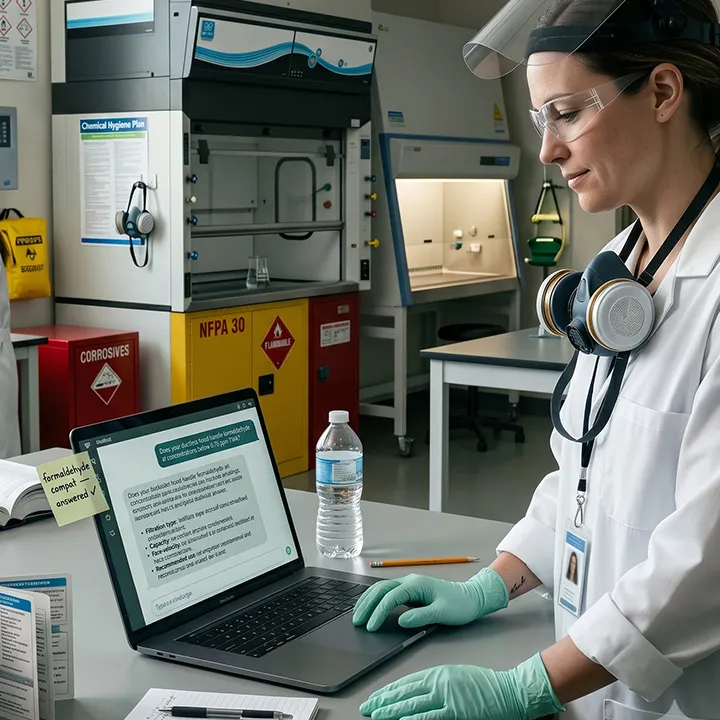
We manually build your AI's knowledge base from your approved content: product specifications, chemical compatibility guides, airflow performance data, regulatory compliance documentation, installation requirements, and competitive differentiators. Typically 200+ pages of source material. The result: your chatbot answers the same technical questions your applications engineers answer. Face velocity specifications. Chemical compatibility for specific compound lists. ASHRAE 110 test data. Filter change intervals based on usage patterns. When a prospect asks, 'Does your ductless hood handle formaldehyde at concentrations below 0.75 ppm TWA?', they get an accurate answer, not a redirect.

Your product line evolves. New filtration options launch. Models get updated. ENGAGE keeps pace with daily product data refreshes. No stale specifications. No outdated chemical compatibility data.
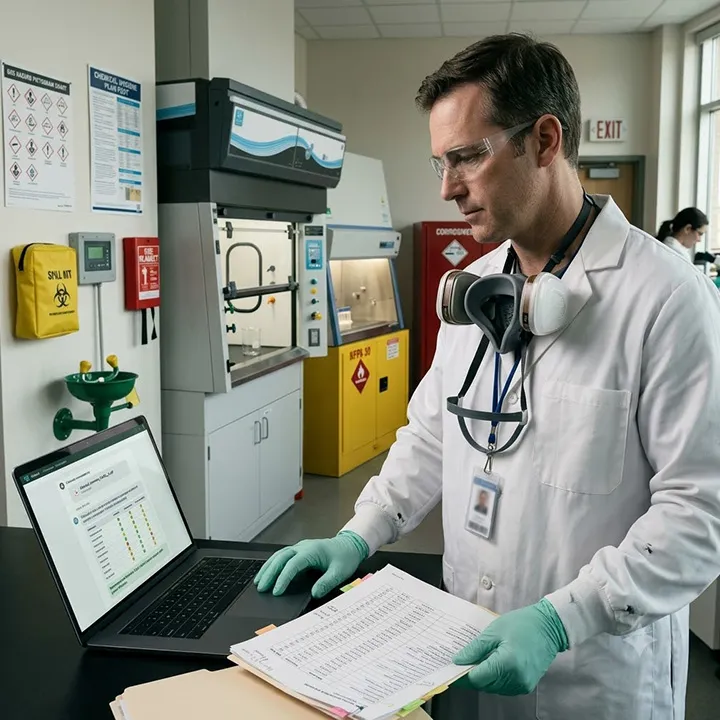
Visitors can upload PDF files into the chat for real-time analysis:

ENGAGE does not just answer questions about your products. It guides the prospect through the decision-making process, asking about their chemical hazards, usage patterns, ventilation infrastructure, and facility constraints. It can help a prospect understand whether a ductless solution is appropriate for their application or whether they need ducted exhaust, based on the criteria your team defines.
Every conversation generates a qualified lead profile. Your sales team receives:

Laboratory safety equipment is life-safety equipment. Accuracy is not optional. ENGAGE ensures your chatbot only answers from approved content. It cannot make unauthorized safety claims, fabricate chemical compatibility data, or misrepresent regulatory compliance. Complex or safety-critical conversations route to human support automatically.
HOW IT WORKS
What happens when an EHS manager or lab planner engages with your ENGAGE chatbot.
Step 1
A visitor lands on your ductless fume hood page. Your chatbot opens with context-aware messaging: 'I see you are looking at our ductless fume hoods. Are you evaluating these for a specific chemical application, or exploring ductless versus ducted options for a lab project?'
Step 2
The chatbot adapts based on the prospect's role:
EHS managers get regulatory compliance details, OSHA face velocity data, and chemical compatibility
Lab planners and architects get dimensions, utility requirements, BIM availability, and specification support
Procurement teams get pricing structures, warranty terms, and GSA/contract availability
Facilities directors get installation requirements, lead times, and project coordination
Step 3
Behind the conversation, the system builds a complete prospect profile:
Project type
Chemical hazards
Regulatory drivers
Timeline
Budget status
Competitive evaluation
Decision-making authority
Step 4
Instant notification
Complete conversation
AI-generated summary
Recommended approach
Step 5
Reviews transcripts weekly
Expands training on new products and regulatory updates
Refines qualification logic
Delivers monthly performance reports
OUTCOMES
We own the work required to deliver qualified lab safety equipment leads, from training the AI on your chemical compatibility data through ongoing conversation optimization.
If the leads do not flow, that is our problem to solve, not yours.
CASE STUDY

Global Manufacturer of Ductless Fume Hoods and Filtered Chemical Storage | Headquartered in France, U.S. Operations
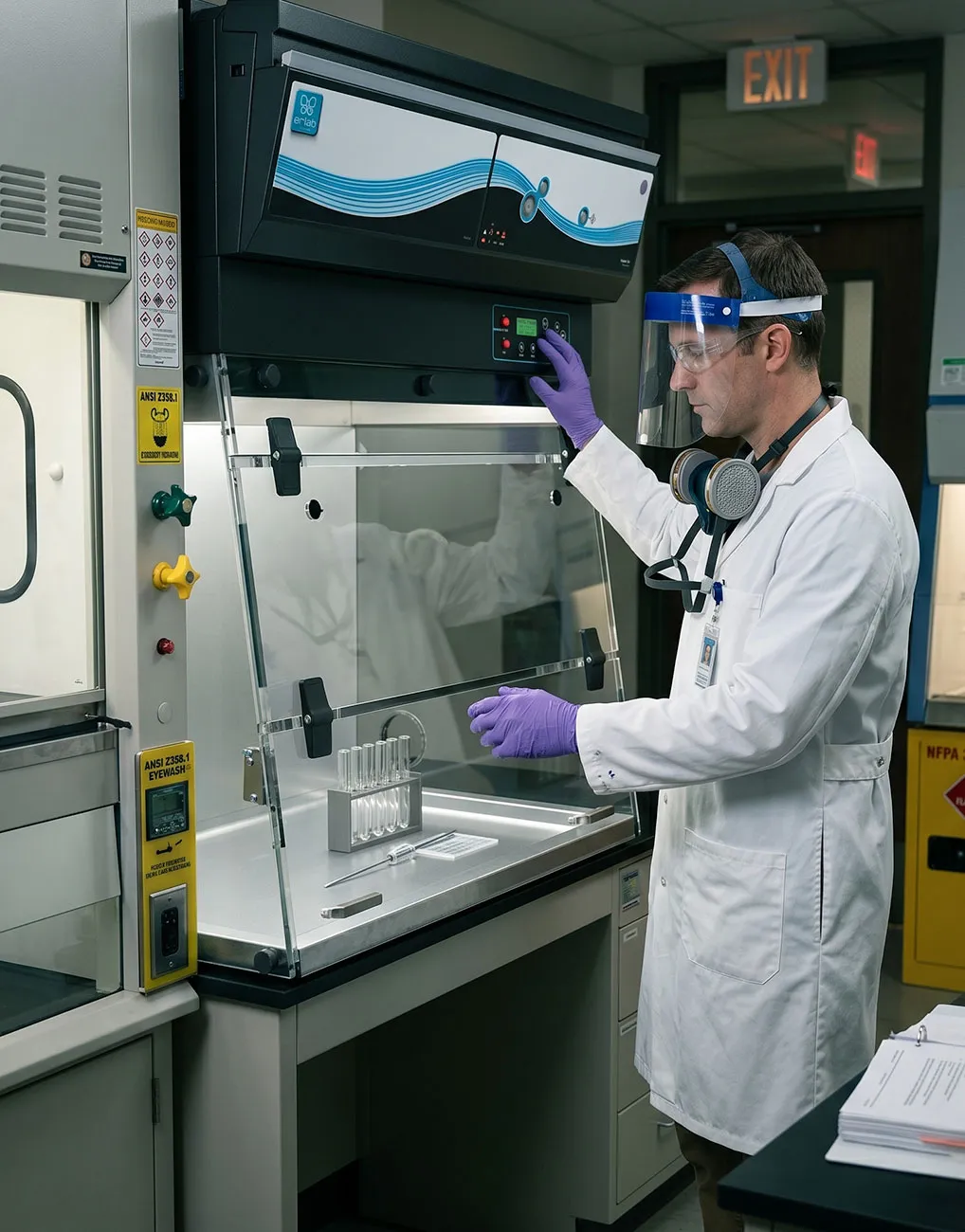
The challenge: Technical buyers evaluating ductless filtration technology needed answers about chemical compatibility, face velocity performance, and regulatory compliance across nine languages and multiple time zones. Erlab's global sales team could not keep pace with the volume of technical inquiries from EHS managers, lab planners, and architects working on time-sensitive lab build and renovation projects.
ENGAGE now serves as Erlab's front-line technical resource, engaging visitors in their preferred language, qualifying them on chemical hazards and application requirements, and routing leads to the appropriate regional sales team with full project context. The deployment covers ductless fume hoods, filtered chemical storage cabinets, and laboratory air purification systems.
SECURITY
Your chatbot handles conversations about life-safety equipment, regulatory compliance, and chemical hazards. Accuracy and security are not optional.
End-to-end encryption: (TLS 1.2+, AES-256)
Data ownership: Your data is yours. Never shared. Never used to train other clients.
Regional compliance: GDPR, CCPA supported
Complete audit trails for compliance verification
Source-locked responses: The AI cannot fabricate chemical compatibility data, misrepresent airflow performance, or make unauthorized safety claims
Escalation protocols: Safety-critical conversations route to human support automatically
Continuous monitoring: Our team catches errors before they become patterns
Configurable safety boundaries:You define what claims the AI is authorized to make about safety performance
INTEGRATION
Your AI chatbot connects to your existing tech stack. No rip-and-replace.
Every qualified lead flows directly into your CRM:

Native integration with lead, contact, and opportunity objects

Full sync, including custom properties and workflow triggers

Enterprise-ready integration

Direct integration with lead scoring sync

Automatic deal and contact creation
Contact and project information
Complete conversation transcript and AI summary
Equipment discussed, chemical hazards, and regulatory requirements
Project type, timeline, and budget signals
Recommended follow-up actions
Install through Google Tag Manager in minutes. No IT project required. Works with every major platform:

Works with all themes and page builders (Elementor, Divi, WPBakery, Beaver Builder)

Supports Drupal 8, 9, and 10

Supports all modern Sitecore versions
Full enterprise CMS support


Installs via theme editor or Shopify app

Native integration available

Full compatibility with Magento 2.x

Installs alongside native HubSpot forms

Full support including custom domains

Works with code injection
Full ERP and CMS integration


If it runs JavaScript, it runs our chatbot
ENGAGE sits at the middle of your lab safety sales funnel. It works alongside your lead capture forms and internal site search. Leads flow into your sales engagement sequences and email campaigns. Our prospecting service fills the top of the funnel.
USE CASES
Real scenarios where AI chatbots capture safety equipment opportunities that static websites miss.
The scenario:An architect designing a new chemistry lab needs to specify fume hoods for the mechanical engineer. They need face velocity data, CFM requirements, and BIM files by Friday for the DD submission.
They email your sales team asking for specifications. Your rep responds Monday. The architect has already specified a competitor to meet their Friday deadline.
ENGAGE provides specification data immediately, identifies the project scope and timeline, and routes the lead to your architectural sales specialist. Your team delivers BIM files and spec support the same day.
The scenario:A chemical hygiene officer at a university is evaluating whether ductless fume hoods can replace aging ducted hoods in a renovation. They need to know if the filtration technology handles their specific chemical inventory.
They browse your website, find a general comparison chart, and still have unanswered questions about their specific chemicals. They default to specifying ducted hoods because it feels safer.

ENGAGE walks them through the chemical compatibility analysis, captures their chemical list, and connects them with your applications engineer for a detailed filtration assessment. The conversation turns a potential ducted replacement into a ductless opportunity.
The scenario:An OSHA inspection flagged a laboratory's eyewash stations as non-compliant with ANSI Z358.1. The EHS manager needs compliant replacement units identified, quoted, and shipped within two weeks.
They submit a contact form. Your inside sales team responds the next day with a product catalog. The EHS manager, who needs specific ANSI-compliant models identified for their plumbing configuration, orders from a competitor who answered immediately.
ENGAGE identifies the compliance urgency, asks about their plumbing setup, recommends specific ANSI Z358.1 compliant models, and routes the lead to your emergency equipment specialist with full installation context.
The scenario:A facilities director received notice that their flammable storage cabinets exceed NFPA 30 gallon limits for their area classification. They need to reconfigure their storage approach and purchase additional cabinets.
They search your website for NFPA 30 cabinet specifications, find product pages with dimensions and capacities, but cannot get answers about how many cabinets their specific laboratory classification allows.
ENGAGE discusses NFPA 30 storage limits for their specific lab type, helps them understand the maximum allowable quantities, recommends appropriate cabinet configurations, and routes the lead to your storage solutions team with complete regulatory context.
ENGAGE: B2B Lead Generation Chatbot
Everything included. No setup fees. No per-conversation charges. No hidden costs.
What is included:
Optional Add-Ons:
ENGAGE Agent
Consultative needs analysis for fume hood and containment selection, qualifying buyers on chemical hazards, airflow requirements, and regulatory compliance
Learn more about Needs Analysis →ENGAGE Agent
Automated branded PDF quotes for filters, accessories, standard-configuration equipment, and replacement parts
Learn more about Instant Quote →Right now, an EHS manager is on your website trying to determine if your ductless fume hood handles their chemical inventory. An architect needs face velocity data by Friday for a DD submission. A facilities director needs NFPA 30-compliant storage cabinets after an audit finding. Your contact form cannot answer any of them. Your applications engineer is on a site visit.
Every day without a trained AI chatbot for laboratory safety equipment is another day of missed project specifications, lost compliance-driven purchases, and deals that went to the manufacturer who answered first.